
We read your photo as:
What is its volume when full? Find the capacity in litres when half full?
ScanSolve AI Answer
Answers
2 partsStep-by-step solution
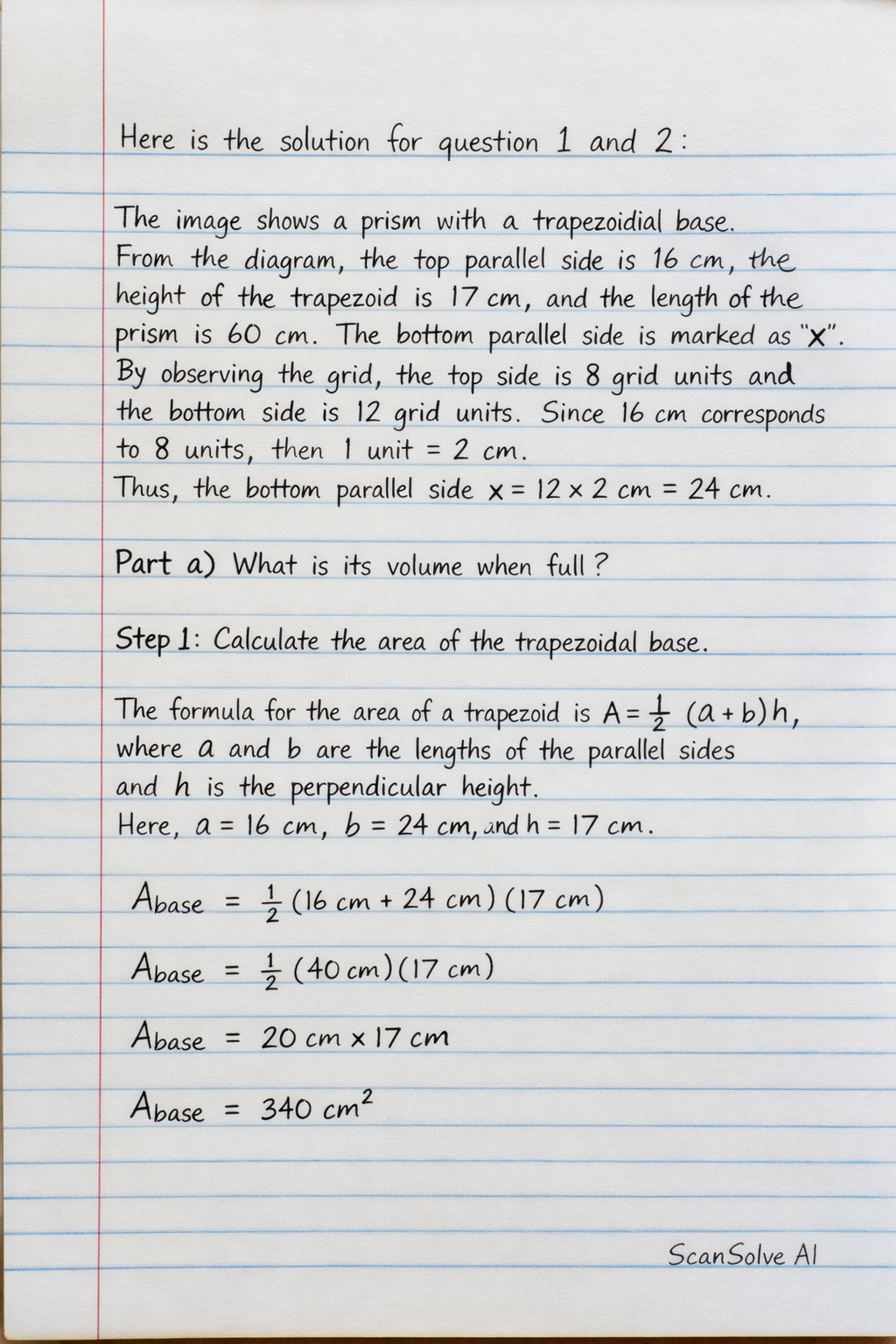
4 stepsHere is the solution for question 1 and 2:
The image shows a prism with a trapezoidal base. From the diagram, the top parallel side is , the height of the trapezoid is , and the length of the prism is . The bottom parallel side is marked as 'x'. By observing the grid, the top side is 8 grid units and the bottom side is 12 grid units. Since corresponds to 8 units, then 1 unit = . Thus, the bottom parallel side .
Part a· 2 steps
What is its volume when full?
Calculate the area of the trapezoidal base.
The formula for the area of a trapezoid is , where and are the lengths of the parallel sides and is the perpendicular height.
Here, , , and .Calculate the volume of the prism when full.
The formula for the volume of a prism is .
Here, and Length .The volume when full is
Part b
Find the capacity in litres when half full.
Calculate the volume when the prism is half full.
Convert the volume from cubic centimetres to litres.
We know that .
The capacity when half full is
Try one yourself
A new problem that tests the same skill.
Still stuck on this one?
Ask a follow-up, and the answer starts from this question.
More Mathematics Questions
Handwritten Step-by-Step Solution
Get this as a handwritten image on WhatsApp — like a tutor wrote it for you.
Try on WhatsApp