

This mathematics problem involves applying core mathematical principles and formulas. Below you will find a complete step-by-step solution with detailed explanations for each step, helping you understand not just the answer but the method behind it.
ScanSolve AI Answer
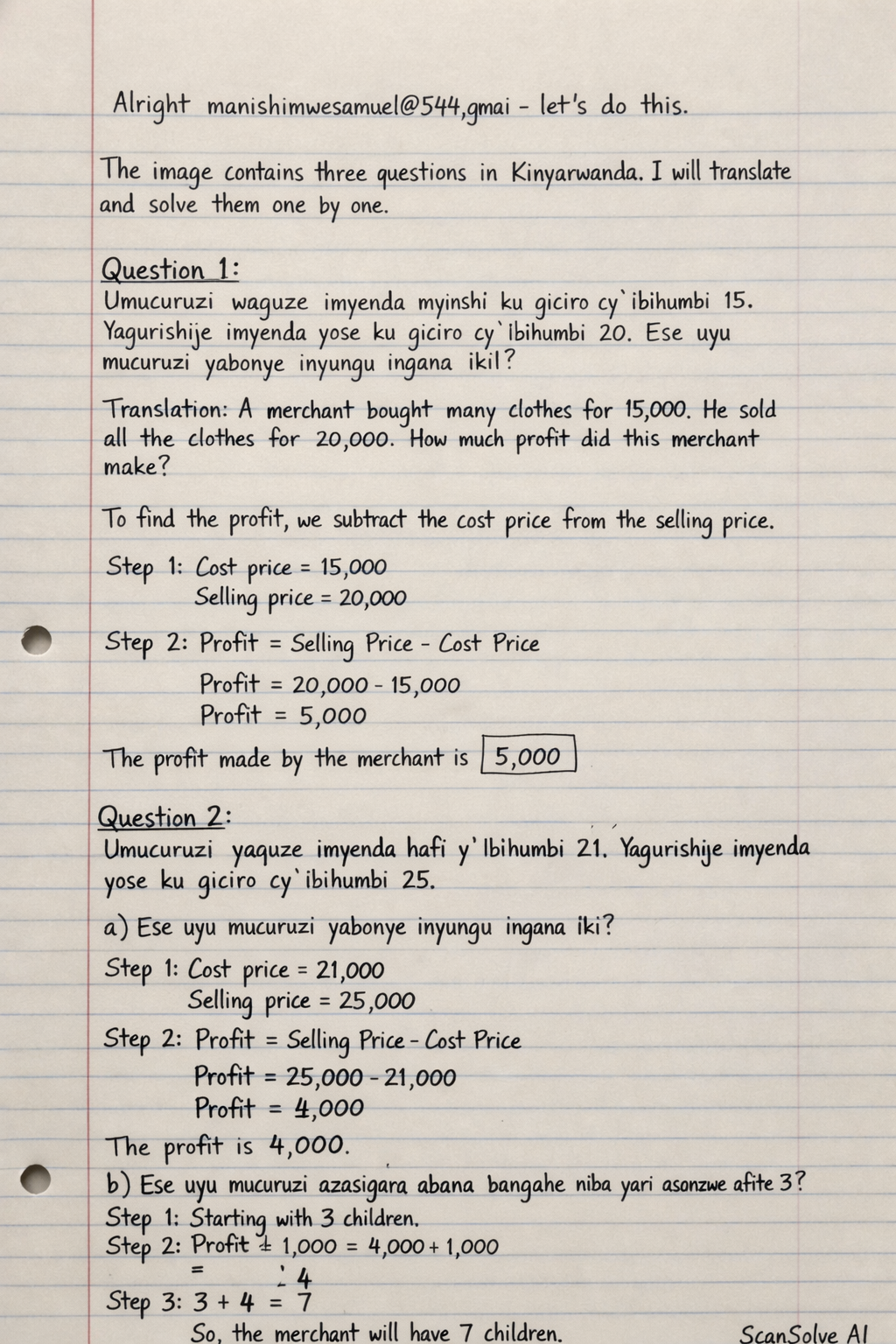
The image contains three questions in Kinyarwanda. I will translate and solve them one by one. Question 1: "Umucuruzi waguze imyenda myinshi ku giciro cy'ibihumbi 15. Yagurishije imyenda yose ku giciro cy'ibihumbi 20. Ese uyu mucuruzi yabonye inyungu ingana iki?" Translation: A merchant bought many clothes for 15,000. He sold all the clothes for 20,000. How much profit did this merchant make? To find the profit, we subtract the cost price from the selling price. Step 1: Identify the cost price and selling price. Cost price = 15,000 Selling price = 20,000 Step 2: Calculate the profit. Profit = Selling Price - Cost Price Profit = 20,000 - 15,000 Profit = 5,000 The profit made by the merchant is 5,000. Question 2: "2. Umucuruzi yaguze imyenda hafi y'ibihumbi 21. Yagurishije imyenda yose ku giciro cy'ibihumbi 25. a. Ese uyu mucuruzi yabonye inyungu ingana iki? b. Ese uyu mucuruzi azasigara abana bangahe niba yari asanzwe afite 3?" Translation: A merchant bought clothes for approximately 21,000. He sold all the clothes for 25,000. a. How much profit did this merchant make? b. How many children will this merchant have left if he originally had 3? a) To find the profit, we subtract the cost price from the selling price. Step 1: Identify the cost price and selling price. Cost price = 21,000 Selling price = 25,000 Step 2: Calculate the profit. Profit = Selling Price - Cost Price Profit = 25,000 - 21,000 Profit = 4,000 The profit made by the merchant is 4,000. b) This part of the question is about the merchant's children and is unrelated to the financial transaction. There is no information to suggest the number of children would change. The number of children remains 3. Question 3: "3. Ufite 15/16. Ese ni angahe adashobora kuba pusa na 8/9?" Below this, there are options: "a. Ubwishimwe bwawe --" (Your happiness --) "b. Mu gihe kirenga 8/9" (More than 8/9) "c. 4/4" "d. 7/7" "e. Ubusa" (Zero) "f. 1/2" Translation: You have (15)/(16). How much is it that cannot be equal to (8)/(9)? The phrase "ni angahe" (how much) usually asks for a numerical quantity. However, given the options, especially option 'b' which is a comparative statement, the question is likely asking for a comparison between the two fractions. Step 1: Compare the two fractions (15)/(16) and (8)/(9). To compare them, we can find a common denominator or cross-multiply. (15)/(16) vs (8)/(9) Cross-multiply the numerators by the opposite denominators: 15 × 9 = 135 16 × 8 = 128 Step 2: Determine the relationship between the fractions. Since 135 > 128, it means that (15)/(16) > (8)/(9). Therefore, (15)/(16) is greater than (8)/(9). Step 3: Select the option that best describes this relationship. Option b states "Mu gihe kirenga 8/9", which translates to "More than 8/9". This accurately describes that (15)/(16) is greater than (8)/(9). The correct option is b. Mu gihe kirenga 8/9. Send me the next one 📸