
This mathematics problem involves applying core mathematical principles and formulas. Below you will find a complete step-by-step solution with detailed explanations for each step, helping you understand not just the answer but the method behind it.
ScanSolve AI Answer
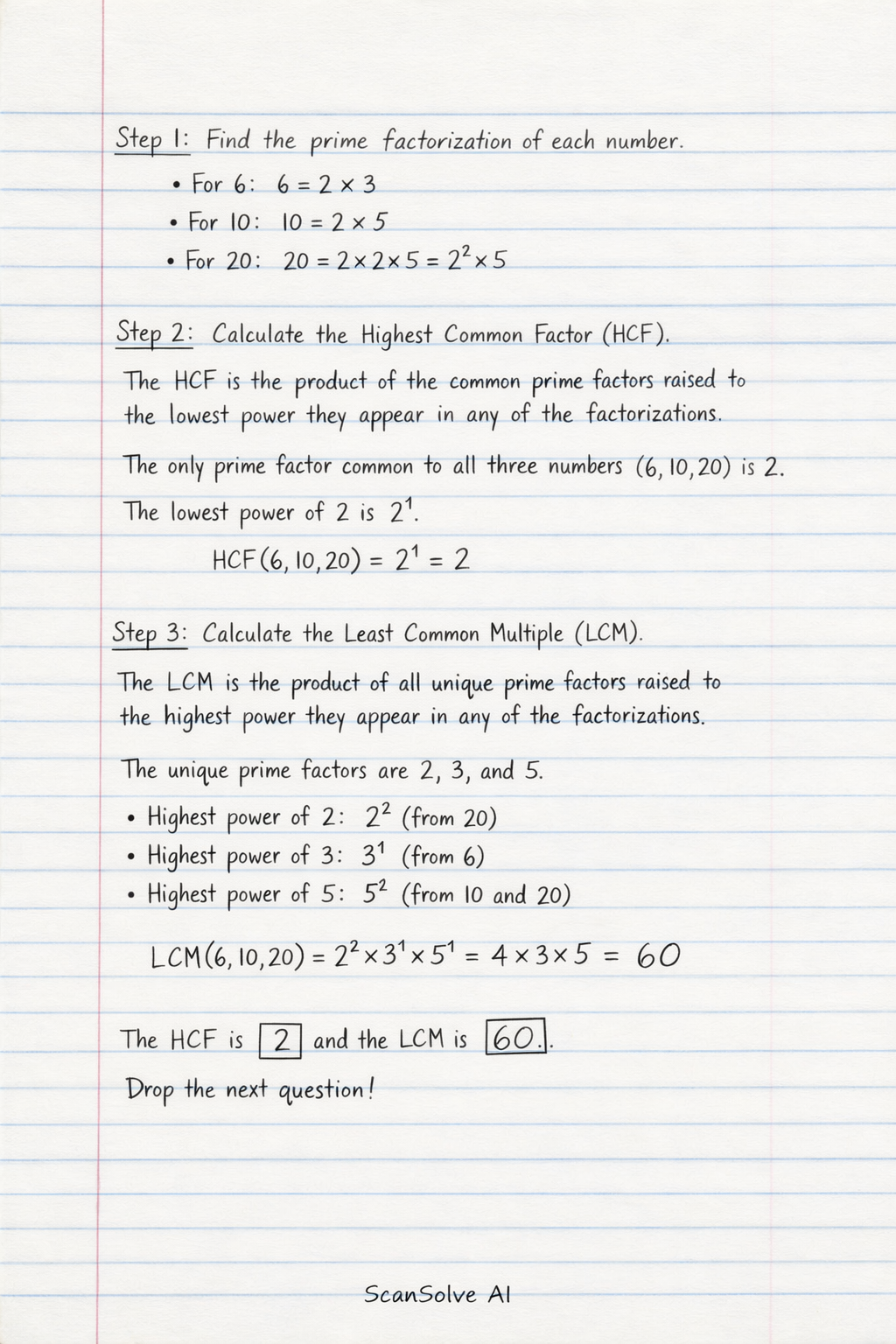
Step 1: Find the prime factorization of each number. • For 6: 6 = 2 × 3 • For 10: 10 = 2 × 5 • For 20: 20 = 2 × 2 × 5 = 2^2 × 5 Step 2: Calculate the Highest Common Factor (HCF). The HCF is the product of the common prime factors raised to the lowest power they appear in any of the factorizations. The only prime factor common to all three numbers (6, 10, 20) is 2. The lowest power of 2 is 2^1. HCF(6, 10, 20) = 2^1 = 2 Step 3: Calculate the Least Common Multiple (LCM). The LCM is the product of all unique prime factors raised to the highest power they appear in any of the factorizations. The unique prime factors are 2, 3, and 5. • Highest power of 2: 2^2 (from 20) • Highest power of 3: 3^1 (from 6) • Highest power of 5: 5^1 (from 10 and 20) LCM(6, 10, 20) = 2^2 × 3^1 × 5^1 = 4 × 3 × 5 = 60 The HCF is 2 and the LCM is 60. Drop the next question!