
We read your photo as:
If tan(pi/4 + theta) + tan(pi/4 − theta) = 3, then the value of tan²(pi/4 + theta) + tan²(pi/4 - theta) is?
ScanSolve AI Answer
Answer
Step-by-step solution
7 stepsLet and .
We are given the equation:
We need to find the value of .
We know that .Use the tangent addition and subtraction formulas.
The formula for is .
The formula for is .
Here, , so .So, we have:
Calculate the product .
Substitute the values of and into the expression for .
The value of is .
Question 7:
Write down the given information and the formula for .
We are given:
We need to find .
The formula for is:Express in terms of and substitute it into the formula.
From the given equation, we have .
Substitute this into the formula:Multiply the numerator and denominator by 2 to simplify:
Compare the result with the given options by expressing the options in terms of .
Let . Then .
We use the double angle formulas:Let's check option 2: .
Substitute the expressions for and :This matches our derived expression for .
The value of is .
Try one yourself
A new problem that tests the same skill.
Still stuck on this one?
Ask a follow-up, and the answer starts from this question.
More Mathematics Questions
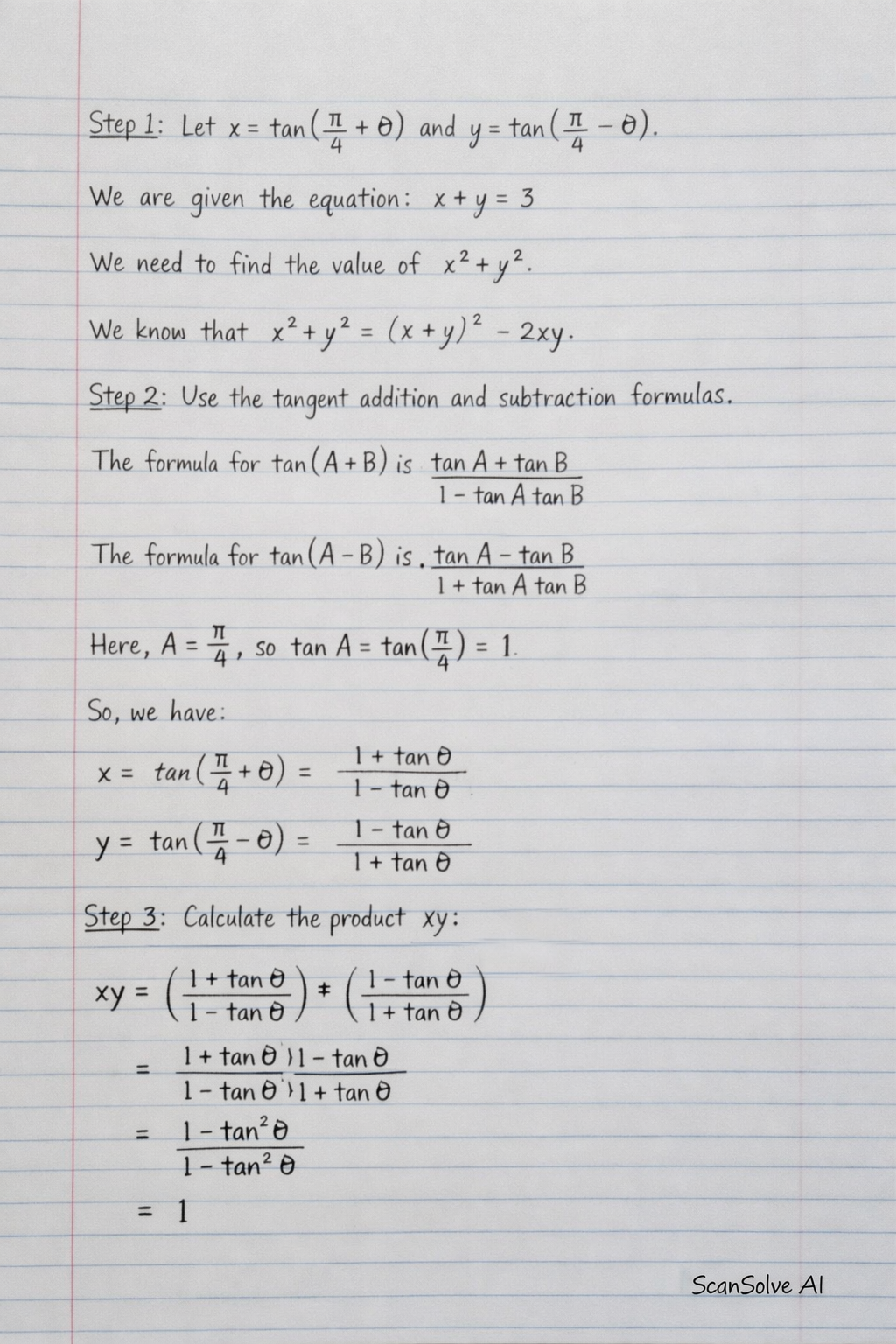
Handwritten Step-by-Step Solution
Get this as a handwritten image on WhatsApp — like a tutor wrote it for you.
Try on WhatsApp