

This mathematics problem involves applying core mathematical principles and formulas. Below you will find a complete step-by-step solution with detailed explanations for each step, helping you understand not just the answer but the method behind it.
ScanSolve AI Answer
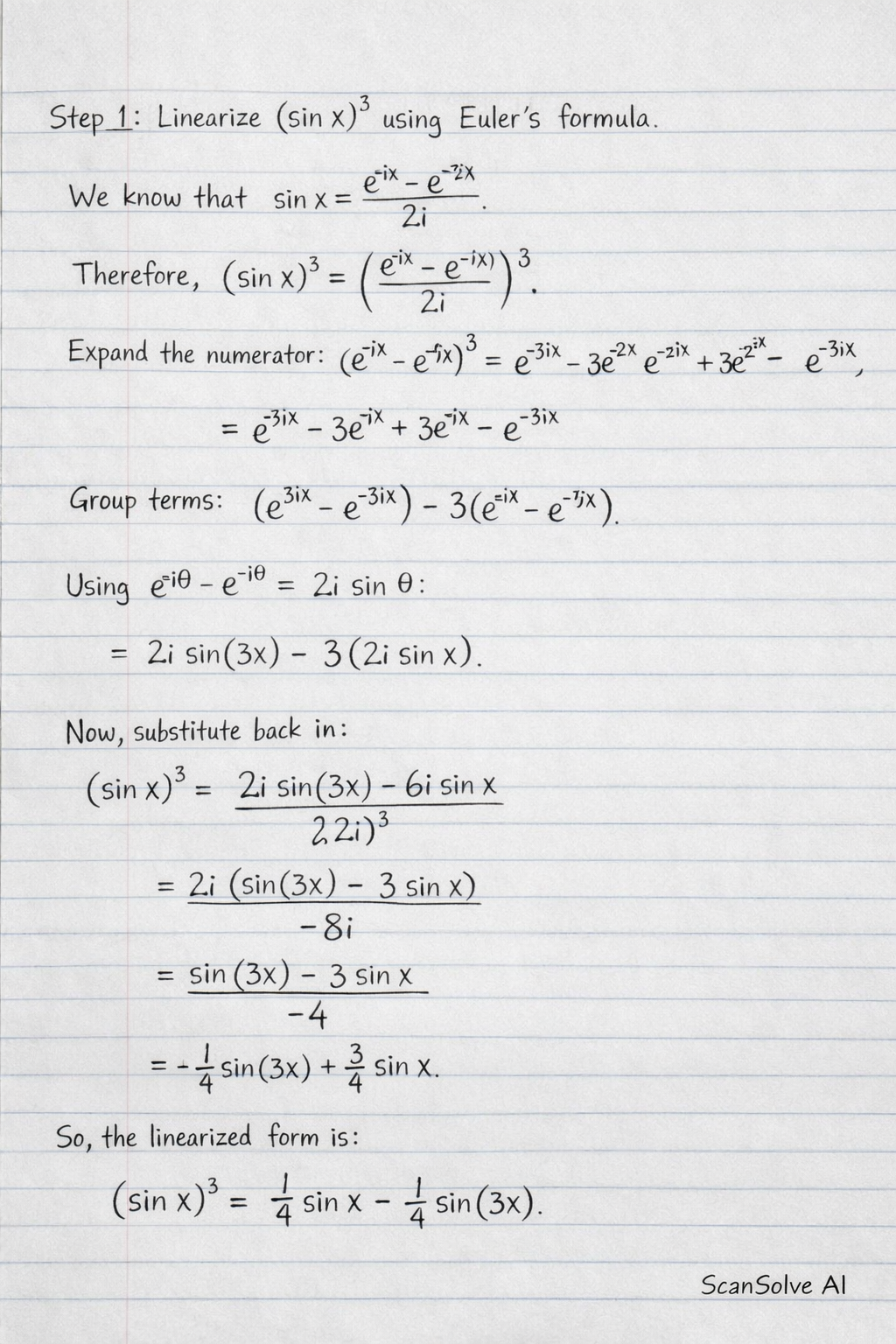
Step 1: Linearize ( x)^3 using Euler's formula. We know that x = e^ix - e^-ix2i. Therefore, ( x)^3 = (e^ix - e^-ix2i)^3. Expand the numerator using the binomial expansion (a-b)^3 = a^3 - 3a^2b + 3ab^2 - b^3: (e^ix - e^-ix)^3 = (e^ix)^3 - 3(e^ix)^2(e^-ix) + 3(e^ix)(e^-ix)^2 - (e^-ix)^3 = e^i3x - 3e^i2xe^-ix + 3e^ixe^-i2x - e^-i3x = e^i3x - 3e^ix + 3e^-ix - e^-i3x Group terms to form sine functions: = (e^i3x - e^-i3x) - 3(e^ix - e^-ix) Using the identity e^i - e^-i = 2i : = 2i (3x) - 3(2i x) Now substitute this back into the expression for ( x)^3: ( x)^3 = (2i (3x) - 6i x)/((2i)^3) = (2i ((3x) - 3 x))/(-8i) = ((3x) - 3 x)/(-4) = -(1)/(4) (3x) + (3)/(4) x So, the linearized form is: ( x)^3 = (3)/(4) x - (1)/(4) (3x) Step 2: Calculate the integral I = _0^()/(2) ( x)^3 dx using the linearized form. Substitute the linearized expression into the integral: I = _0^()/(2) ((3)/(4) x - (1)/(4) (3x)) dx Integrate term by term: I = (3)/(4) _0^()/(2) x \, dx - (1)/(4) _0^()/(2) (3x) \, dx The antiderivative of x is - x. The antiderivative of (3x) is -(1)/(3)(3x). I = [-(3)/(4) x - (1)/(4) (-(1)/(3) (3x))]_0^()/(2) I = [-(3)/(4) x + (1)/(12) (3x)]_0^()/(2) Step 3: Evaluate the definite integral. Evaluate the expression at the upper limit x = ()/(2): (-(3)/(4) (()/(2)) + (1)/(12) (3 · ()/(2))) = (-(3)/(4) · 0 + (1)/(12) · 0) = 0 Evaluate the expression at the lower limit x = 0: (-(3)/(4) (0) + (1)/(12) (3 · 0)) = (-(3)/(4) · 1 + (1)/(12) · 1) = -(3)/(4) + (1)/(12) To combine these, find a common denominator, which is 12: -(3)/(4) + (1)/(12) = -(9)/(12) + (1)/(12) = -(8)/(12) = -(2)/(3) Subtract the lower limit value from the upper limit value: I = 0 - (-(2)/(3)) = (2)/(3) The final answer is (2)/(3). Send me the next one 📸