
We read your photo as:
Find all whole numbers n such that 2n > 30 and 5n < 100.
Mathematics
ScanSolve AI Answer
Answer
16, 17, 18, 19
Step-by-step solution
6 stepsSet up the first inequality.
The problem states that is greater than 30.
Solve the first inequality for n.
Divide both sides by 2:
Set up the second inequality.
The problem states that is less than 100.
Solve the second inequality for n.
Divide both sides by 5:
Combine the inequalities.
We have two conditions for n: and .
This can be written as a single compound inequality:Identify all whole numbers that satisfy the combined inequality.
A whole number is a non-negative integer. We need to find all integers strictly between 15 and 20.
These numbers are 16, 17, 18, and 19.The numbers that n stands for are $16, 17, 18, 19$.
Was this helpful?
Try one yourself
A new problem that tests the same skill.
Still stuck on this one?
Ask a follow-up, and the answer starts from this question.
Got a different question?Ask your own question
More Mathematics Questions
QFind the number of integers n such that 1 <= n <= 1000 and n is a multiple of 7 but not a multiple…QFind the sum of the first three prime numbers between 30 and 50.QIf 'n' is a natural number such that n+10 > 26, what is the minimum value of 'n'?QPrime number of 24 and 30QFind the sum of all natural numbers between 250 and 550 which are divisible by 5.
Browse by topic:Pre-Algebra
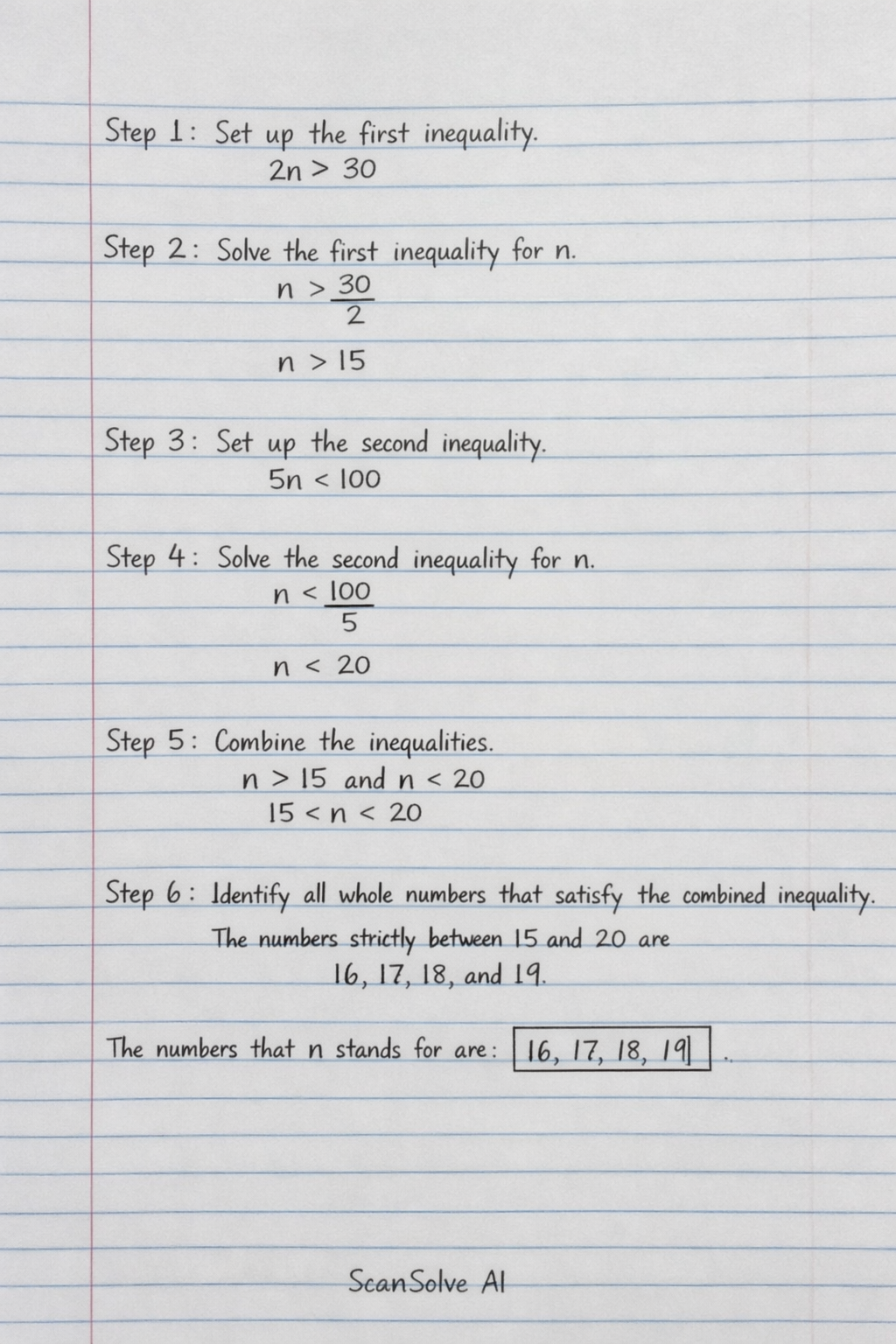
Handwritten Step-by-Step Solution
Get this as a handwritten image on WhatsApp — like a tutor wrote it for you.
Try on WhatsApp