How many Spud/bags were produced since? Kapaladan 9x10=90 100x5=15 Spud/bags 2) What is the total number of good bags for the seventy 35 x 20 = 700 3) Calculate the average number of good bags per 25p in one day, round to the nearest whole number 700 ÷ 7 = 100% to = 10

Mathematics
How many Spud/bags were produced since? Kapaladan 9x10=90 100x5=15 Spud/bags 2) What is the total number of good bags for the seventy 35 x 20 = 700 3) Calculate the average number of good bags per 25p in one day, round to the nearest whole number 700 ÷ 7 = 100% to = 10

ScanSolve AI Answer

2 steps

Answer

70 bags

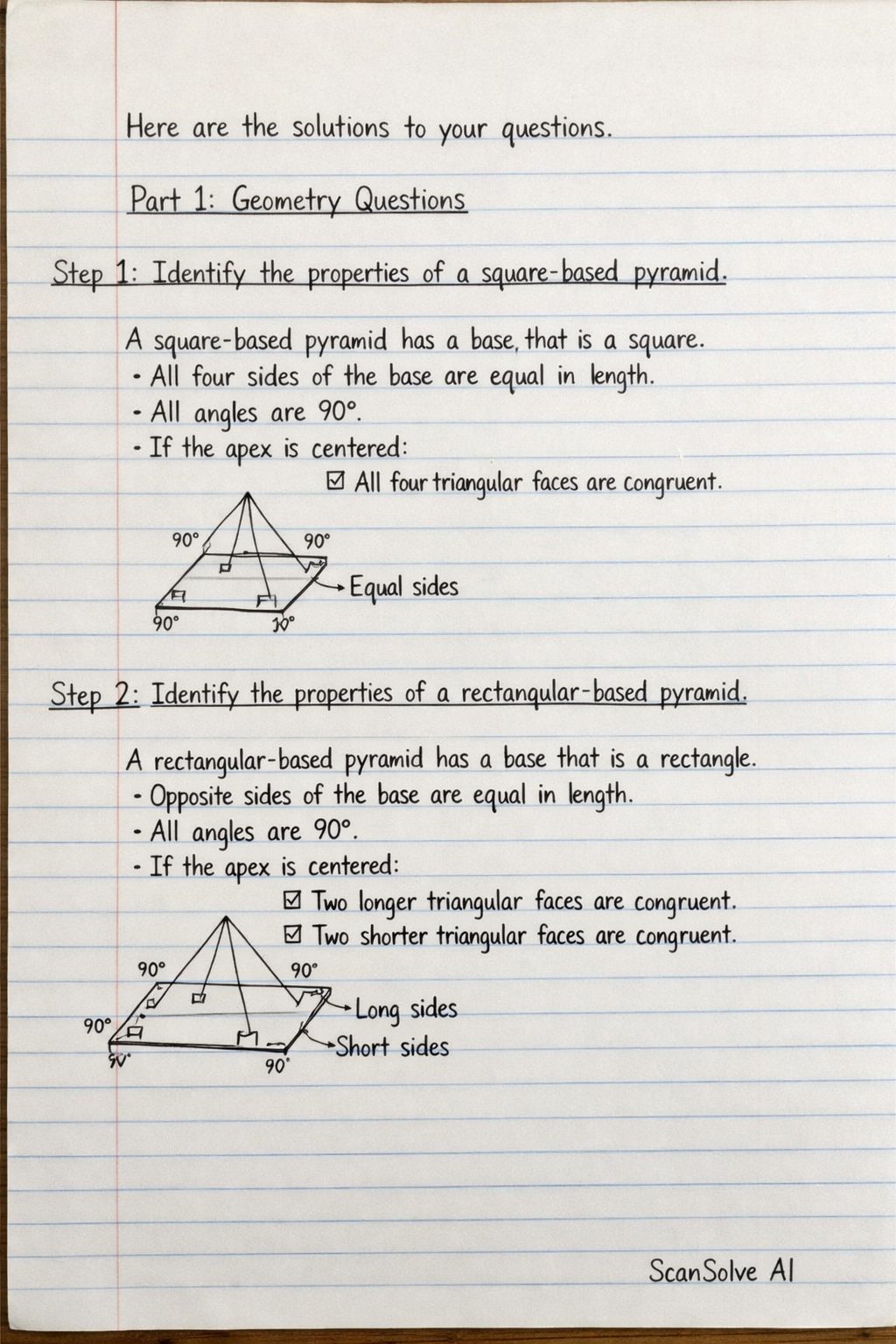
Here are the solutions to your questions.

Part 1: Geometry Questions

Step 1: Identify the properties of a square-based pyramid. A square-based pyramid has a base that is a square. All four sides of the base are equal in length, and all angles are right angles. If the apex is centered, all four triangular faces are congruent.

Step 2: Identify the properties of a rectangular-based pyramid. A rectangular-based pyramid has a base that is a rectangle. Opposite sides of the base are equal in length, and all angles are right angles. If the apex is centered, there are two pairs of congruent triangular faces (the faces corresponding to the longer sides are congruent, and the faces corresponding to the shorter sides are congruent).

Step 3: State the differences.

  1. Base Shape: A square-based pyramid has a base with four equal sides, while a rectangular-based pyramid has a base where only opposite sides are necessarily equal.
  2. Triangular Faces: If the apex is directly above the center of the base, a square-based pyramid has four congruent (identical) triangular faces. A rectangular-based pyramid, under the same condition, has only two pairs of congruent triangular faces.

Part 2: Pictogram Questions

Let's re-evaluate the pictogram data from the previous interaction to ensure accuracy. Key: 1 light brown bag = 20 good bags, 1 dark grey bag = 5 spoilt bags.

  • Monday: Good: 4×20=804 \times 20 = 80. Spoilt: 1×5=51 \times 5 = 5.
  • Tuesday: Good: 3×20=603 \times 20 = 60. Spoilt: 2×5=102 \times 5 = 10.
  • Wednesday: Good: 5×20=1005 \times 20 = 100. Spoilt: 1×5=51 \times 5 = 5.
  • Thursday: Good: 4×20=804 \times 20 = 80. Spoilt: 2×5=102 \times 5 = 10.
  • Friday: Good: 3×20=603 \times 20 = 60. Spoilt: 3×5=153 \times 5 = 15.
  • Saturday: Good: 4×20=804 \times 20 = 80. Spoilt: 2×5=102 \times 5 = 10.
  • Sunday: Good: 3×20=603 \times 20 = 60. Spoilt: 3×5=153 \times 5 = 15.

Question 1: How many spoilt bags were produced in all?

Step 1: Sum the spoilt bags from each day. 5+10+5+10+15+10+15=705 + 10 + 5 + 10 + 15 + 10 + 15 = 70 The total number of spoilt bags produced in all is 70bags\boxed{70 bags}.

Question 2: What is the total number of good bags for the seven days?

Step 1: Sum the good bags from each day. 80+60+100+80+60+80+60=52080 + 60 + 100 + 80 + 60 + 80 + 60 = 520 The total number of good bags for the seven days is 520bags\boxed{520 bags}.

Question 3: Calculate the average number of good bags produced in one day, correct to the nearest whole number.

Step 1: Use the total number of good bags and divide by the number of days. Average good bags=TotalgoodbagsNumberofdays\text{Average good bags} = \frac{Total good bags}{Number of days} Average good bags=5207\text{Average good bags} = \frac{520}{7} Average good bags74.2857\text{Average good bags} \approx 74.2857

Step 2: Round to the nearest whole number. Rounding 74.285774.2857 to the nearest whole number gives 7474. The average number of good bags produced in one day to the nearest whole number is 74bags\boxed{74 bags}.

What's next?

Was this helpful?

Need help with your own homework?

Get instant step-by-step solutions to any question. Free to start.

Ask Your Question
Handwritten step-by-step solution preview

Handwritten Step-by-Step Solution

Get this as a handwritten image on WhatsApp — like a tutor wrote it for you.

Try on WhatsApp

Still have questions?

Quick Answer

Geometry Questions Step 1: Identify the properties of a square-based pyramid. A square-based pyramid has a base that is a square.

How many Spud/bags were produced since? Kapaladan 9x10=90 100x5=15 Spud/bags 2) What is the total number of good bags for the seventy 35 x 20 = 700 3) Calculate the average number of good bags per 25p in one day, round to the nearest whole number 700 ÷ 7 = 100% to = 10
Mathematics

This mathematics problem involves applying core mathematical principles and formulas. Below you will find a complete step-by-step solution with detailed explanations for each step, helping you understand not just the answer but the method behind it.

ScanSolve AI Answer
Here are the solutions to your questions. Part 1: Geometry Questions Step 1: Identify the properties of a square-based pyramid. A square-based pyramid has a base that is a square. All four sides of the base are equal in length, and all angles are right angles. If the apex is centered, all four triangular faces are congruent. Step 2: Identify the properties of a rectangular-based pyramid. A rectangular-based pyramid has a base that is a rectangle. Opposite sides of the base are equal in length, and all angles are right angles. If the apex is centered, there are two pairs of congruent triangular faces (the faces corresponding to the longer sides are congruent, and the faces corresponding to the shorter sides are congruent). Step 3: State the differences. 1. Base Shape: A square-based pyramid has a base with four equal sides, while a rectangular-based pyramid has a base where only opposite sides are necessarily equal. 2. Triangular Faces: If the apex is directly above the center of the base, a square-based pyramid has four congruent (identical) triangular faces. A rectangular-based pyramid, under the same condition, has only two pairs of congruent triangular faces. Part 2: Pictogram Questions Let's re-evaluate the pictogram data from the previous interaction to ensure accuracy. Key: 1 light brown bag = 20 good bags, 1 dark grey bag = 5 spoilt bags. Monday: Good: 4 × 20 = 80. Spoilt: 1 × 5 = 5. Tuesday: Good: 3 × 20 = 60. Spoilt: 2 × 5 = 10. Wednesday: Good: 5 × 20 = 100. Spoilt: 1 × 5 = 5. Thursday: Good: 4 × 20 = 80. Spoilt: 2 × 5 = 10. Friday: Good: 3 × 20 = 60. Spoilt: 3 × 5 = 15. Saturday: Good: 4 × 20 = 80. Spoilt: 2 × 5 = 10. Sunday: Good: 3 × 20 = 60. Spoilt: 3 × 5 = 15. Question 1: How many spoilt bags were produced in all? Step 1: Sum the spoilt bags from each day. 5 + 10 + 5 + 10 + 15 + 10 + 15 = 70 The total number of spoilt bags produced in all is 70 bags. Question 2: What is the total number of good bags for the seven days? Step 1: Sum the good bags from each day. 80 + 60 + 100 + 80 + 60 + 80 + 60 = 520 The total number of good bags for the seven days is 520 bags. Question 3: Calculate the average number of good bags produced in one day, correct to the nearest whole number. Step 1: Use the total number of good bags and divide by the number of days. Average good bags = Total good bagsNumber of days Average good bags = (520)/(7) Average good bags ≈ 74.2857 Step 2: Round to the nearest whole number. Rounding 74.2857 to the nearest whole number gives 74. The average number of good bags produced in one day to the nearest whole number is 74 bags. What's next?