
We read your photo as:
Maria has £40. A coat is priced at £65. In week 1, the price is reduced by 20%. In week 2, the price is reduced by a further £10. Does Maria have enough money to buy the coat in week 2?
Mathematics
ScanSolve AI Answer
Step-by-step solution
3 stepsCalculate the price of the coat in Week 1.
The normal price is £65. In Week 1, the price is reduced by 20%.
Calculate the price of the coat in Week 2.
In Week 2, the price is reduced by a further £10 from the Week 1 price.
Compare the Week 2 price with Maria's money.
Maria has £40. The price of the coat in Week 2 is £42.
Since , Maria does not have enough money.Maria does not have enough money to buy the coat in week 2 of the sale. She needs an additional .
Was this helpful?
Still stuck on this one?
Ask a follow-up, and the answer starts from this question.
Got a different question?Ask your own question
More Mathematics Questions
QA coat's price is reduced by 15%. a) Original price 60. Calculate sale price. b) Sale price 58.14…QMaria working as a salesperson sold out goods whose marked price are Ksh. 340,000 at a 3% discount…QCalculate Mary's total pay for the week if she works 41 hours and is paid K6 per hour for the first…QNo .2 Mister Wall usually buys 12 pints of milk each week and pays R4.92.In a week when she has…QLottie buys 18 pens. The cheapest pens cost 27p each, and the most expensive pens cost 35p each. a)…
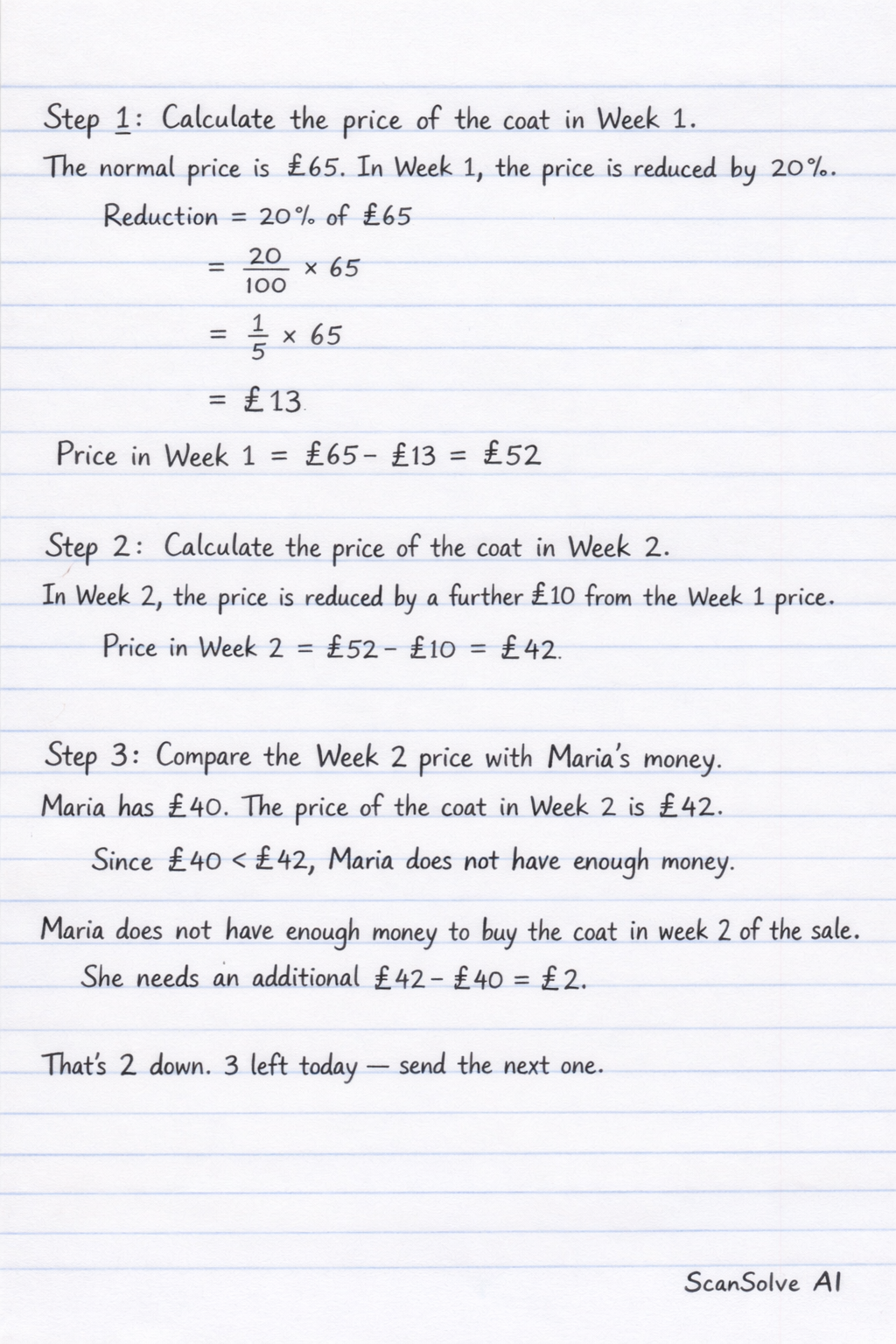
Handwritten Step-by-Step Solution
Get this as a handwritten image on WhatsApp — like a tutor wrote it for you.
Try on WhatsApp