
We read your photo as:
MATHEMATICS PAPER 1 [40 Marks]
ScanSolve AI Answer
Answer
Step-by-step solution
15 stepsHere are the solutions for the questions you've sent.
Part 1· 6 steps
If , find the value of .
Express both sides of the equation with the same base.
Since , we can rewrite as .
Since the bases are the same, equate the exponents.
Solve for .
The value of is B. 3.
Question 2: Kwaku and Attah formed a company and agreed that their profit will be shared in the ratio 3:2 respectively. At the end of the year, Attah received GH¢5000.00 more than Kwaku. How much profit did the company make in the year?
Assumption: The problem states the ratio for Kwaku:Attah is 3:2, but then says Attah received GH¢5000.00 more than Kwaku. This implies Attah's share is larger. To reconcile this, we assume the ratio of shares is Kwaku:Attah = 2:3, which means Attah gets 3 parts and Kwaku gets 2 parts.
Let the total profit be .
Let Kwaku's share be and Attah's share be .
The difference in their shares is GH¢5000.00.Solve for .
Calculate the total profit, which is the sum of their shares ().
The company made a profit of B. GH¢25,000.00.
Part 3· 3 steps
Find the inverse of the matrix .
Calculate the determinant of matrix , denoted as .
For a matrix , the determinant is .
Find the adjugate matrix.
For a matrix , the adjugate is .
Calculate the inverse matrix using the formula .
The inverse of the matrix is B. .
Part 4· 2 steps
Find the equation of the line with gradient 3 which passes through the point .
Use the point-slope form of a linear equation, , where is the gradient and is the given point.
Given and .
Distribute the gradient and rearrange the equation into the general form to match the options.
Or, multiplying by -1 to match option D:
The equation of the line is D. .
Part 5· 4 steps
Solve .
Rewrite the quadratic equation in standard form .
Factor the quadratic expression.
We look for two numbers that multiply to and add up to . These numbers are and .
Rewrite the middle term using these numbers:Factor by grouping.
Set each factor equal to zero and solve for .
The solutions are and . Note that can be written as .
The correct option is C. .
Part 6
Which of the following is the definition of a prism?
A prism is a three-dimensional solid object with two identical ends (bases) that are parallel and straight sides. The sides are parallelograms.
Based on this definition and the visible options:
- A. A solid figure with a rectangular base. (This is too specific and could describe other shapes like pyramids.)
- B. A solid figure with two identical and parallel bases. (This is the defining characteristic of a prism.)
- C. A solid figure with a circular base. (This describes a cylinder, which is a type of prism, but not the general definition.)
- D. A solid figure with a triangular cross-section. (This describes a triangular prism, not the general definition.)
The most accurate general definition of a prism among the choices is B. A solid figure with two identical and parallel bases.
Try one yourself
A new problem that tests the same skill.
Still stuck on this one?
Ask a follow-up, and the answer starts from this question.
More Mathematics Questions
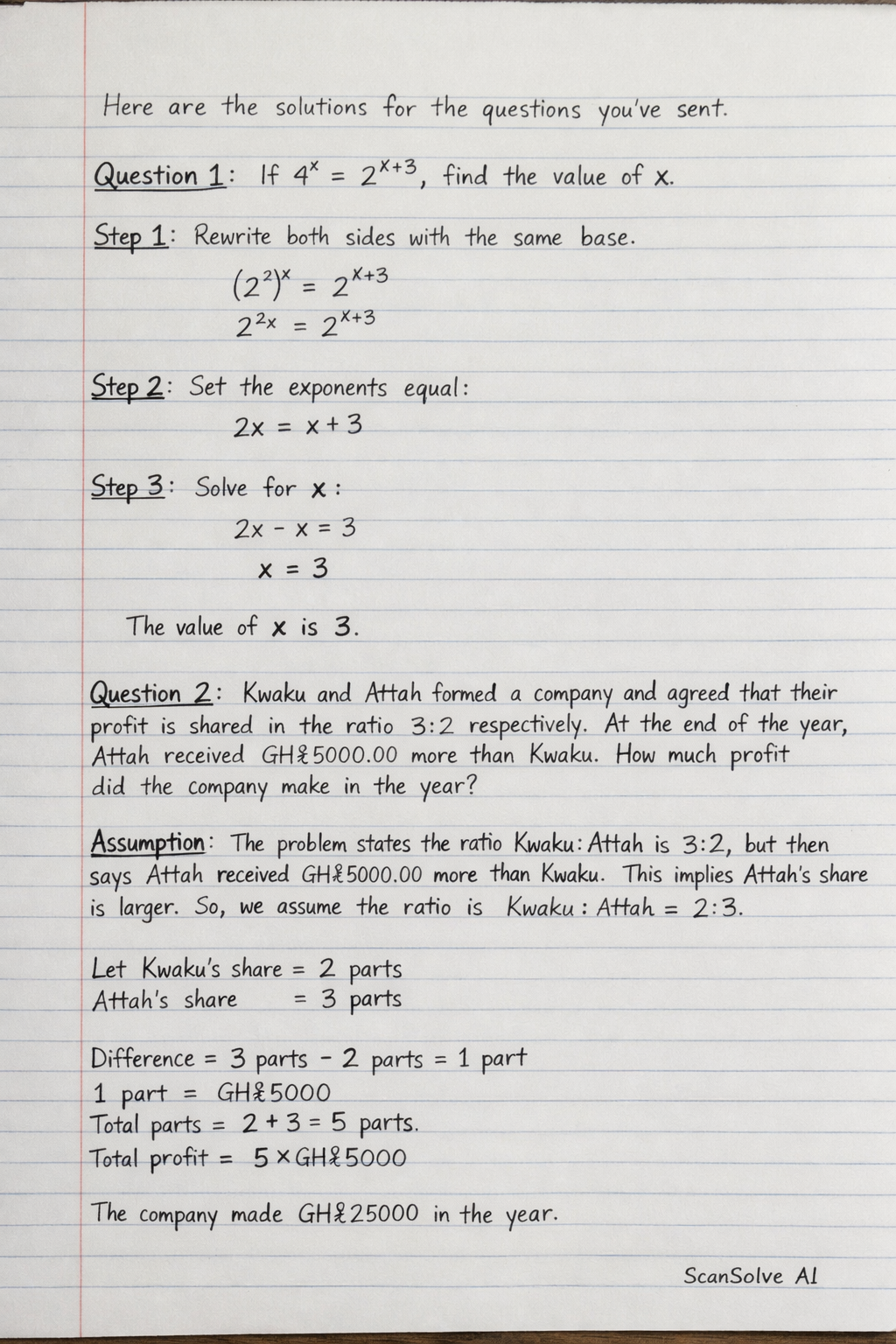
Handwritten Step-by-Step Solution
Get this as a handwritten image on WhatsApp — like a tutor wrote it for you.
Try on WhatsApp