

This mathematics problem involves applying core mathematical principles and formulas. Below you will find a complete step-by-step solution with detailed explanations for each step, helping you understand not just the answer but the method behind it.
ScanSolve AI Answer
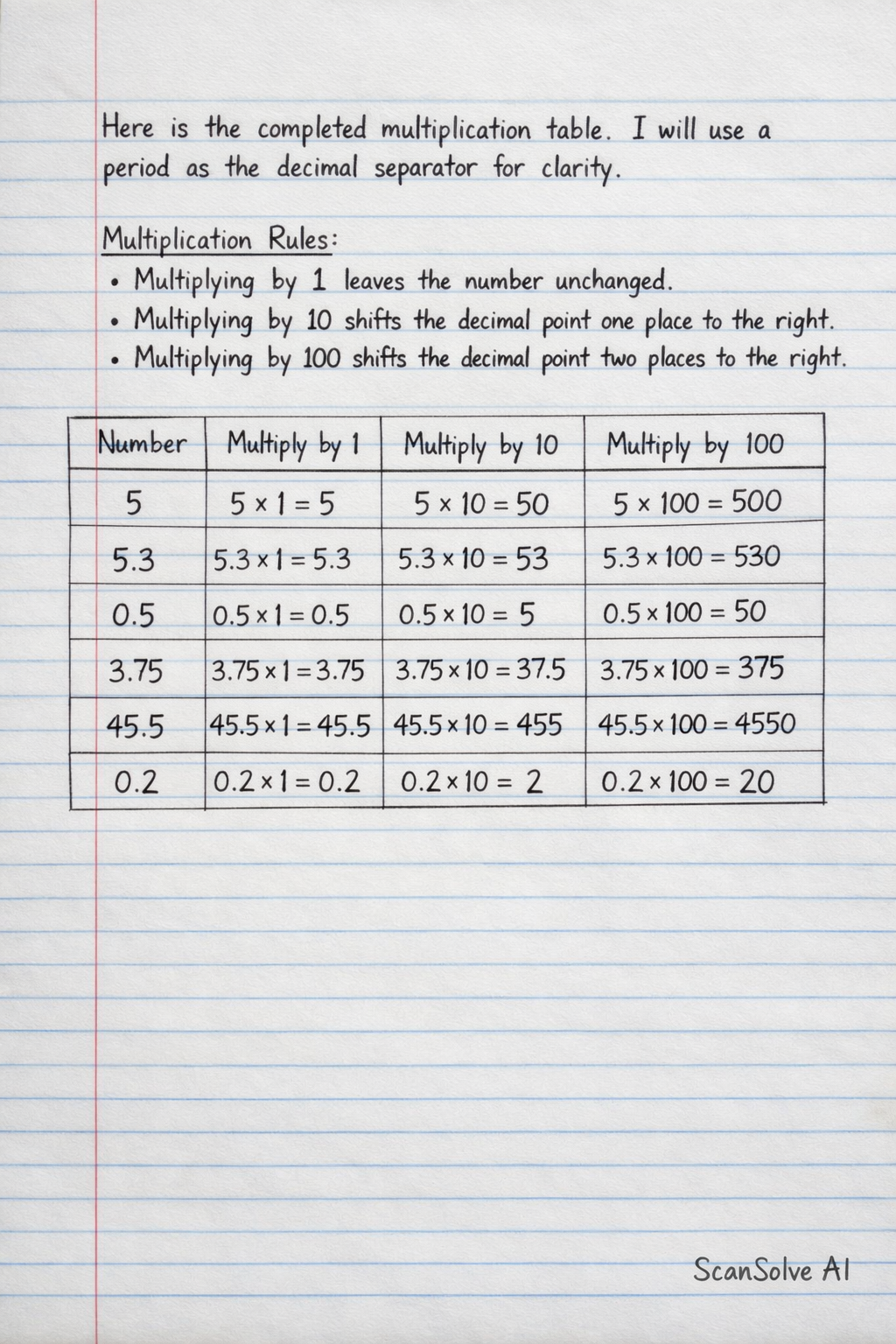
Here is the completed multiplication table. I will use a period as the decimal separator for clarity. Multiplication Rules: • Multiplying by 1 leaves the number unchanged. • Multiplying by 10 shifts the decimal point one place to the right. • Multiplying by 100 shifts the decimal point two places to the right. | Number | multiply by 1 | multiply by 10 | multiply by 100 | | :----- | :------------ | :------------- | :-------------- | | 5 | 5 × 1 = 5 | 5 × 10 = 50 | 5 × 100 = 500 | | 5.3 | 5.3 × 1 = 5.3 | 5.3 × 10 = 53 | 5.3 × 100 = 530 | | 0.5 | 0.5 × 1 = 0.5 | 0.5 × 10 = 5 | 0.5 × 100 = 50 | | 3.75 | 3.75 × 1 = 3.75 | 3.75 × 10 = 37.5 | 3.75 × 100 = 375 | | 45.5 | 45.5 × 1 = 45.5 | 45.5 × 10 = 455 | 45.5 × 100 = 4550 | | 0.2 | 0.2 × 1 = 0.2 | 0.2 × 10 = 2 | 0.2 × 100 = 20 | Here is the table with the calculated values: | Number | multiply by 1 | multiply by 10 | multiply by 100 | | :----- | :------------ | :------------- | :-------------- | | 5 | 5 | 50 | 500 | | 5.3 | 5.3 | 53 | 530 | | 0.5 | 0.5 | 5 | 50 | | 3.75 | 3.75 | 37.5 | 375 | | 45.5 | 45.5 | 455 | 4550 | | 0.2 | 0.2 | 2 | 20 |