My apologies for the previous incomplete answer. I will now identify all irrational numbers from the full list provided in the image for question 4(a).
This mathematics problem involves applying core mathematical principles and formulas. Below you will find a complete step-by-step solution with detailed explanations for each step, helping you understand not just the answer but the method behind it.
ScanSolve AI Answer
My apologies for the previous incomplete answer. I will now identify all irrational numbers from the full list provided in the image for question 4(a).
An irrational number is a number that cannot be expressed as a simple fraction $\frac{p}{q}$, where $p$ and $q$ are integers and $q \neq 0$. Their decimal representations are non-terminating and non-repeating.
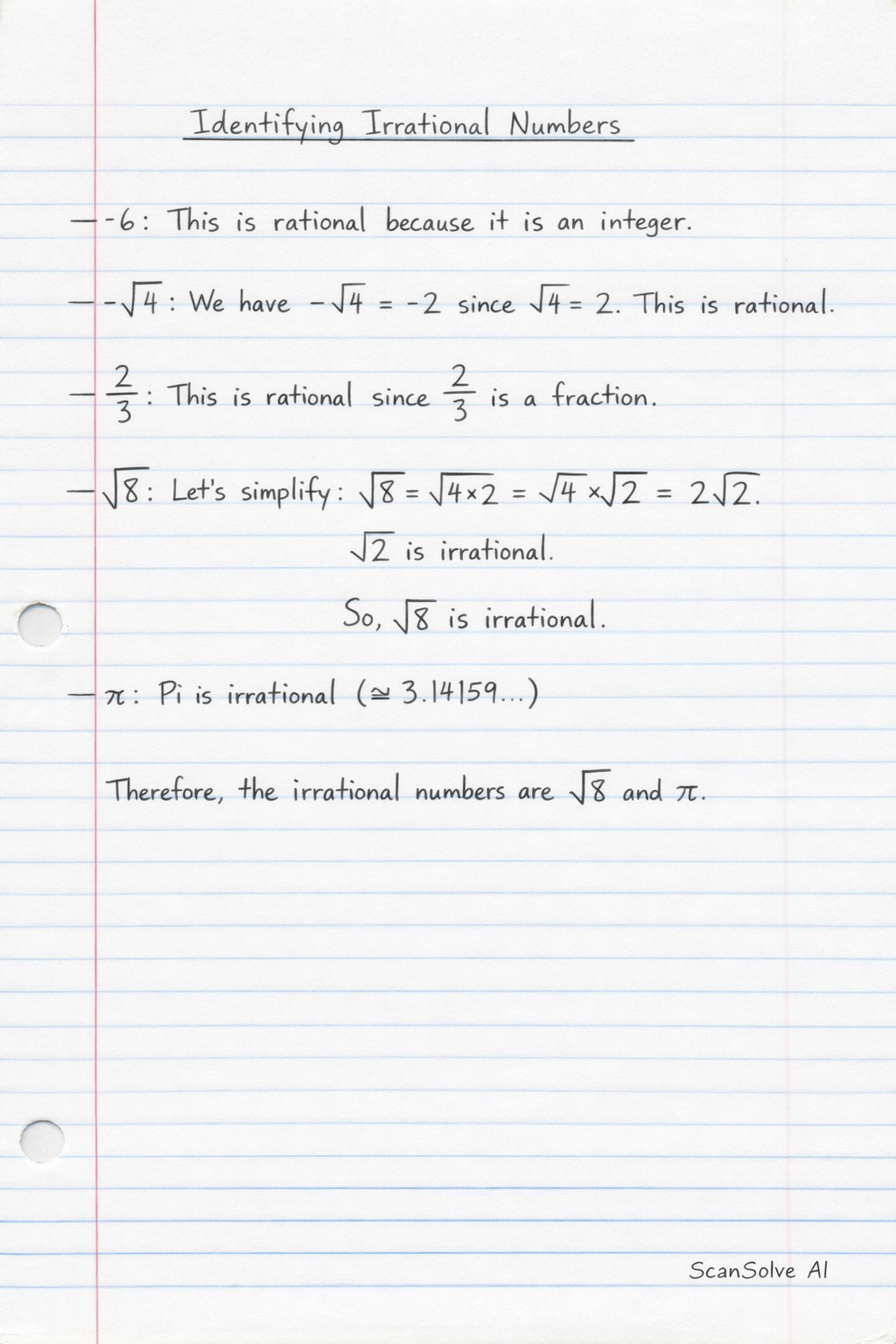
Let's examine each number from the list: $-6, -\sqrt{4}, \frac{2}{3}, \sqrt{8}, \text{ and } \pi$.
1. -6: This is an integer. It can be written as $\frac{-6}{1}$. It is a rational number.
2. $-\sqrt{4}$:
$$ -\sqrt{4} = -2 $$
This is an integer. It can be written as $\frac{-2}{1}$. It is a rational number.
3. $\frac{2}{3}$: This is already in the form of a fraction of two integers. It is a rational number.
4. $\sqrt{8}$:
$$ \sqrt{8} = \sqrt{4 \times 2} = 2\sqrt{2} $$
Since $\sqrt{2}$ is an irrational number (its decimal representation is non-terminating and non-repeating), $2\sqrt{2}$ is also an irrational number.
5. $\pi$: This is a mathematical constant that is famously irrational. Its decimal representation is non-terminating and non-repeating. It is an irrational number.
The irrational numbers from the list are: $\boxed{\sqrt{8}, \pi}$
Last free one today — make it count tomorrow, or type /upgrade for unlimited.
My apologies for the previous incomplete answer. I will now identify all irrational numbers from the full list provided in the image for question 4(a).
|Mathematics
My apologies for the previous incomplete answer. I will now identify all irrational numbers from the full list provided in the image for question 4(a).
ScanSolve AI Answer
My apologies for the previous incomplete answer. I will now identify all irrational numbers from the full list provided in the image for question 4(a).
An irrational number is a number that cannot be expressed as a simple fraction qp, where p and q are integers and q=0. Their decimal representations are non-terminating and non-repeating.
Let's examine each number from the list: −6,−4,32,8,andπ.
-6: This is an integer. It can be written as 1−6. It is a rational number.
−4:
−4=−2
This is an integer. It can be written as 1−2. It is a rational number.
32: This is already in the form of a fraction of two integers. It is a rational number.
8:
8=4×2=22
Since 2 is an irrational number (its decimal representation is non-terminating and non-repeating), 22 is also an irrational number.
π: This is a mathematical constant that is famously irrational. Its decimal representation is non-terminating and non-repeating. It is an irrational number.
The irrational numbers from the list are: 8,π
Last free one today — make it count tomorrow, or type /upgrade for unlimited.
Need help with your own homework?
Get instant step-by-step solutions to any question. Free to start.