
No like how could it says are the four are the four parts of the rectangle equal in area how do you know
Mathematics
ScanSolve AI Answer
Step-by-step solution
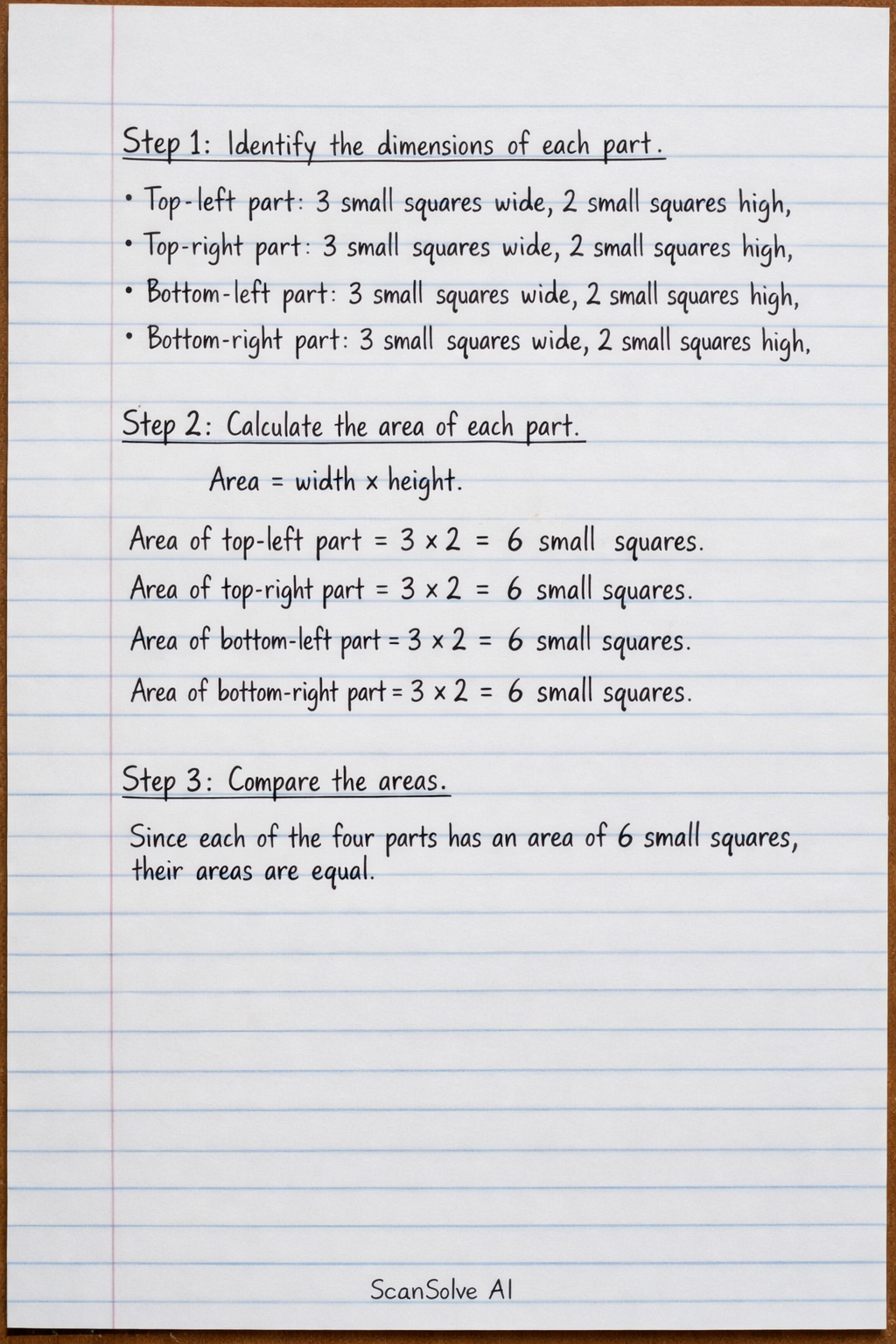
3 stepsIdentify the dimensions of each part.
The rectangle is divided into four smaller rectangles by thick lines.
- The top-left part is 3 small squares wide and 2 small squares high.
- The top-right part is 3 small squares wide and 2 small squares high.
- The bottom-left part is 3 small squares wide and 2 small squares high.
- The bottom-right part is 3 small squares wide and 2 small squares high.
Calculate the area of each part.
The area of each part is found by multiplying its width by its height (in terms of small squares).
- Area of top-left part = small squares.
- Area of top-right part = small squares.
- Area of bottom-left part = small squares.
- Area of bottom-right part = small squares.
Compare the areas.
Since each of the four parts has an area of 6 small squares, their areas are equal.
3) Yes, the four parts of the rectangle are equal in area. We know this because each part is a rectangle with dimensions of 3 small squares by 2 small squares, resulting in an area of small squares for each part.
Was this helpful?
Still stuck on this one?
Ask a follow-up, and the answer starts from this question.
Got a different question?Ask your own question
More Mathematics Questions
QAre the diagonals equal in a rectangleQGiven that (1)/(4) of the rectangle is shaded, we multiply the total area by this fraction.QCalculate the area of the rectangle.QIdentify the dimensions of the rectangle.QA rectangle is a quadrilateral, which means it has four sides.
Browse by topic:Geometry
Handwritten Step-by-Step Solution
Get this as a handwritten image on WhatsApp — like a tutor wrote it for you.
Try on WhatsApp