

This mathematics problem involves applying core mathematical principles and formulas. Below you will find a complete step-by-step solution with detailed explanations for each step, helping you understand not just the answer but the method behind it.
ScanSolve AI Answer
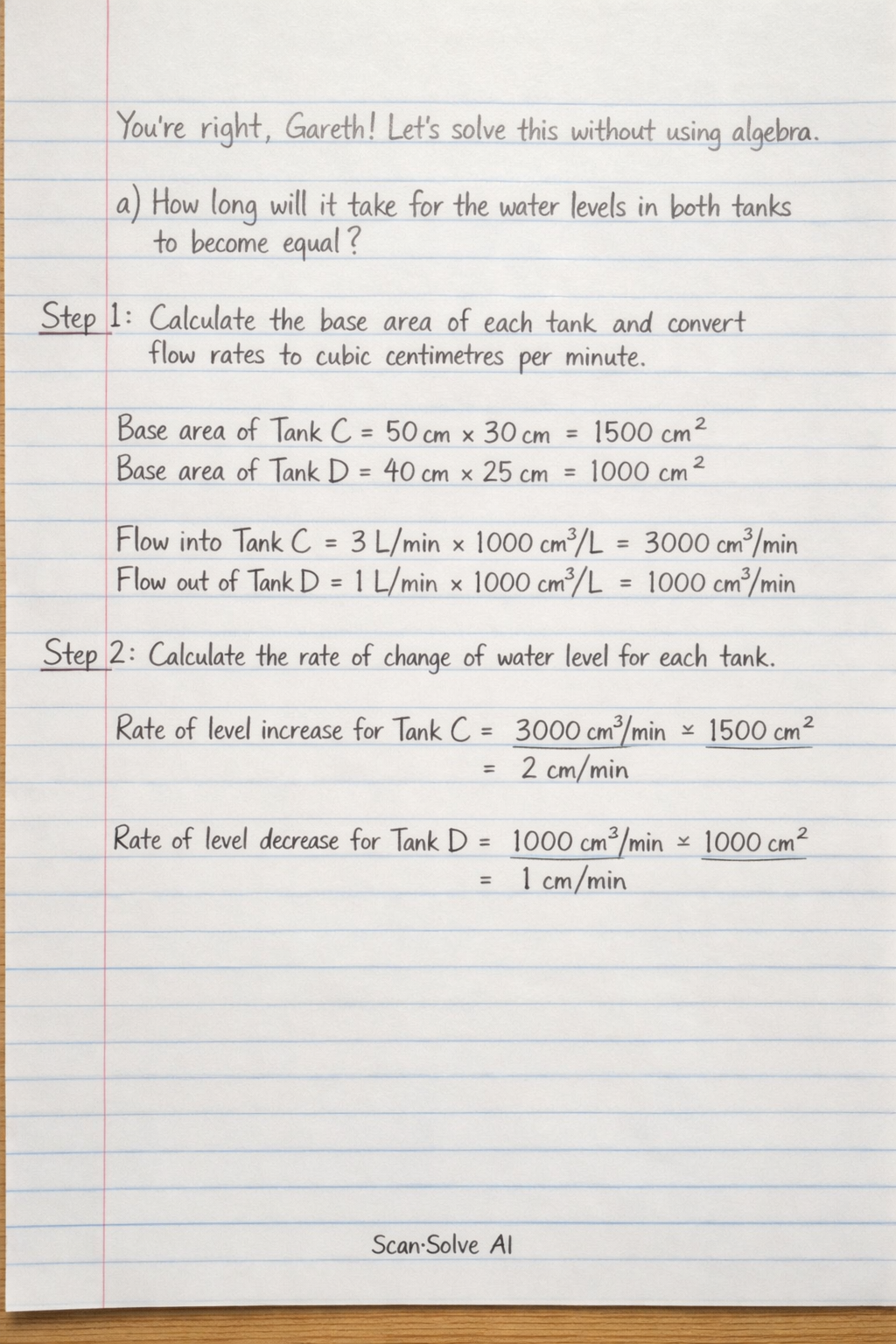
You're right, Gareth! Let's solve this without using algebra. a) How long will it take for the water levels in both tanks to become equal? Step 1: Calculate the base area of each tank and convert flow rates to cubic centimetres per minute. Base area of Tank C = 50 cm × 30 cm = 1500 cm^2 Base area of Tank D = 40 cm × 25 cm = 1000 cm^2 Flow into Tank C = 3 L/min × 1000 cm^3/L = 3000 cm^3/min Flow out of Tank D = 1 L/min × 1000 cm^3/L = 1000 cm^3/min Step 2: Calculate the rate of change of water level for each tank. Rate of level increase for Tank C = 3000 cm^3/min1500 cm^2 = 2 cm/min Rate of level decrease for Tank D = 1000 cm^3/min1000 cm^2 = 1 cm/min Step 3: Determine the initial difference in water levels. Tank C starts at 12 cm. Tank D starts at 30 cm. Initial difference in levels = 30 cm - 12 cm = 18 cm Step 4: Calculate the rate at which the difference between the water levels changes. Since Tank C's level is increasing and Tank D's level is decreasing, their levels are moving towards each other. The difference between them is closing at a combined rate. Rate at which difference closes = 2 cm/min (Tank C) + 1 cm/min (Tank D) = 3 cm/min Step 5: Calculate the time it takes for the water levels to become equal. Divide the initial difference by the rate at which the difference closes. Time = Initial differenceRate at which difference closes = 18 cm3 cm/min = 6 minutes The water levels will become equal after 6 minutes. Answer (a): 6 minutes b) What will the common water level be then? Step 6: Calculate the water level in either tank after 6 minutes. Using Tank C: Final level in Tank C = Initial level + (Rate of increase × Time) Final level in Tank C = 12 cm + (2 cm/min × 6 min) = 12 cm + 12 cm = 24 cm (Alternatively, using Tank D: 30 cm - (1 cm/min × 6 min) = 30 cm - 6 cm = 24 cm) The common water level will be 24 cm. Answer (b): 24 cm