

This mathematics problem involves applying core mathematical principles and formulas. Below you will find a complete step-by-step solution with detailed explanations for each step, helping you understand not just the answer but the method behind it.
ScanSolve AI Answer
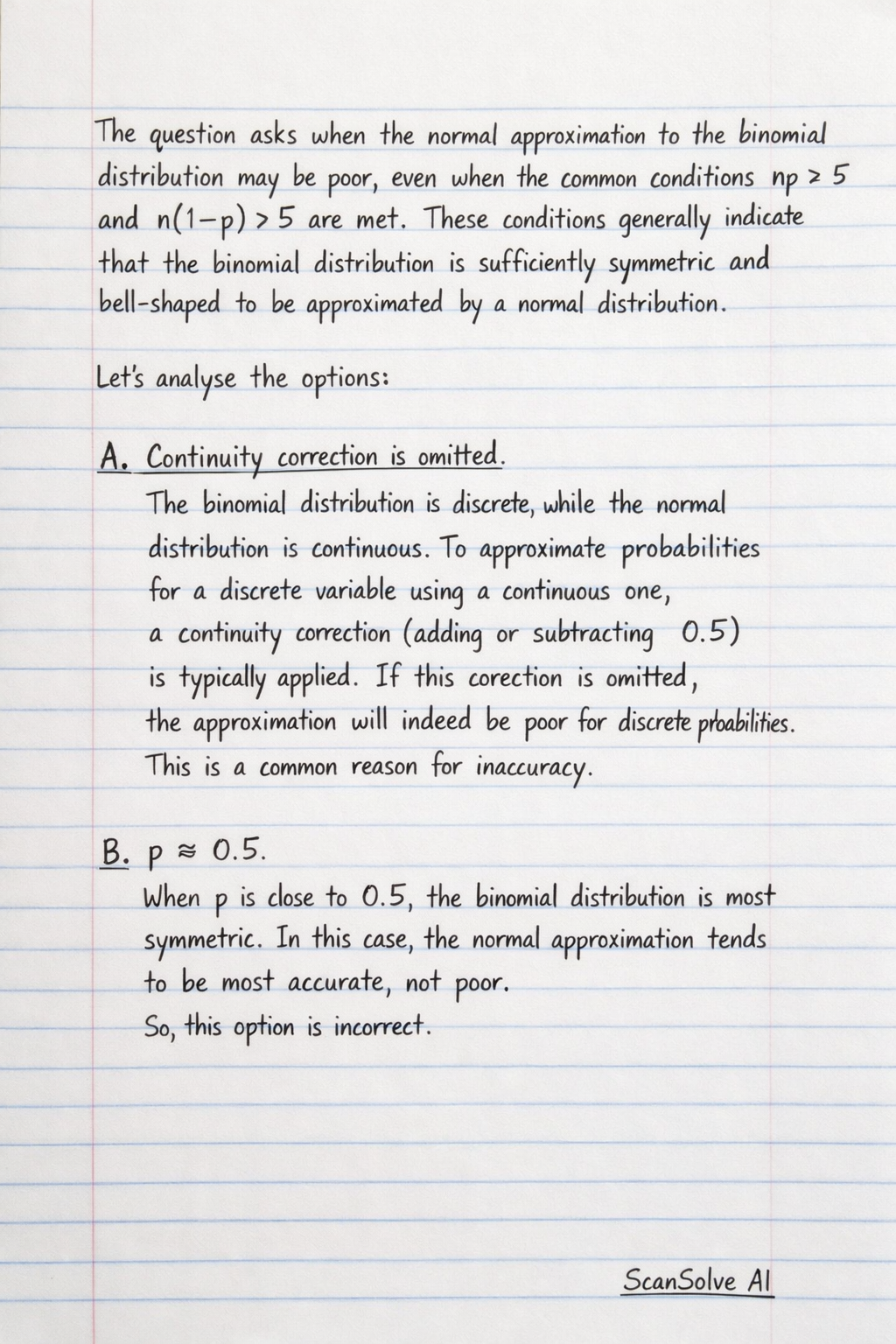
The question asks when the normal approximation to the binomial distribution may be poor, even when the common conditions np > 5 and n(1-p) > 5 are met. These conditions generally indicate that the binomial distribution is sufficiently symmetric and bell-shaped to be approximated by a normal distribution. Let's analyze the options: A. Continuity correction is omitted. The binomial distribution is discrete, while the normal distribution is continuous. To approximate probabilities for a discrete variable using a continuous one, a continuity correction (adding or subtracting 0.5) is typically applied. If this correction is omitted, the approximation will indeed be poor for discrete probabilities. This is a common reason for inaccuracy. B. p ≈ 0.5. When p is close to 0.5, the binomial distribution is most symmetric. In this case, the normal approximation tends to be most accurate*, not poor. So, this option is incorrect. C. Accurate tail probabilities are required. The normal approximation is generally less accurate in the tails (extreme ends) of the distribution, even when the conditions np > 5 and n(1-p) > 5 are met and continuity correction is applied. The approximation works best for probabilities near the mean. If very precise probabilities for events far from the mean are needed, the normal approximation might not be sufficient. This is a known limitation of the approximation. D. The distribution is discrete. The fact that the binomial distribution is discrete is the fundamental reason why an approximation by a continuous distribution (the normal) is needed in the first place. It's not a condition that causes the approximation to be poor despite* meeting the np > 5 and n(1-p) > 5 criteria. Comparing A and C, both can lead to a poor approximation. However, option C points to an inherent limitation of the normal approximation itself, even when applied correctly. The approximation's accuracy diminishes in the tails, regardless of whether continuity correction is used. If the problem specifically requires high accuracy for tail probabilities, the normal approximation may be poor. Option A describes a procedural error that would make the approximation poor for any probability calculation. The question asks "mainly when" it may be poor, suggesting a scenario where the approximation's inherent limitations are exposed. Therefore, the most appropriate answer is that the approximation may be poor when accurate tail probabilities are required. The final answer is C