

This mathematics problem involves applying core mathematical principles and formulas. Below you will find a complete step-by-step solution with detailed explanations for each step, helping you understand not just the answer but the method behind it.
ScanSolve AI Answer
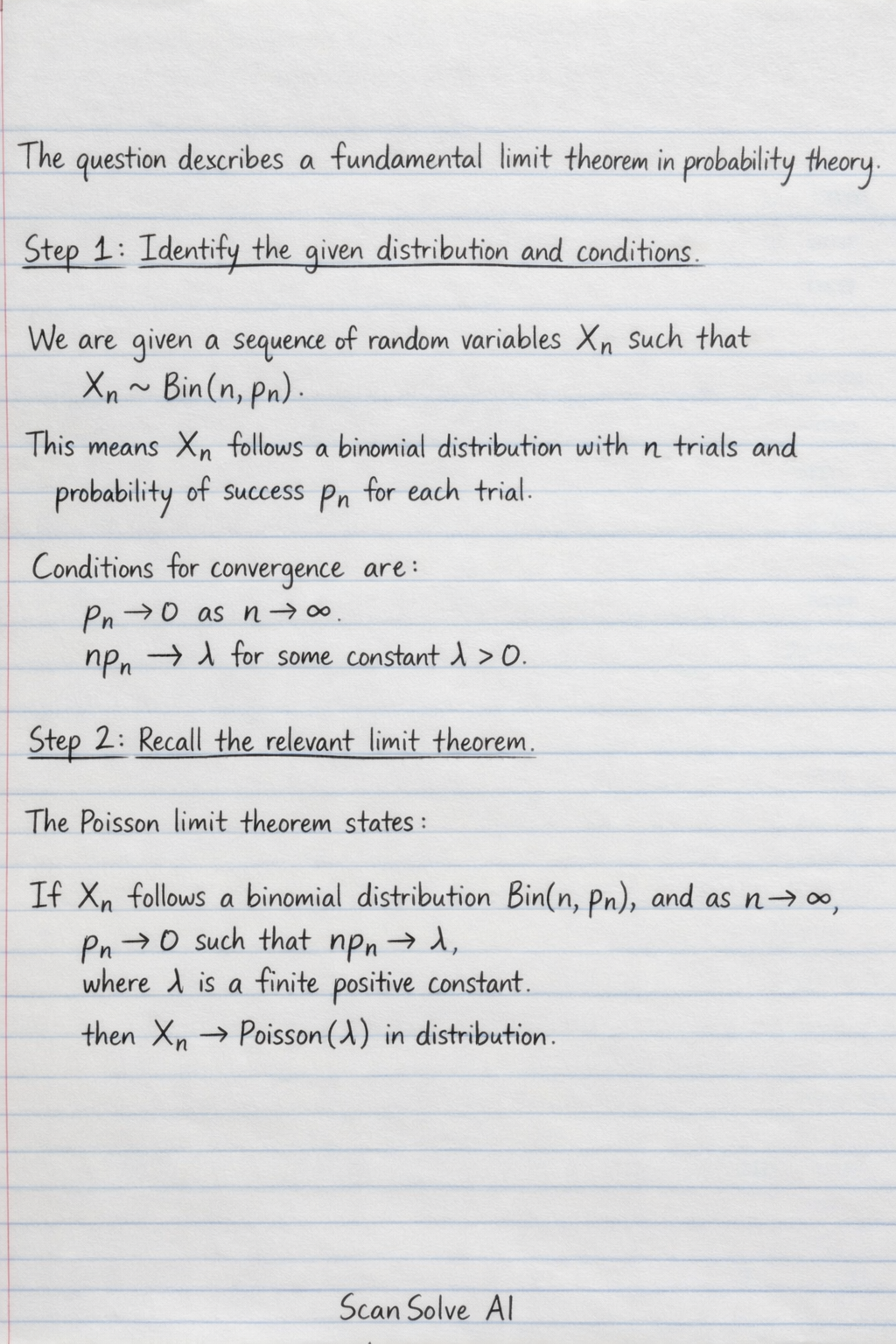
The question describes a fundamental limit theorem in probability theory. Step 1: Identify the given distribution and conditions. We are given a sequence of random variables X_n such that X_n Bin(n, p_n). This means X_n follows a binomial distribution with n trials and probability of success p_n for each trial. The conditions for convergence are p_n 0 as n and np_n for some constant > 0. Step 2: Recall the relevant limit theorem. The Poisson limit theorem states that if X_n follows a binomial distribution Bin(n, p_n), and as n , p_n 0 such that the product np_n approaches a finite positive constant , then X_n converges in distribution to a Poisson distribution with parameter . Step 3: Compare with the given options. A. Bernoulli (): A Bernoulli distribution is for a single trial, not a limit of n trials. B. Degenerate at : A degenerate distribution means the random variable takes a single value with probability 1. This is not the case for the limit of a binomial distribution under these conditions. C. Normal (, ): The normal approximation to the binomial distribution is typically used when n is large and p is not too close to 0 or 1. Here, p_n 0, which violates the conditions for a good normal approximation. D. Poisson (): This matches the statement of the Poisson limit theorem. Therefore, X_n converges in distribution to a Poisson distribution with parameter . The final answer is D