
Now give me all the formulas under mensuration leave none...I'm talking about all the shapes....total surface area, volume etc
Mathematics
ScanSolve AI Answer
Step-by-step solution
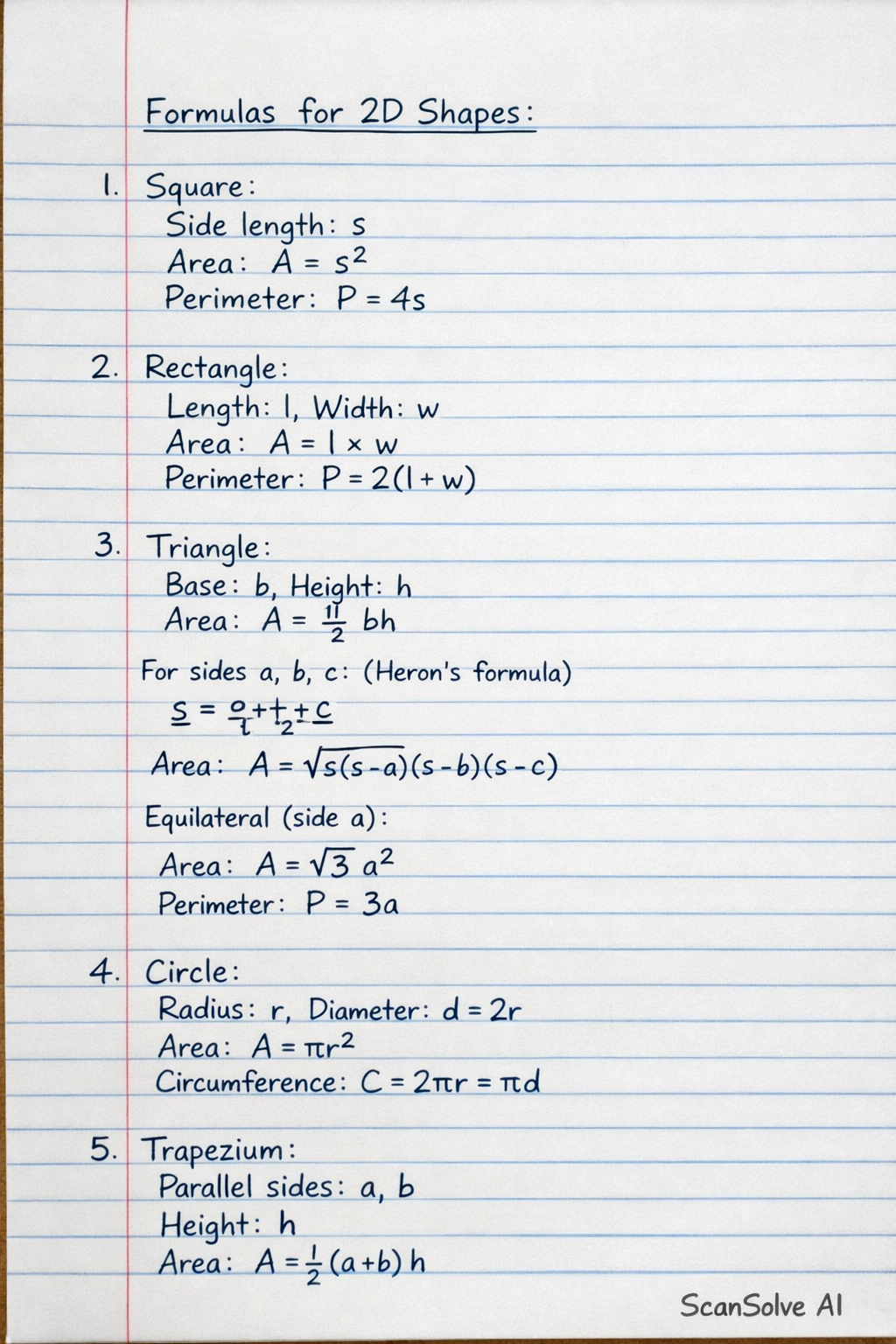
17 stepsHere are the common mensuration formulas for various 2D and 3D shapes:
2D Shapes
Square
- Side length:
- Area:
- Perimeter:
Rectangle
- Length: , Width:
- Area:
- Perimeter:
Triangle
- Base: , Height:
- Area:
- For a triangle with sides (Heron's formula):
- Semi-perimeter:
- Area:
- For an equilateral triangle with side :
- Area:
- Perimeter:
Circle
- Radius: , Diameter:
- Area:
- Circumference:
Trapezium (or Trapezoid)
- Parallel sides: , Height:
- Area:
Parallelogram
- Base: , Height:
- Area:
- Perimeter: (where and are adjacent sides)
Rhombus
- Diagonals:
- Area:
- Perimeter: (where is the side length)
Sector of a Circle
- Radius: , Angle (in degrees):
- Area:
- Arc Length:
Segment of a Circle
- Radius: , Angle (in degrees):
- Area of segment = Area of sector - Area of triangle
- Area:
3D Shapes
Cube
- Side length:
- Volume:
- Total Surface Area (TSA):
- Lateral Surface Area (LSA):
Cuboid (Rectangular Prism)
- Length: , Width: , Height:
- Volume:
- Total Surface Area (TSA):
- Lateral Surface Area (LSA):
Cylinder
- Radius: , Height:
- Volume:
- Curved Surface Area (CSA):
- Total Surface Area (TSA):
Cone
- Radius: , Height: , Slant height:
- Volume:
- Curved Surface Area (CSA):
- Total Surface Area (TSA):
Sphere
- Radius:
- Volume:
- Surface Area:
Hemisphere
- Radius:
- Volume:
- Curved Surface Area (CSA):
- Total Surface Area (TSA):
Pyramid (General)
- Base Area: , Height:
- Volume:
- For a square pyramid with base side and slant height :
- Base Area:
- Lateral Surface Area (LSA):
- Total Surface Area (TSA):
Prism (General)
- Base Area: , Height: , Perimeter of Base:
- Volume:
- Lateral Surface Area (LSA):
- Total Surface Area (TSA):
Was this helpful?
Still stuck on this one?
Ask a follow-up, and the answer starts from this question.
Got a different question?Ask your own question
More Mathematics Questions
QGive me all the formulas of relative density, all the formulas, all the theorems, all the states…QHow do I memorise formula for mensurationQList the physical quantities, their formulas, and dimensions.QState three types of formulas (i) Area of rectangle (ii) Volume of rectangleQI need all physics formulas
Handwritten Step-by-Step Solution
Get this as a handwritten image on WhatsApp — like a tutor wrote it for you.
Try on WhatsApp