

This mathematics problem involves applying core mathematical principles and formulas. Below you will find a complete step-by-step solution with detailed explanations for each step, helping you understand not just the answer but the method behind it.
ScanSolve AI Answer
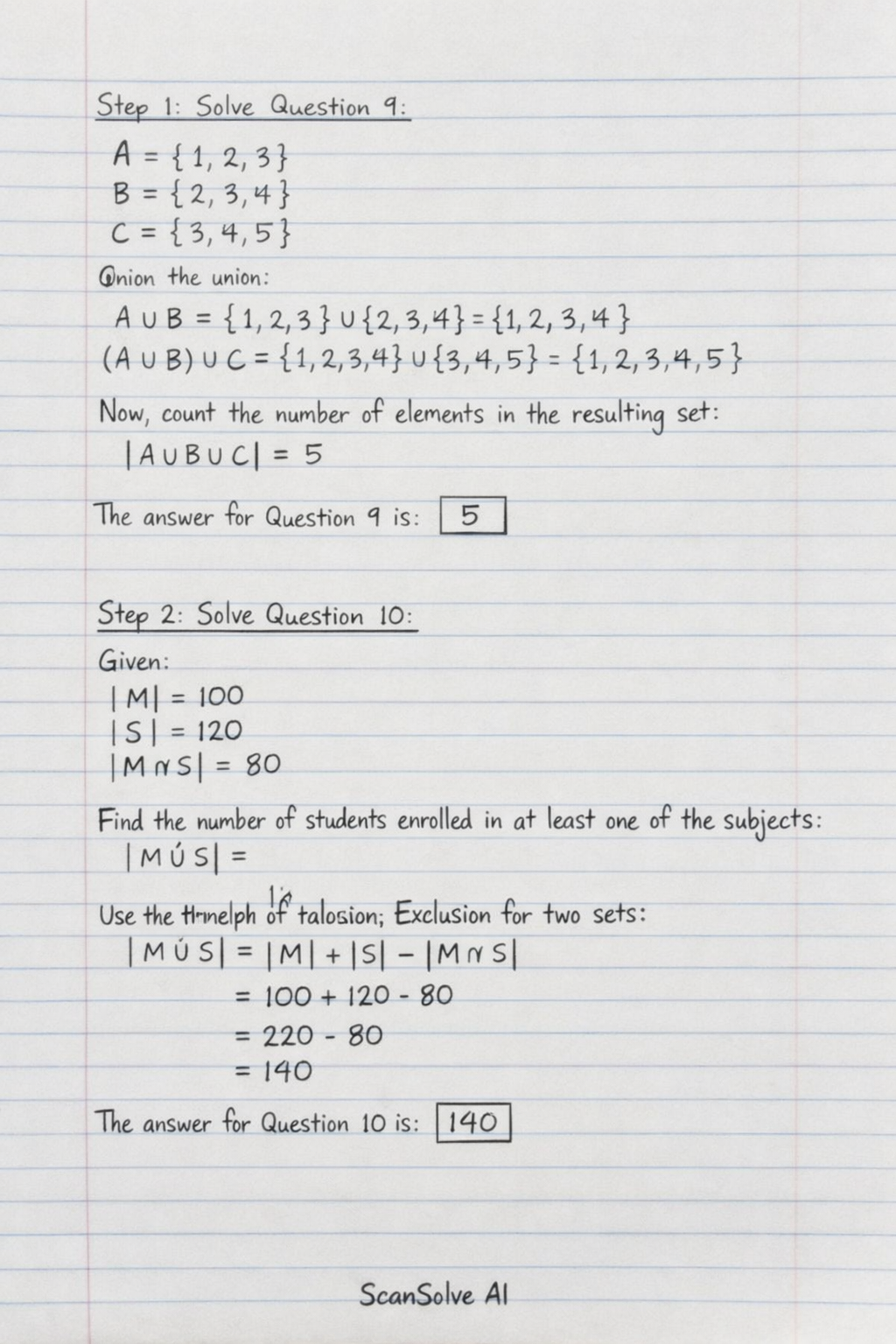
Step 1: Solve Question 9. Given the sets: A = \1, 2, 3\ B = \2, 3, 4\ C = \3, 4, 5\ Compute the number of elements in A B C, denoted as |A B C|. First, find the union of all three sets: A B = \1, 2, 3\ \2, 3, 4\ = \1, 2, 3, 4\ (A B) C = \1, 2, 3, 4\ \3, 4, 5\ A B C = \1, 2, 3, 4, 5\ Now, count the number of elements in the resulting set: |A B C| = 5 The answer for Question 9 is: 5 Step 2: Solve Question 10. Given: Number of students enrolled in mathematics (|M|) = 100 Number of students enrolled in science (|S|) = 120 Number of students enrolled in both subjects (|M S|) = 80 Find the number of students enrolled in at least one of the subjects, which is |M S|. Use the Principle of Inclusion-Exclusion for two sets: |M S| = |M| + |S| - |M S| Substitute the given values: |M S| = 100 + 120 - 80 |M S| = 220 - 80 |M S| = 140 The answer for Question 10 is: 140 Step 3: Solve Question 11. Given the sets: A = \1, 2\ B = \2, 3\ C = \3, 4\ a) Compute (A B) C First, calculate A B: A B = \1, 2\ \2, 3\ = \1, 2, 3\ Next, find the union of this result with C: (A B) C = \1, 2, 3\ \3, 4\ (A B) C = \1, 2, 3, 4\ b) Compute A (B C) First, calculate B C: B C = \2, 3\ \3, 4\ = \2, 3, 4\ Next, find the union of A with this result: A (B C) = \1, 2\ \2, 3, 4\ A (B C) = \1, 2, 3, 4\ The answers for Question 11 are: *a) \1, 2, 3, 4\ *b) \1, 2, 3, 4\