
We read your photo as:
What number when decreased by 9% becomes 36,400? (3marks)
ScanSolve AI Answer
Step-by-step solution
16 stepsHere are the solutions to your questions:
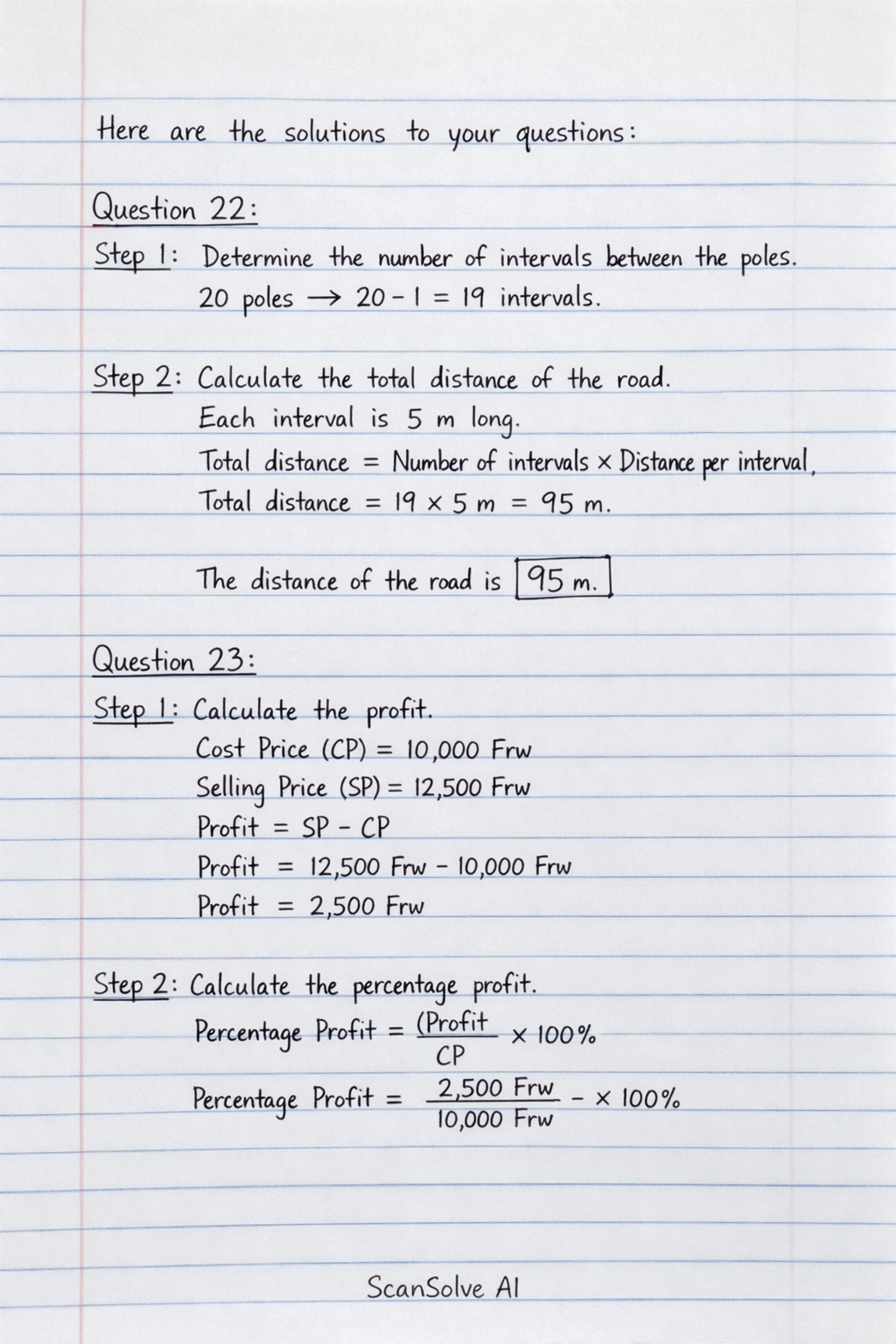
Question 22:
Determine the number of intervals between the poles.
If there are 20 poles along one side of a road, the number of spaces between them is one less than the number of poles.
Number of intervals .Calculate the total distance of the road.
Each interval is long.
Total distance .
Total distance .
The distance of the road is .Question 23:
Calculate the profit.
Cost Price (CP) .
Selling Price (SP) .
Profit .Calculate the percentage profit.
Percentage Profit .
Percentage Profit .Simplify the expression.
Percentage Profit .
Her percentage profit was .Question 24:
To check for divisibility by 11, we use the rule: find the alternating sum of the digits (starting from the rightmost digit, subtract the next, add the next, and so on). If the result is divisible by 11, the number is divisible by 11.- a) 64,737: . (Not divisible by 11)
- b) 66,858: . (Divisible by 11)
- c) 565,798: . (Not divisible by 11)
- d) 232,467: . (Not divisible by 11)
The number exactly divisible by 11 is .
Question 25:
Set up the equation.
Let the original number be .
When the number is decreased by , it means it becomes of its original value.
So, of is 36,400.
.Solve for .
.
.
.Calculate the value of .
.
The number is .Question 26:
Perform the multiplication.
.
So, the quantity is .Convert hectoliters (hl) to decaliters (dal).
We know that .
.
The result is .Question 27:
Find the common difference in the sequence.
The sequence is .
.
.
.
The common difference is .Find the next two missing numbers.
The next number after 4 is .
The number after is .
The missing numbers in the sequence are .Question 28:
Perform the division .
We can use long division.
with a remainder. ()
. Bring down 7, making it 587.
with a remainder. ()
. Bring down 3, making it 853.
with a remainder. ()
. Bring down 4, making it 1004.
with no remainder. ()
The result of the division is .Question 29:
-
a) Name above figure: The figure shown is a three-dimensional shape with six square faces. The name of the figure is a .
-
b) How many edges does above figure have? A cube has 12 edges. The figure has edges.
-
c) How many vertices does above figure have? A cube has 8 vertices (corners). The figure has vertices.
-
d) If the side of above figure is , work out its area.
-
Identify what "area" refers to for a 3D figure.
For a cube, this typically means the total surface area.
A cube has 6 identical square faces.Calculate the area of one face.
Area of one face $= \text{side} \times \text{side} = (5 \text{ cm})^2 = 25 \text{ cm}^2$.Calculate the total surface area.
Total Surface Area $= 6 \times (\text{Area of one face}) = 6 \times 25 \text{ cm}^2 = 150 \text{ cm}^2$.
The area of the figure is $\boxed{150 \text{ cm}^2}$.
Still stuck on this one?
Ask a follow-up, and the answer starts from this question.
More Mathematics Questions
Handwritten Step-by-Step Solution
Get this as a handwritten image on WhatsApp — like a tutor wrote it for you.
Try on WhatsApp