
We read your photo as:
Which of the following is not a composite number? A. 65 B. 39 C. 41 D. 24
ScanSolve AI Answer
Answer
Step-by-step solution
10 steps1.
Solve: .
Collect terms on one side and constant terms on the other.
Add to both sides:
Subtract 7 from both sides:
Isolate .
Divide by 2:
The correct option is A.
The solution is .2.
Evaluate when and .Substitute the given values of and into the expression.
Simplify the expression.
Perform the multiplication.
The correct option is C.
The value is .3.
Antwi has 20 mangoes and 20% are rotten. How many of them are not rotten?Calculate the number of rotten mangoes.
Number of rotten mangoes = of 20
Calculate the number of mangoes that are not rotten.
Number of not rotten mangoes = Total mangoes - Number of rotten mangoes
The correct option is A.
The number of mangoes that are not rotten is .4.
Which of the following is not a composite number?
A. 65
B. 39
C. 41
D. 24A composite number is a positive integer that has at least one divisor other than 1 and itself. A prime number has only two divisors: 1 and itself.
Check each option to determine if it is composite or prime.
- A. . Since 65 has factors other than 1 and 65 (e.g., 5 and 13), it is a composite number.
- B. . Since 39 has factors other than 1 and 39 (e.g., 3 and 13), it is a composite number.
- C. 41. The only positive divisors of 41 are 1 and 41. Therefore, 41 is a prime number, not a composite number.
- D. . Since 24 has factors other than 1 and 24, it is a composite number.
The number that is not a composite number is 41.
The correct option is C.
The number that is not a composite number is .5.
Mary receives a commission of 15% on articles sold in a week. If her commission was GH¢ 60.00, how much sales did she make?Set up the equation for commission.
Let be the total sales.
Commission = ofSolve for .
Multiply both sides by 100:
Divide by 15:
The correct option is B.
Mary's total sales were .
Try one yourself
A new problem that tests the same skill.
Still stuck on this one?
Ask a follow-up, and the answer starts from this question.
More Mathematics Questions
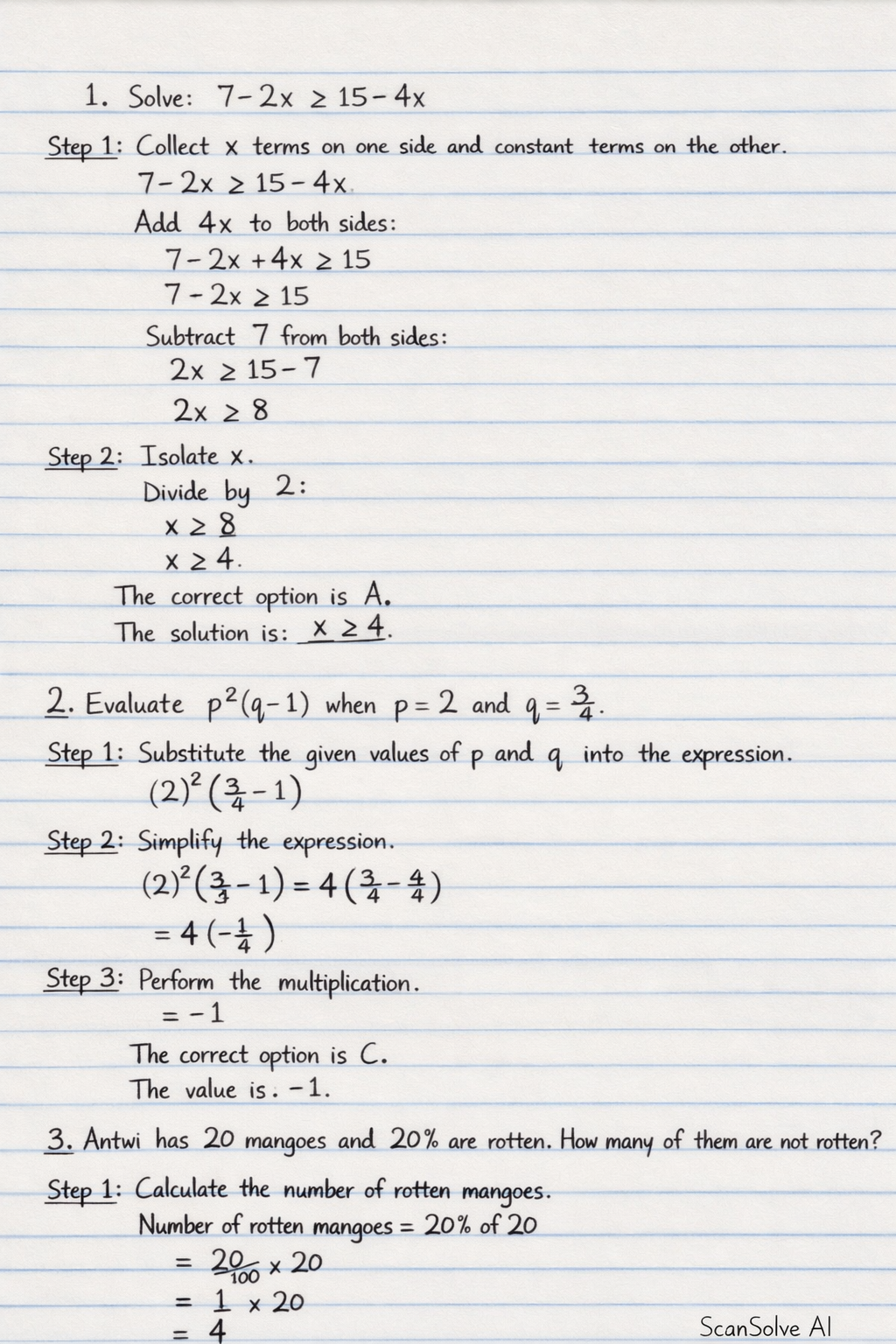
Handwritten Step-by-Step Solution
Get this as a handwritten image on WhatsApp — like a tutor wrote it for you.
Try on WhatsApp