
We read your photo as:
On the number line, is Desmond correct? Explain why or why not.
Mathematics
ScanSolve AI Answer
Step-by-step solution
4 stepsDetermine the value represented by the dot on the number line.
The number line between 0 and 1 is divided into 6 equal segments. The dot is located on the 4th mark from 0.
Therefore, the dot represents the fraction .Evaluate Desmond's first claim
represents the dot.
To compare with , we can simplify :Since , does not represent the dot.
Evaluate Desmond's second claim
represents the dot.
Comparing with , we see that they are not equal.
Since , does not represent the dot.Conclude whether Desmond is correct.
Desmond is incorrect. The dot on the number line represents . Neither (which simplifies to ) nor is equivalent to .
Desmond is incorrect.
Was this helpful?
Still stuck on this one?
Ask a follow-up, and the answer starts from this question.
Got a different question?Ask your own question
More Mathematics Questions
QDesmond says 12/6 and 3/6 could be used to represent the dot on the number line. Is Desmond correct?…Qq & 10 (2 points) Constructed Response Desmond says 6/12 and 3/6 could be used to represent the dot…QWhat number does the arrow point to on the number line?QFrom the number line above, −6 is the smallest and 5 is the biggest. Is this statement correct?
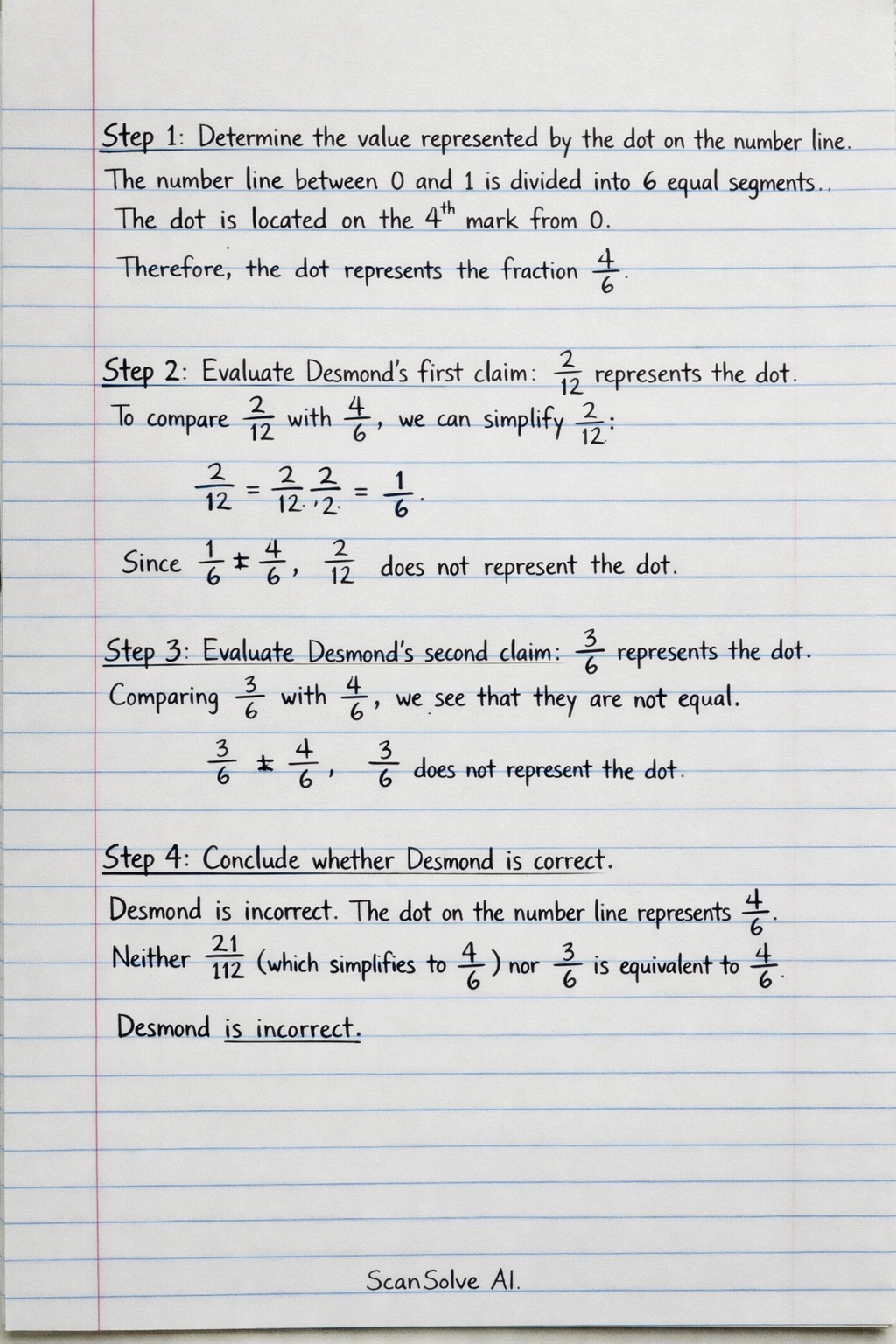
Handwritten Step-by-Step Solution
Get this as a handwritten image on WhatsApp — like a tutor wrote it for you.
Try on WhatsApp