We read your photo as:

One corner of this cuboid has been sliced off along the plane QTU. WU = 4 cm. a) Calculate the length of the three sides of the triangle QTU b) Calculate the three angles P, Q, and T in triangle PQT.

Mathematics

ScanSolve AI Answer

Answers

4 parts
i

30∘\text{30}^\circ

ii

9.67 cm\text{9.67 cm}

iii

3 cm\text{3 cm}

iv

6 cm\text{6 cm}

Step-by-step solution

10 steps

Part 2

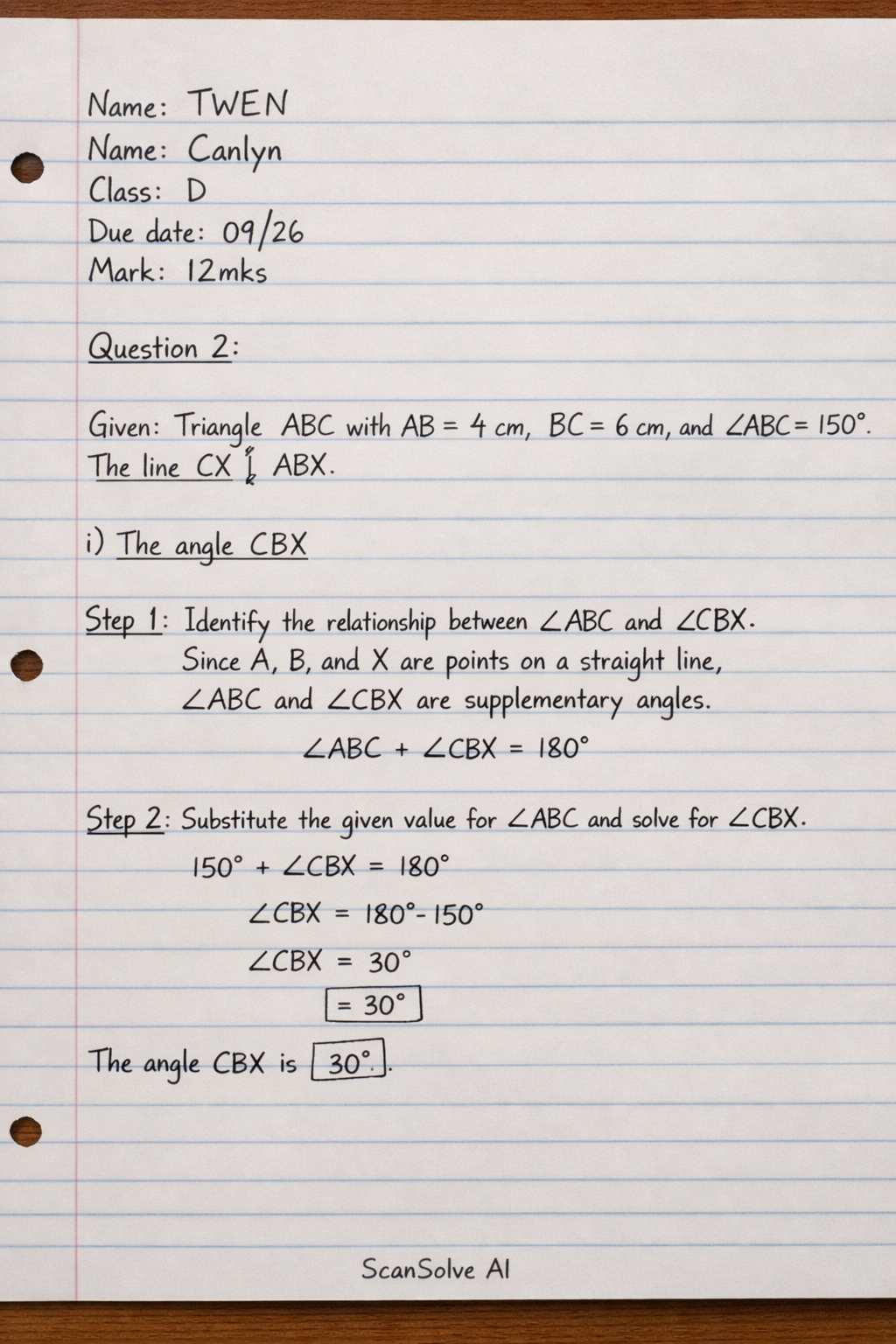
Given: Triangle ABC with AB = 4 cm, BC = 6 cm, and ∠ABC=150∘\angle ABC = 150^\circ. The line CX is perpendicular to the line ABX.

Part i

30∘\text{30}^\circ

The angle CBX

  1. Identify the relationship between ∠ABC\angle ABC and ∠CBX\angle CBX.

    Since A, B, and X are points on a straight line, ∠ABC\angle ABC and ∠CBX\angle CBX are supplementary angles.

    ∠ABC+∠CBX=180∘\angle ABC + \angle CBX = 180^\circ
  2. Substitute the given value for ∠ABC\angle ABC and solve for ∠CBX\angle CBX.

    150∘+∠CBX=180∘150^\circ + \angle CBX = 180^\circ ∠CBX=180∘−150∘\angle CBX = 180^\circ - 150^\circ ∠CBX=30∘\angle CBX = 30^\circ

    The angle CBX is 30∘\boxed{\text{30}^\circ}.

Part ii

9.67 cm\text{9.67 cm}

The length AC

  1. Apply the Cosine Rule to triangle ABC.

    The Cosine Rule states b2=a2+c2−2accos⁡Bb^2 = a^2 + c^2 - 2ac \cos B. Here, a=BC=6a = BC = 6 cm, c=AB=4c = AB = 4 cm, and B=∠ABC=150∘B = \angle ABC = 150^\circ.

    AC2=AB2+BC2−2(AB)(BC)cos⁡(∠ABC)AC^2 = AB^2 + BC^2 - 2(AB)(BC)\cos(\angle ABC)
  2. Substitute the given values into the Cosine Rule.

    AC2=(4)2+(6)2−2(4)(6)cos⁡(150∘)AC^2 = (4)^2 + (6)^2 - 2(4)(6)\cos(150^\circ)
  3. Calculate the values.

    We know cos⁡(150∘)=−cos⁡(30∘)=−32\cos(150^\circ) = -\cos(30^\circ) = -\frac{\sqrt{3}}{2}.

    AC2=16+36−48(−32)AC^2 = 16 + 36 - 48\left(-\frac{\sqrt{3}}{2}\right) AC2=52+243AC^2 = 52 + 24\sqrt{3}
  4. Calculate the numerical value for AC.

    AC=52+243AC = \sqrt{52 + 24\sqrt{3}} AC≈52+24(1.73205)AC \approx \sqrt{52 + 24(1.73205)} AC≈52+41.5692AC \approx \sqrt{52 + 41.5692} AC≈93.5692AC \approx \sqrt{93.5692} AC≈9.67 cmAC \approx 9.67 \, \text{cm}

    The length AC is approximately 9.67 cm\boxed{\text{9.67 cm}}.

Part iii

3 cm\text{3 cm}

The length CX

  1. Identify the relevant triangle and known values.

    Since CX is perpendicular to ABX, △CBX\triangle CBX is a right-angled triangle with the right angle at X (∠CXB=90∘\angle CXB = 90^\circ). We know BC = 6 cm (hypotenuse) and ∠CBX=30∘\angle CBX = 30^\circ from part i).

  2. Use trigonometry to find CX.

    In a right-angled triangle, sin⁡(θ)=oppositehypotenuse\sin(\theta) = \frac{\text{opposite}}{\text{hypotenuse}}.

    sin⁡(∠CBX)=CXBC\sin(\angle CBX) = \frac{CX}{BC}
  3. Substitute the known values and solve for CX.

    sin⁡(30∘)=CX6\sin(30^\circ) = \frac{CX}{6}

    We know sin⁡(30∘)=12\sin(30^\circ) = \frac{1}{2}.

    12=CX6\frac{1}{2} = \frac{CX}{6} CX=6×12CX = 6 \times \frac{1}{2} CX=3 cmCX = 3 \, \text{cm}

    The length CX is 3 cm\boxed{\text{3 cm}}.

Part iv

6 cm\text{6 cm}

The length BC

  1. State the given value.

    The problem statement explicitly gives the length of BC.

    BC=6 cmBC = 6 \, \text{cm}

    The length BC is 6 cm\boxed{\text{6 cm}}.

Was this helpful?

Try one yourself

A new problem that tests the same skill.

Still stuck on this one?

Ask a follow-up, and the answer starts from this question.
Got a different question?Ask your own question
Handwritten step-by-step solution preview

Handwritten Step-by-Step Solution

Get this as a handwritten image on WhatsApp — like a tutor wrote it for you.

Try on WhatsApp