
We read your photo as:
Order these amounts of time in descending order: A) half a week, B) 255,600 seconds, C) 3 days and 14 hours, D) 4740 minutes, E) 82 hours, F) noon on April 27th until noon on May 1st.
ScanSolve AI Answer
Answers
2 partsStep-by-step solution
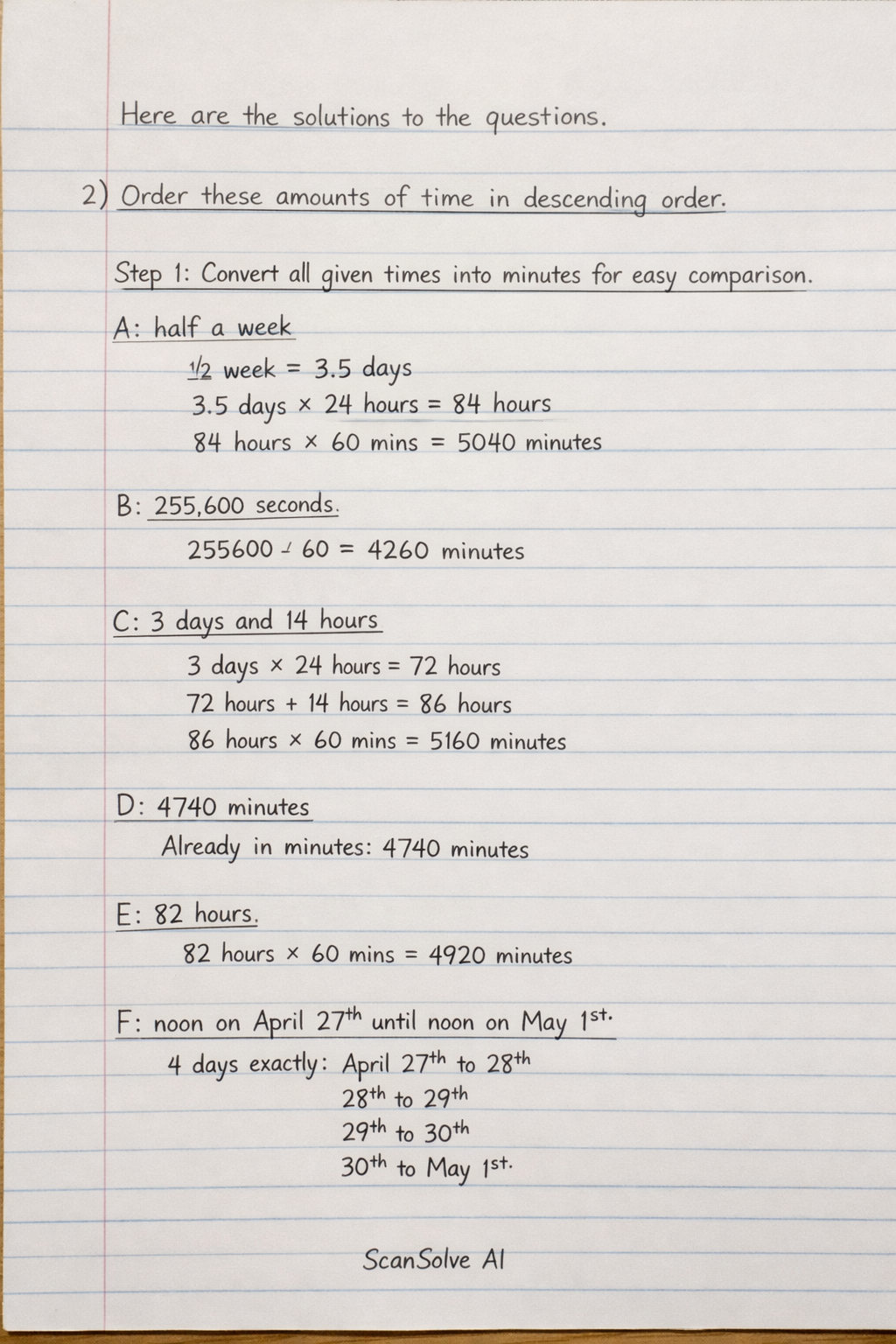
5 stepsHere are the solutions to the questions.
2) Order these amounts of time in descending order.
Step 1: Convert all given times into minutes for easy comparison.
- A: half a week
- B: 255 600 seconds
- C: 3 days and 14 hours
- D: 4740 minutes Already in minutes:
- E: 82 hours
- F: noon on April 27th until noon on May 1st This period is exactly 4 days (April 27th to 28th, 28th to 29th, 29th to 30th, 30th to May 1st).
Step 2: List the times in minutes and order them in descending order (longest to shortest).
- F: 5760 minutes
- C: 5160 minutes
- A: 5040 minutes
- E: 4920 minutes
- D: 4740 minutes
- B: 4260 minutes
The descending order is:
3) Felix uses a maths learning app daily and has an impressive daily streak.
Part a· 3 steps
What is his daily streak if he has used it every day for exactly 3 years and one of those years was a leap year?
Calculate the number of days for the normal years.
There are 3 years in total, and one was a leap year, so there are normal years.
Calculate the number of days for the leap year.
Calculate the total daily streak.
His daily streak is .
Part b
If he continues to use it every day for another 2 months, starting on 1st January until the end of February, what will his new daily streak be?
Determine the number of additional days for January and February.
January has 31 days.
February has 28 days (assuming it is not a leap year for this additional period, as no specific information is provided).Add the additional days to the streak from part 3a.
His new daily streak will be .
Try one yourself
A new problem that tests the same skill.
Still stuck on this one?
Ask a follow-up, and the answer starts from this question.
More Mathematics Questions
Handwritten Step-by-Step Solution
Get this as a handwritten image on WhatsApp — like a tutor wrote it for you.
Try on WhatsApp