
We read your photo as:
Write out the terms using the binomial theorem.
Mathematics
ScanSolve AI Answer
Answer
Step-by-step solution
4 stepsTo express , we use the binomial theorem, which states that .
Here, , , and .
Write out the terms using the binomial theorem.
The expansion will have terms:
Calculate the binomial coefficients .
Expand each term.
- For :
- For :
- For :
- For :
- For :
Combine all the terms.
The expanded expression is:
Was this helpful?
Try one yourself
A new problem that tests the same skill.
Still stuck on this one?
Ask a follow-up, and the answer starts from this question.
Got a different question?Ask your own question
More Mathematics Questions
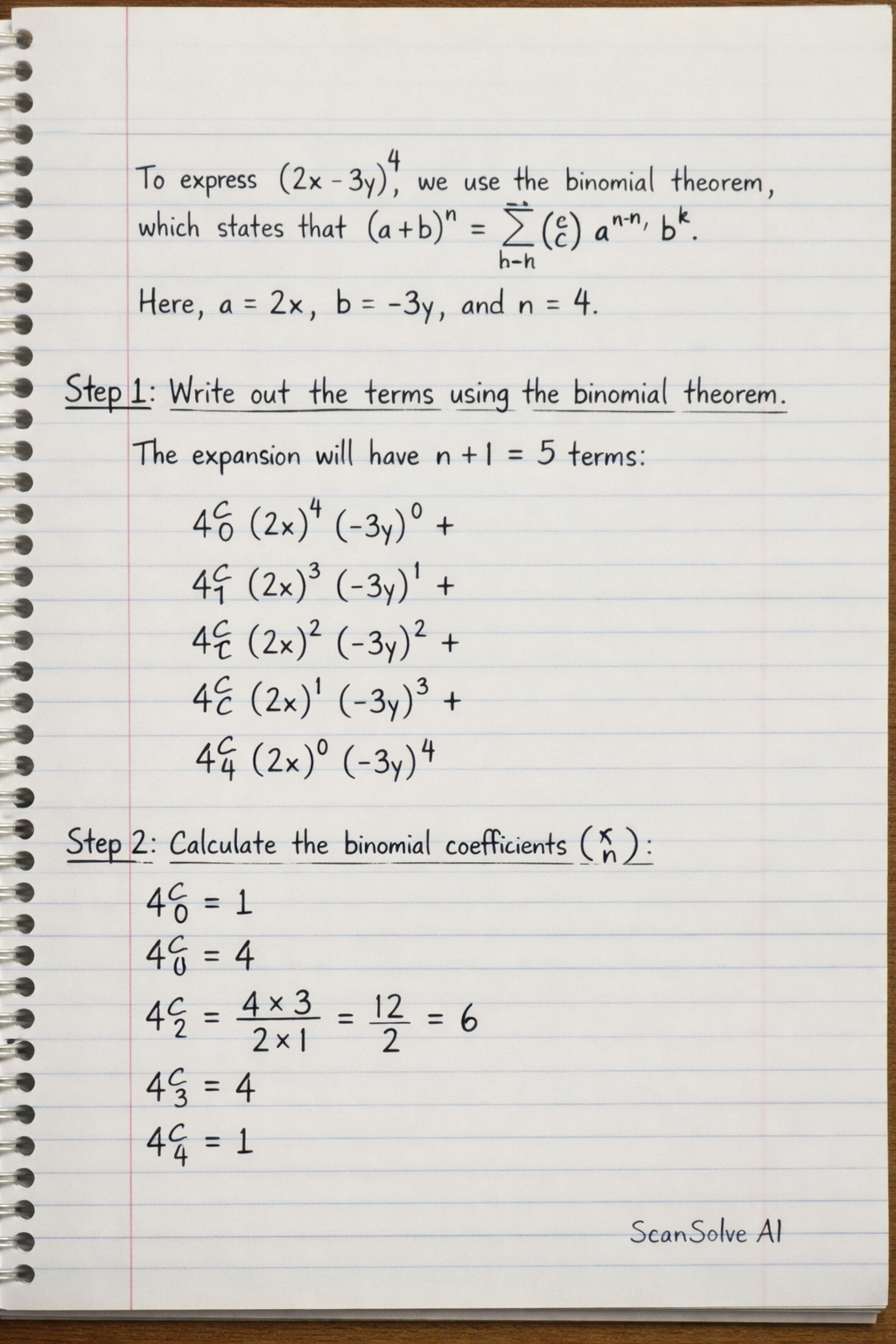
Handwritten Step-by-Step Solution
Get this as a handwritten image on WhatsApp — like a tutor wrote it for you.
Try on WhatsApp