We read your photo as:

Parmi les fonctions ci-dessous, indique celles qui sont dérivables à gauche en x₀ ou dérivables à droite en x₀.

Mathematics

ScanSolve AI Answer

Step-by-step solution

9 steps

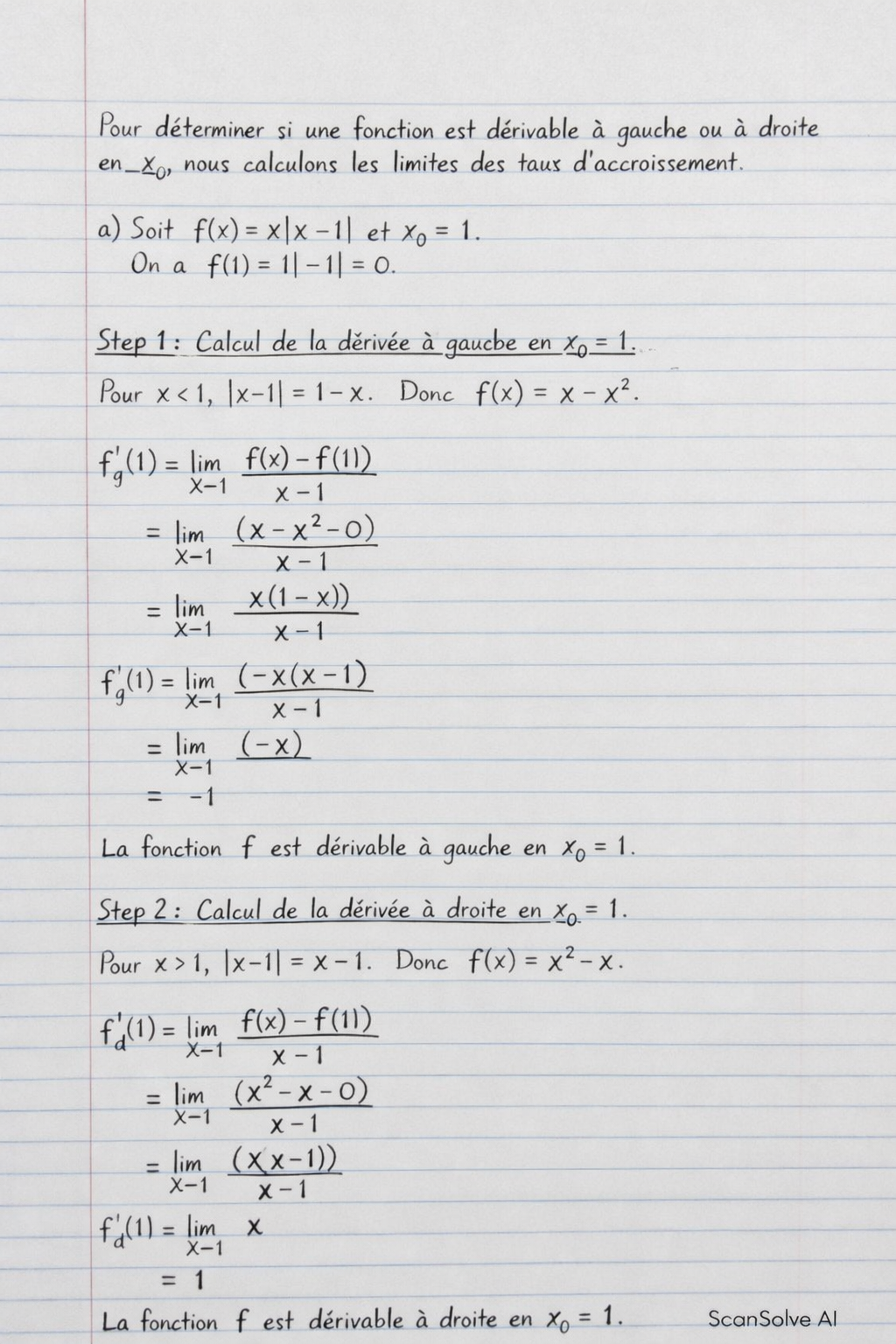
Pour déterminer si une fonction est dérivable à gauche ou à droite en x0x_0, nous calculons les limites des taux d'accroissement.

Part a· 3 steps

Soit f(x)=x∣x−1∣f(x) = x|x - 1| et x0=1x_0 = 1.

On a f(1)=1∣1−1∣=0f(1) = 1|1 - 1| = 0.

  1. Calcul de la dérivée à gauche en x0=1x_0 = 1.

    Pour x<1x < 1, ∣x−1∣=−(x−1)=1−x|x - 1| = -(x - 1) = 1 - x. Donc f(x)=x(1−x)=x−x2f(x) = x(1 - x) = x - x^2.

    fg′(1)=lim⁡x→1−f(x)−f(1)x−1=lim⁡x→1−(x−x2)−0x−1=lim⁡x→1−x(1−x)x−1f'_g(1) = \lim_{x \to 1^-} \frac{f(x) - f(1)}{x - 1} = \lim_{x \to 1^-} \frac{(x - x^2) - 0}{x - 1} = \lim_{x \to 1^-} \frac{x(1 - x)}{x - 1} fg′(1)=lim⁡x→1−−x(x−1)x−1=lim⁡x→1−(−x)=−1f'_g(1) = \lim_{x \to 1^-} \frac{-x(x - 1)}{x - 1} = \lim_{x \to 1^-} (-x) = -1

    La fonction ff est dérivable à gauche en x0=1x_0 = 1.

  2. Calcul de la dérivée à droite en x0=1x_0 = 1.

    Pour x>1x > 1, ∣x−1∣=x−1|x - 1| = x - 1. Donc f(x)=x(x−1)=x2−xf(x) = x(x - 1) = x^2 - x.

    fd′(1)=lim⁡x→1+f(x)−f(1)x−1=lim⁡x→1+(x2−x)−0x−1=lim⁡x→1+x(x−1)x−1f'_d(1) = \lim_{x \to 1^+} \frac{f(x) - f(1)}{x - 1} = \lim_{x \to 1^+} \frac{(x^2 - x) - 0}{x - 1} = \lim_{x \to 1^+} \frac{x(x - 1)}{x - 1} fd′(1)=lim⁡x→1+x=1f'_d(1) = \lim_{x \to 1^+} x = 1

    La fonction ff est dérivable à droite en x0=1x_0 = 1.

  3. Conclusion pour a).

    Puisque fg′(1)=−1f'_g(1) = -1 et fd′(1)=1f'_d(1) = 1, la fonction ff est dérivable à gauche et à droite en x0=1x_0 = 1.
    Réponse: La fonction f(x)=x∣x−1∣f(x) = x|x - 1| est dérivable à gauche et à droite en x0=1x_0 = 1.

Part b· 3 steps

Soit f(x)=∣x∣+1x−2f(x) = \frac{|x| + 1}{x - 2} et x0=0x_0 = 0.

On a f(0)=∣0∣+10−2=1−2=−12f(0) = \frac{|0| + 1}{0 - 2} = \frac{1}{-2} = -\frac{1}{2}.

  1. Calcul de la dérivée à gauche en x0=0x_0 = 0.

    Pour x<0x < 0, ∣x∣=−x|x| = -x. Donc f(x)=−x+1x−2f(x) = \frac{-x + 1}{x - 2}.

    fg′(0)=lim⁡x→0−f(x)−f(0)x−0=lim⁡x→0−−x+1x−2−(−12)xf'_g(0) = \lim_{x \to 0^-} \frac{f(x) - f(0)}{x - 0} = \lim_{x \to 0^-} \frac{\frac{-x + 1}{x - 2} - (-\frac{1}{2})}{x} fg′(0)=lim⁡x→0−2(−x+1)+(x−2)2(x−2)x=lim⁡x→0−−2x+2+x−22x(x−2)f'_g(0) = \lim_{x \to 0^-} \frac{\frac{2(-x + 1) + (x - 2)}{2(x - 2)}}{x} = \lim_{x \to 0^-} \frac{-2x + 2 + x - 2}{2x(x - 2)} fg′(0)=lim⁡x→0−−x2x(x−2)=lim⁡x→0−−12(x−2)=−12(0−2)=−1−4=14f'_g(0) = \lim_{x \to 0^-} \frac{-x}{2x(x - 2)} = \lim_{x \to 0^-} \frac{-1}{2(x - 2)} = \frac{-1}{2(0 - 2)} = \frac{-1}{-4} = \frac{1}{4}

    La fonction ff est dérivable à gauche en x0=0x_0 = 0.

  2. Calcul de la dérivée à droite en x0=0x_0 = 0.

    Pour x>0x > 0, ∣x∣=x|x| = x. Donc f(x)=x+1x−2f(x) = \frac{x + 1}{x - 2}.

    fd′(0)=lim⁡x→0+f(x)−f(0)x−0=lim⁡x→0+x+1x−2−(−12)xf'_d(0) = \lim_{x \to 0^+} \frac{f(x) - f(0)}{x - 0} = \lim_{x \to 0^+} \frac{\frac{x + 1}{x - 2} - (-\frac{1}{2})}{x} fd′(0)=lim⁡x→0+2(x+1)+(x−2)2(x−2)x=lim⁡x→0+2x+2+x−22x(x−2)f'_d(0) = \lim_{x \to 0^+} \frac{\frac{2(x + 1) + (x - 2)}{2(x - 2)}}{x} = \lim_{x \to 0^+} \frac{2x + 2 + x - 2}{2x(x - 2)} fd′(0)=lim⁡x→0+3x2x(x−2)=lim⁡x→0+32(x−2)=32(0−2)=3−4=−34f'_d(0) = \lim_{x \to 0^+} \frac{3x}{2x(x - 2)} = \lim_{x \to 0^+} \frac{3}{2(x - 2)} = \frac{3}{2(0 - 2)} = \frac{3}{-4} = -\frac{3}{4}

    La fonction ff est dérivable à droite en x0=0x_0 = 0.

  3. Conclusion pour b).

    Puisque fg′(0)=14f'_g(0) = \frac{1}{4} et fd′(0)=−34f'_d(0) = -\frac{3}{4}, la fonction ff est dérivable à gauche et à droite en x0=0x_0 = 0.
    Réponse: La fonction f(x)=∣x∣+1x−2f(x) = \frac{|x| + 1}{x - 2} est dérivable à gauche et à droite en x0=0x_0 = 0.

Part c· 3 steps

Soit f(x)={−x2+x+1si x∈]−∞;1]2−xsi x∈[1;+∞[f(x) = \begin{cases} -x^2 + x + 1 & \text{si } x \in ]-\infty ; 1] \\ 2 - x & \text{si } x \in [1 ; +\infty[ \end{cases} et x0=1x_0 = 1.

On a f(1)=−12+1+1=1f(1) = -1^2 + 1 + 1 = 1.

  1. Calcul de la dérivée à gauche en x0=1x_0 = 1.

    Pour x<1x < 1, f(x)=−x2+x+1f(x) = -x^2 + x + 1.

    fg′(1)=lim⁡x→1−f(x)−f(1)x−1=lim⁡x→1−(−x2+x+1)−1x−1f'_g(1) = \lim_{x \to 1^-} \frac{f(x) - f(1)}{x - 1} = \lim_{x \to 1^-} \frac{(-x^2 + x + 1) - 1}{x - 1} fg′(1)=lim⁡x→1−−x2+xx−1=lim⁡x→1−−x(x−1)x−1=lim⁡x→1−(−x)=−1f'_g(1) = \lim_{x \to 1^-} \frac{-x^2 + x}{x - 1} = \lim_{x \to 1^-} \frac{-x(x - 1)}{x - 1} = \lim_{x \to 1^-} (-x) = -1

    La fonction ff est dérivable à gauche en x0=1x_0 = 1.

  2. Calcul de la dérivée à droite en x0=1x_0 = 1.

    Pour x>1x > 1, f(x)=2−xf(x) = 2 - x.

    fd′(1)=lim⁡x→1+f(x)−f(1)x−1=lim⁡x→1+(2−x)−1x−1f'_d(1) = \lim_{x \to 1^+} \frac{f(x) - f(1)}{x - 1} = \lim_{x \to 1^+} \frac{(2 - x) - 1}{x - 1} fd′(1)=lim⁡x→1+1−xx−1=lim⁡x→1+−(x−1)x−1=lim⁡x→1+(−1)=−1f'_d(1) = \lim_{x \to 1^+} \frac{1 - x}{x - 1} = \lim_{x \to 1^+} \frac{-(x - 1)}{x - 1} = \lim_{x \to 1^+} (-1) = -1

    La fonction ff est dérivable à droite en x0=1x_0 = 1.

  3. Conclusion pour c).

    Puisque fg′(1)=−1f'_g(1) = -1 et fd′(1)=−1f'_d(1) = -1, la fonction ff est dérivable à gauche et à droite en x0=1x_0 = 1.
    Réponse: La fonction f(x)f(x) définie par morceaux est dérivable à gauche et à droite en x0=1x_0 = 1.

    En résumé, les trois fonctions sont dérivables à gauche et à droite en leurs points x0x_0 respectifs.

Was this helpful?

Still stuck on this one?

Ask a follow-up, and the answer starts from this question.
Got a different question?Ask your own question
Handwritten step-by-step solution preview

Handwritten Step-by-Step Solution

Get this as a handwritten image on WhatsApp — like a tutor wrote it for you.

Try on WhatsApp