
We read your photo as:
Patrick deposited an amount of R18 500 into an account earning r% interest p.a., compounded monthly. After 6 months, his balance was R19 319,48. 6.1.1 Calculate the value of r. 6.1.2 Calculate the effective interest rate.
ScanSolve AI Answer
Step-by-step solution
16 stepsHere are the solutions to the questions:
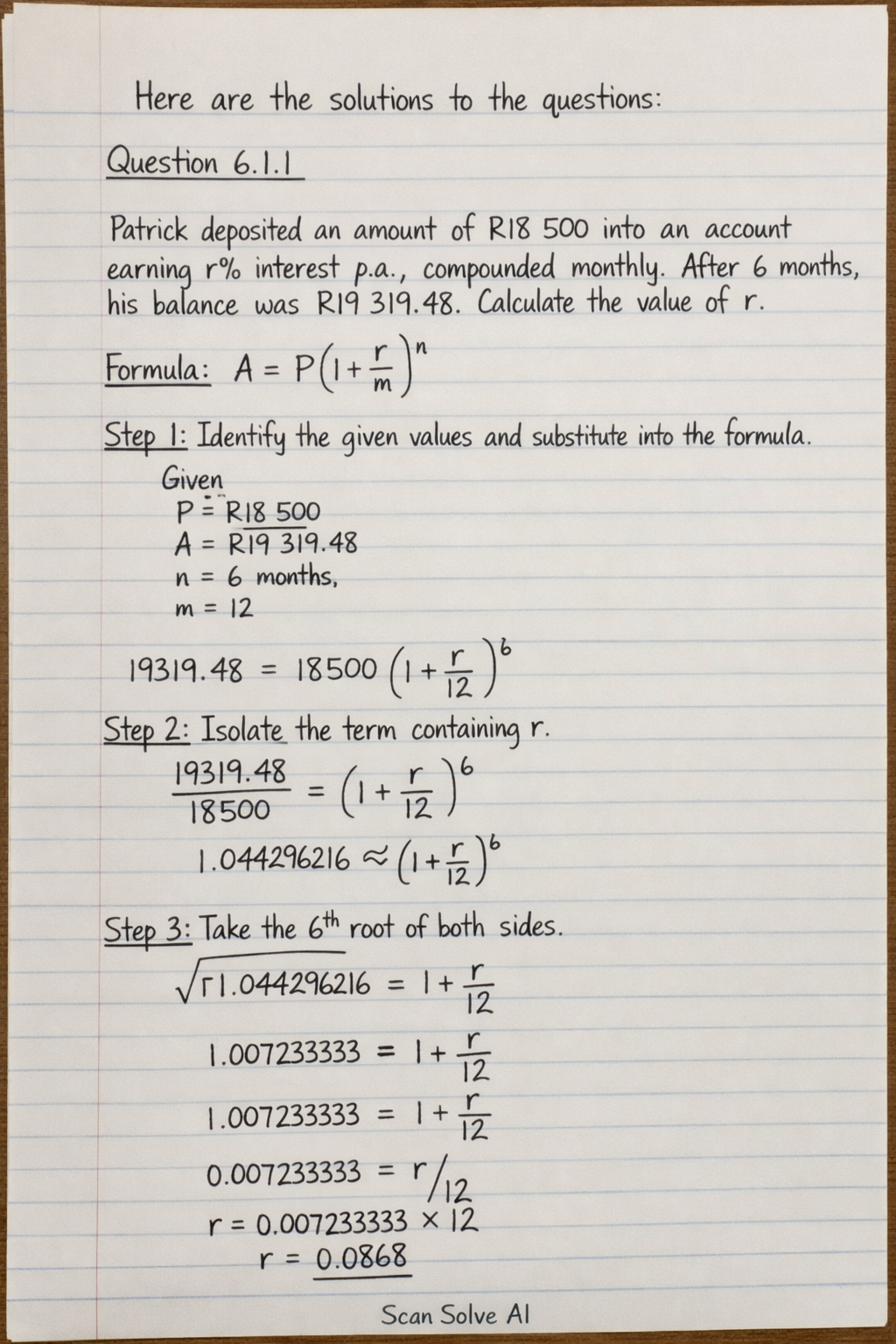
Question 6.1.1
Patrick deposited an amount of R18 500 into an account earning interest p.a., compounded monthly. After 6 months, his balance was R19 319.48. Calculate the value of .
The formula for compound interest is , where is the future value, is the principal, is the annual interest rate, is the number of compounding periods per year, and is the total number of compounding periods.
Identify the given values and substitute them into the formula.
Given: , , months, (compounded monthly).
Isolate the term containing .
Take the 6th root of both sides.
Solve for .
To express as a percentage:
Question 6.1.2
Calculate the effective interest rate.
The formula for the effective interest rate is , where is the nominal annual interest rate and is the number of compounding periods per year.
Substitute the nominal interest rate () and compounding frequency () into the formula.
Calculate the effective interest rate.
To express as a percentage:
Question 6.2.1
The value of the old laptop depreciates annually at a rate of 20% p.a. according to the straight-line method. After how many years will the laptop have a value of R0?
The formula for straight-line depreciation is , where is the future value, is the present value, is the annual depreciation rate, and is the number of years.
Identify the given values and substitute them into the formula.
Given: , , .
Solve for .
The laptop will have a value of R0 after:
Question 6.2.2
Kuda will buy a laptop that costs R20 000. In order to cover the cost price, he made his first monthly deposit into a savings account on 28 February 2019. He will make his 60th monthly deposit on 31 January 2024. The savings account pays interest at 8.7% p.a., compounded monthly. Calculate Kuda's monthly deposit into this account.
This is a future value of an ordinary annuity problem. The formula is , where is the future value, is the monthly deposit, is the monthly interest rate, and is the number of deposits.
Identify the given values and calculate the monthly interest rate.
Given: , annual interest rate , deposits.
Substitute the known values into the future value of an annuity formula.
Calculate the annuity factor.
Solve for .
Kuda's monthly deposit is:
Question 6.3
Tino wins a jackpot of R1 600 000. He invests all of his winnings in a fund that earns interest of 11.2% p.a., compounded monthly. He withdraws R20 000 from the fund at the end of each month. His first withdrawal is exactly 1 month after his initial investment. How many withdrawals of R20 000 will Tino be able to make from this fund?
This is a present value of an ordinary annuity problem. The formula is , where is the present value, is the withdrawal amount, is the monthly interest rate, and is the number of withdrawals.
Identify the given values and calculate the monthly interest rate.
Given: , , annual interest rate .
Substitute the known values into the present value of an annuity formula.
Isolate the term containing .
Use logarithms to solve for .
Since Tino can only make full withdrawals, we round down to the nearest whole number.
Tino will be able to make:
Still stuck on this one?
Ask a follow-up, and the answer starts from this question.
More Mathematics Questions
Handwritten Step-by-Step Solution
Get this as a handwritten image on WhatsApp — like a tutor wrote it for you.
Try on WhatsApp