
We read your photo as:
Find the perimeter of an equilateral triangle.
ScanSolve AI Answer
Step-by-step solution
4 stepsFind the perimeter of an equilateral triangle.
An equilateral triangle has 3 equal sides. If each side is denoted by , the perimeter is the sum of the lengths of its three sides.
The rule for the perimeter of an equilateral triangle is .
Find the perimeter of a rhombus.
A rhombus has 4 equal sides. If each side is denoted by , the perimeter is the sum of the lengths of its four sides.
The perimeter of a rhombus is .
Find the perimeter of a regular pentagon.
A regular pentagon has 5 equal sides. If each side is denoted by , the perimeter is the sum of the lengths of its five sides.
The perimeter of a regular pentagon is .
Express the associativity of multiplication using variables and .
The associative property of multiplication states that when multiplying three or more numbers, the way the numbers are grouped does not affect the product.
Using variables and :The general way to express the associativity of multiplication is .
Still stuck on this one?
Ask a follow-up, and the answer starts from this question.
More Mathematics Questions
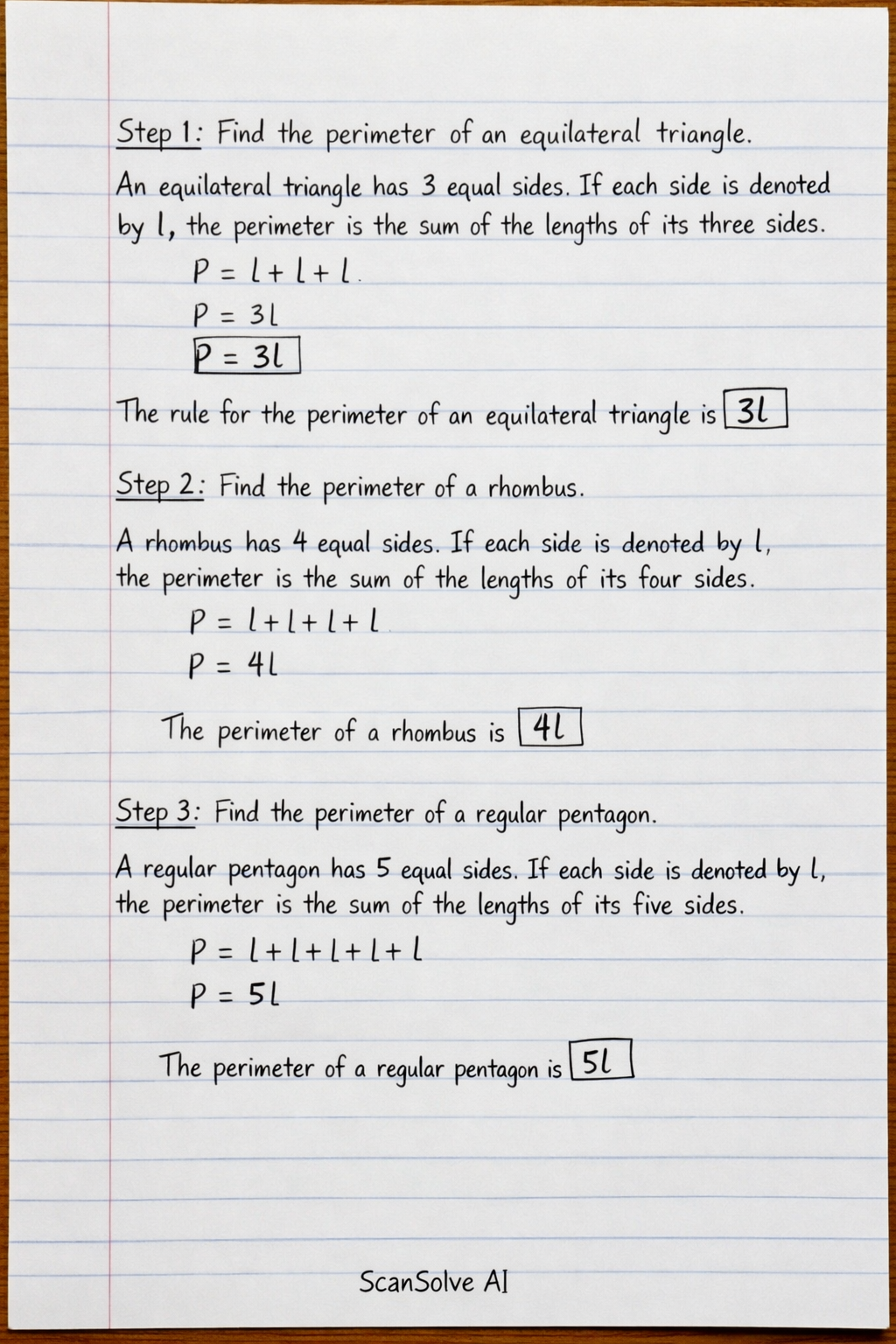
Handwritten Step-by-Step Solution
Get this as a handwritten image on WhatsApp — like a tutor wrote it for you.
Try on WhatsApp