
We read your photo as:
Permutation and Combination: In how many ways can the letters of the word "BUSINESS" be arranged?
ScanSolve AI Answer
Answer
6720
Step-by-step solution
26 stepsHere are the solutions to the permutation, combination, and probability questions:
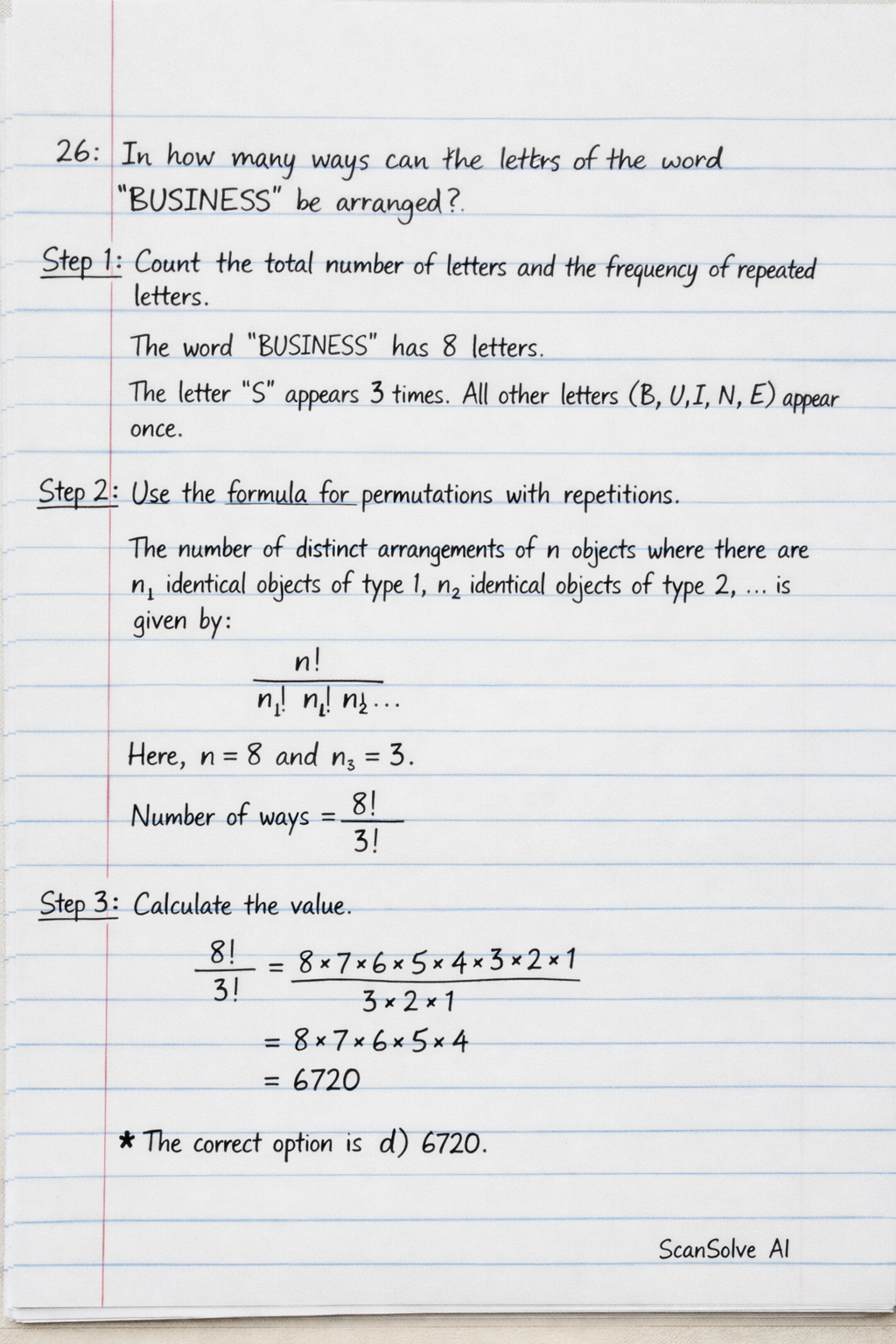
26. In how many ways can the letters of the word "BUSINESS" be arranged?
Count the total number of letters and the frequency of repeated letters.
The word "BUSINESS" has 8 letters.
The letter 'S' appears 3 times. All other letters (B, U, I, N, E) appear once.Use the formula for permutations with repetitions.
The number of distinct arrangements of objects where there are identical objects of type 1, identical objects of type 2, ..., is given by .
Here, and .Calculate the value.
- The correct option is d) 6720.
27. A committee of 4 members is to be formed from a group of 10 people. In how many ways can this be done?
Identify this as a combination problem, as the order of members in a committee does not matter.
We need to choose 4 members from 10.
Use the combination formula .
Here, (total people) and (members to choose).
Calculate the value.
- The correct option is a) 210.
28. How many 3-digit numbers can be formed using the digits 1, 2, 3, and 4 without repetition?
Identify this as a permutation problem, as the order of digits matters for forming different numbers.
We have 4 distinct digits (1, 2, 3, 4) and we need to choose and arrange 3 of them.
Use the permutation formula .
Here, (total digits) and (digits for the number).
Calculate the value.
- The correct option is b) 24.
29. In how many ways can 5 books be arranged on a shelf?
Identify this as a permutation problem, as the order of books on a shelf matters.
We have 5 distinct books to arrange.
The number of ways to arrange distinct items is .
Here, .
Calculate the value.
- The correct option is c) 120.
30. A pizza place offers 5 toppings. If a customer can choose any number of toppings, including none, how many different choices are possible?
For each topping, there are two independent choices
either select it or not select it.
If there are items and for each item there are 2 choices, the total number of combinations is .
Here, (number of toppings).
Calculate the value.
- The correct option is d) 32.
31. In how many ways can 3 different books be arranged on a bookshelf?
Identify this as a permutation problem, as the order of books on a shelf matters.
We have 3 distinct books to arrange.
The number of ways to arrange distinct items is .
Here, .
Calculate the value.
- The correct option is b) 6.
32. How many different 4-letter codes can be formed using letters A, B, C, and D if repetition is allowed?
For each position in the 4-letter code, there are 4 possible letters (A, B, C, D).
Repetition is allowed.
Since there are 4 positions and 4 choices for each position, the total number of codes is .
Calculate the value.
- The correct option is d) 256.
33. A box contains 6 red balls, 4 blue balls, and 3 green balls. If two balls are drawn randomly, without replacement, what is the probability that both balls are blue?
Determine the total number of balls and the number of blue balls.
Total balls = balls.
Number of blue balls = 4.Calculate the probability of drawing the first blue ball.
Calculate the probability of drawing the second blue ball, given the first was blue and not replaced.
After drawing one blue ball, there are 3 blue balls left and a total of 12 balls remaining.
Multiply the probabilities to find the probability of both events occurring.
Simplify the result.
- The correct option is e) None of the above. (The calculated probability is , which is not among options a, b, c, d).
Try one yourself
A new problem that tests the same skill.
Still stuck on this one?
Ask a follow-up, and the answer starts from this question.
More Mathematics Questions
Handwritten Step-by-Step Solution
Get this as a handwritten image on WhatsApp — like a tutor wrote it for you.
Try on WhatsApp