
This mathematics problem involves applying core mathematical principles and formulas. Below you will find a complete step-by-step solution with detailed explanations for each step, helping you understand not just the answer but the method behind it.
ScanSolve AI Answer
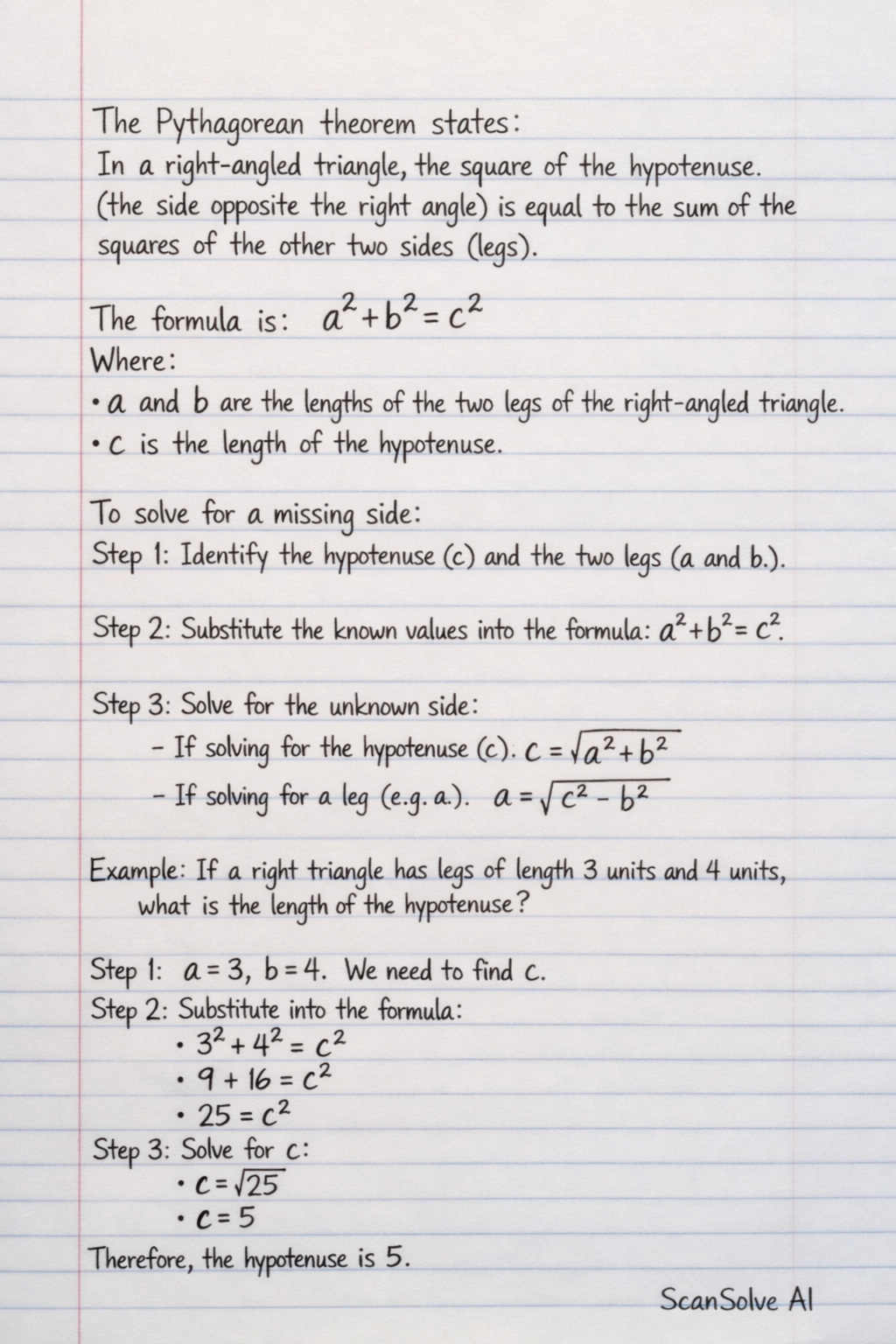
The Pythagorean theorem states that in a right-angled triangle, the square of the hypotenuse (the side opposite the right angle) is equal to the sum of the squares of the other two sides (legs). The formula is: a^2 + b^2 = c^2 Where: a and b are the lengths of the two legs of the right-angled triangle. c is the length of the hypotenuse. To solve for a missing side: Step 1: Identify the hypotenuse (c) and the two legs (a and b). The hypotenuse is always the longest side and is opposite the right angle. Step 2: Substitute the known values into the formula a^2 + b^2 = c^2. Step 3: Solve for the unknown side. If you are solving for the hypotenuse (c), calculate a^2 + b^2 and then take the square root of the result: c = sqrt(a^2 + b^2). If you are solving for a leg (e.g., a), rearrange the formula: a^2 = c^2 - b^2, and then take the square root: a = sqrt(c^2 - b^2). Example: If a right triangle has legs of length 3 units and 4 units, what is the length of the hypotenuse? Step 1: a = 3, b = 4. We need to find c. Step 2: Substitute into the formula: 3^2 + 4^2 = c^2. Step 3: Calculate: 9 + 16 = c^2. 25 = c^2 c = sqrt(25) c = 5 The hypotenuse is 5 units long. Send me the next one 📸