This mathematics problem involves applying core mathematical principles and formulas. Below you will find a complete step-by-step solution with detailed explanations for each step, helping you understand not just the answer but the method behind it.
ScanSolve AI Answer
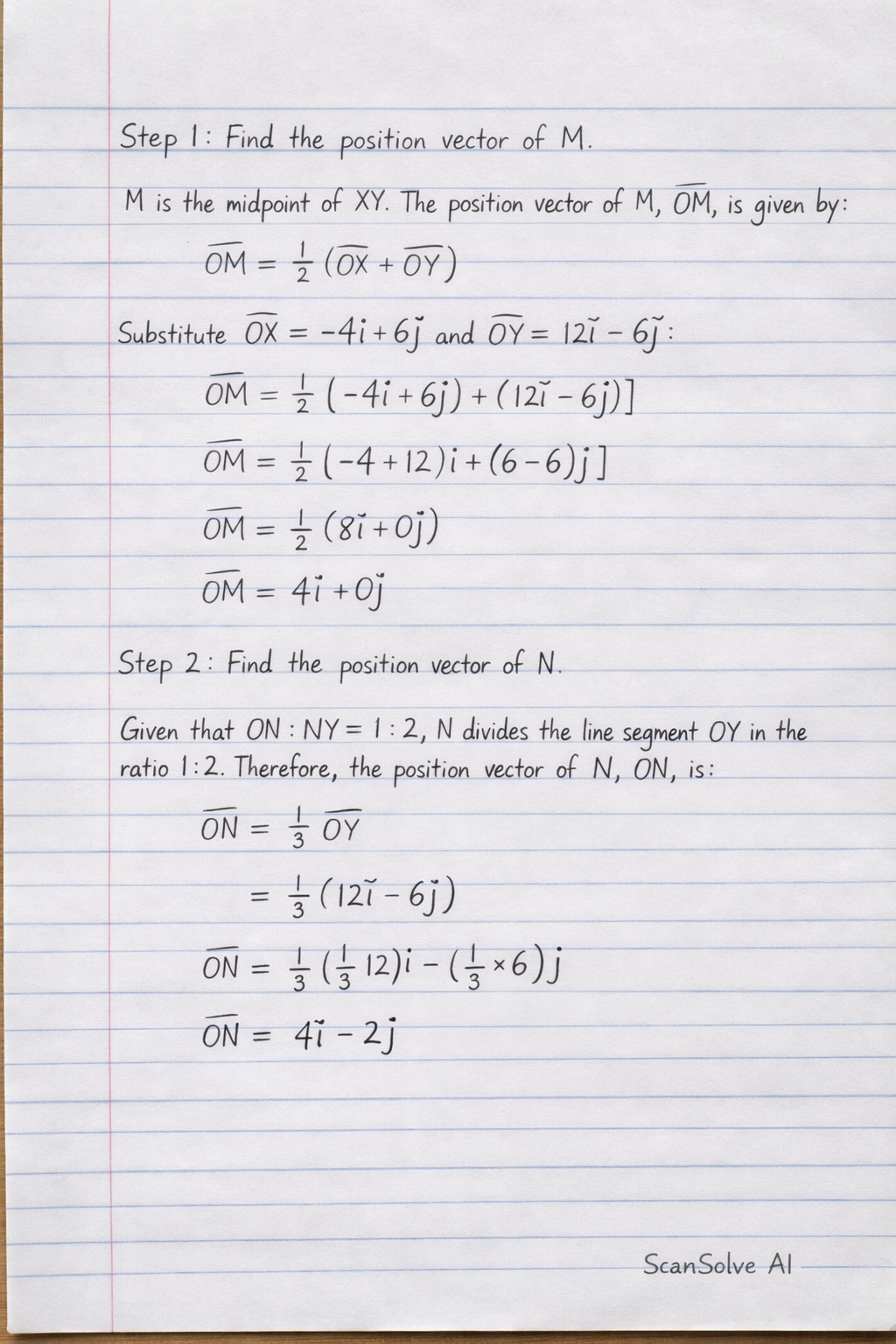
Step 1: Find the position vector of M.
M is the midpoint of XY. The position vector of M, $\vec{OM}$, is given by:
$$ \vec{OM} = \frac{1}{2}(\vec{OX} + \vec{OY}) $$
Substitute the given vectors $\vec{OX} = -4\vec{i} + 6\vec{j}$ and $\vec{OY} = 12\vec{i} - 6\vec{j}$:
$$ \vec{OM} = \frac{1}{2}((-4\vec{i} + 6\vec{j}) + (12\vec{i} - 6\vec{j})) $$
$$ \vec{OM} = \frac{1}{2}((-4+12)\vec{i} + (6-6)\vec{j}) $$
$$ \vec{OM} = \frac{1}{2}(8\vec{i} + 0\vec{j}) $$
$$ \vec{OM} = 4\vec{i} + 0\vec{j} $$
Step 2: Find the position vector of N.
Given that ON:NY = 1:2, N divides the line segment OY in the ratio 1:2. Therefore, the position vector of N, $\vec{ON}$, is:
$$ \vec{ON} = \frac{1}{1+2}\vec{OY} = \frac{1}{3}\vec{OY} $$
Substitute $\vec{OY} = 12\vec{i} - 6\vec{j}$:
$$ \vec{ON} = \frac{1}{3}(12\vec{i} - 6\vec{j}) $$
$$ \vec{ON} = (\frac{1}{3} \times 12)\vec{i} - (\frac{1}{3} \times 6)\vec{j} $$
$$ \vec{ON} = 4\vec{i} - 2\vec{j} $$
Step 3: Find the vector $\vec{NM}$.
The vector $\vec{NM}$ is found by subtracting the position vector of N from the position vector of M:
$$ \vec{NM} = \vec{OM} - \vec{ON} $$
Substitute the calculated $\vec{OM}$ and $\vec{ON}$:
$$ \vec{NM} = (4\vec{i} + 0\vec{j}) - (4\vec{i} - 2\vec{j}) $$
$$ \vec{NM} = (4-4)\vec{i} + (0 - (-2))\vec{j} $$
$$ \vec{NM} = 0\vec{i} + 2\vec{j} $$
Step 4: Calculate the magnitude of $\vec{NM}$.
The magnitude of a vector $a\vec{i} + b\vec{j}$ is given by $\sqrt{a^2 + b^2}$.
$$ |\vec{NM}| = \sqrt{0^2 + 2^2} $$
$$ |\vec{NM}| = \sqrt{0 + 4} $$
$$ |\vec{NM}| = \sqrt{4} $$
$$ |\vec{NM}| = 2 $$
Correct to 1 decimal place, the magnitude is 2.0.
The magnitude of NM is $\boxed{\text{2.0 units}}$.
Send me the next one 📸
Find the position vector of M.
|Mathematics
Find the position vector of M.
ScanSolve AI Answer
Step 1: Find the position vector of M.
M is the midpoint of XY. The position vector of M, OM, is given by:
OM=21(OX+OY)
Substitute the given vectors OX=−4i+6j and OY=12i−6j:
OM=21((−4i+6j)+(12i−6j))OM=21((−4+12)i+(6−6)j)OM=21(8i+0j)OM=4i+0j
Step 2: Find the position vector of N.
Given that ON:NY = 1:2, N divides the line segment OY in the ratio 1:2. Therefore, the position vector of N, ON, is:
ON=1+21OY=31OY
Substitute OY=12i−6j:
ON=31(12i−6j)ON=(31×12)i−(31×6)jON=4i−2j
Step 3: Find the vector NM.
The vector NM is found by subtracting the position vector of N from the position vector of M:
NM=OM−ON
Substitute the calculated OM and ON:
NM=(4i+0j)−(4i−2j)NM=(4−4)i+(0−(−2))jNM=0i+2j
Step 4: Calculate the magnitude of NM.
The magnitude of a vector ai+bj is given by a2+b2.
∣NM∣=02+22∣NM∣=0+4∣NM∣=4∣NM∣=2
Correct to 1 decimal place, the magnitude is 2.0.
The magnitude of NM is 2.0units.
Send me the next one 📸
Need help with your own homework?
Get instant step-by-step solutions to any question. Free to start.