
Proof that (cos3x-sin3x)/(1−2sin2x) =cosx+sinx
Mathematics
ScanSolve AI Answer
Answer
Step-by-step solution
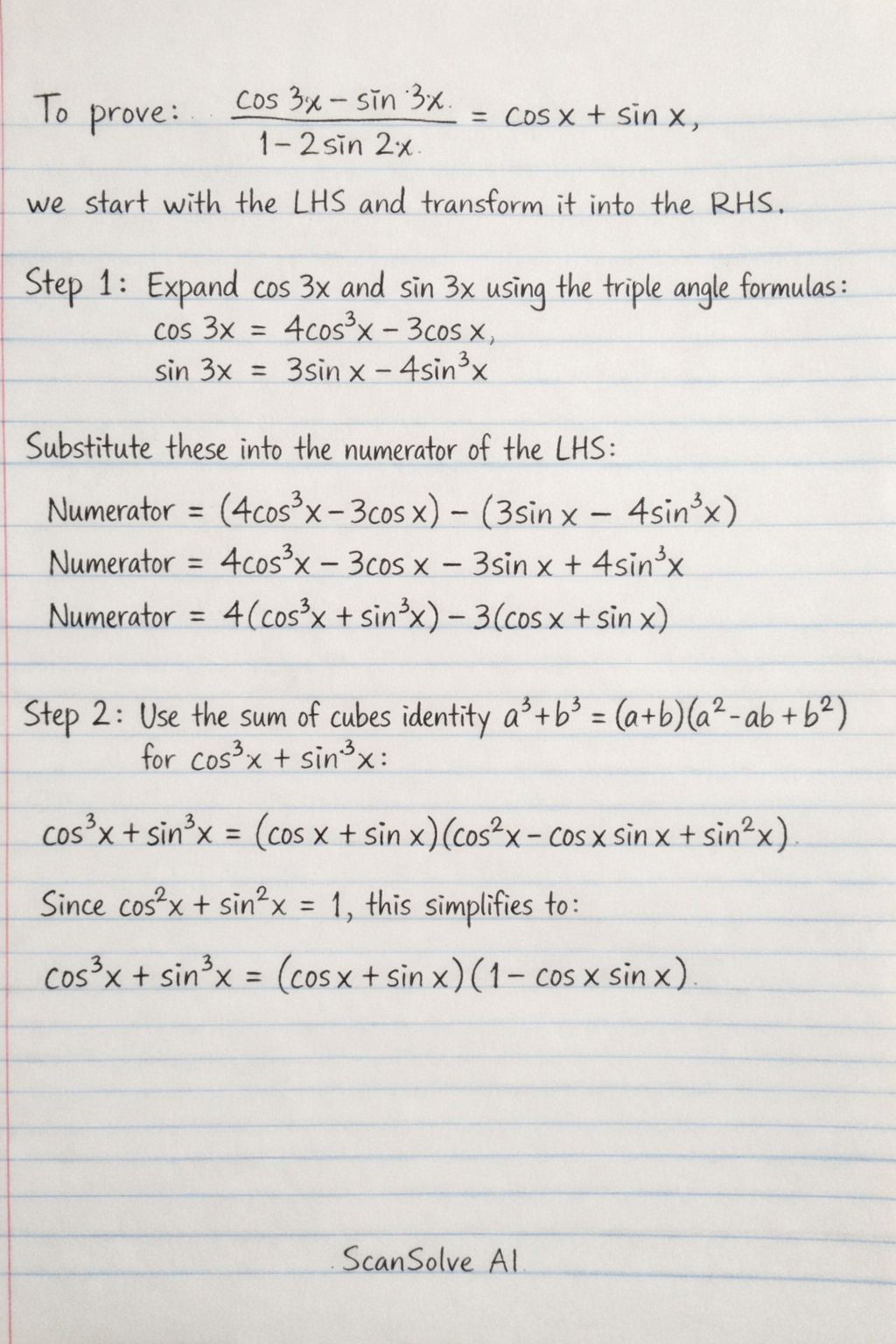
5 stepsTo prove the identity , we will start with the left-hand side (LHS) and transform it into the right-hand side (RHS) using trigonometric identities.
Expand and using the triple angle formulas
Substitute these into the numerator of the LHS:
Use the sum of cubes identity for .
Since , this simplifies to:
Substitute this back into the numerator expression from Step 1.
Factor out :
Simplify the denominator of the LHS using the double angle formula .
Combine the simplified numerator and denominator.
Assuming , we can cancel the common term in the numerator and denominator.
This matches the RHS.
Thus, the identity is proven.
Was this helpful?
Try one yourself
A new problem that tests the same skill.
Still stuck on this one?
Ask a follow-up, and the answer starts from this question.
Got a different question?Ask your own question
More Mathematics Questions
QProve the identity: sin 2x / 2 cos2 x + sin x / tan x [1 + cos(90 − x)] = 1 / cos xQ(g.) prove that sin2x - cos2x = −1QProve that cos 7x + cos 5x / cos 7x - cos 5x = cot x Prove that sin 2x / sin 2 x + cos 2 x = 2 sin xQProve that cos³θ.sin3θ + sin³θ.cos3θ = 3/4 sin4θQProve the trigonometric identity: sin(3θ)/sin θ - cos(3θ)/cos θ = 2
Handwritten Step-by-Step Solution
Get this as a handwritten image on WhatsApp — like a tutor wrote it for you.
Try on WhatsApp