Q1. If cosA = 2/5, SinB = 12/13. Find a) Cos (A + B) b) Sin (A-B) c) Sin2A Q2. a) Solve the equation 2sin2 x - sinx -1 =0
|Mathematics
Q1. If cosA = 2/5, SinB = 12/13. Find a) Cos (A + B) b) Sin (A-B) c) Sin2A Q2. a) Solve the equation 2sin2 x - sinx -1 =0
ScanSolve AI Answer
Answer
a) cos(A+B)=−6533
Here are the solutions to the structured questions:
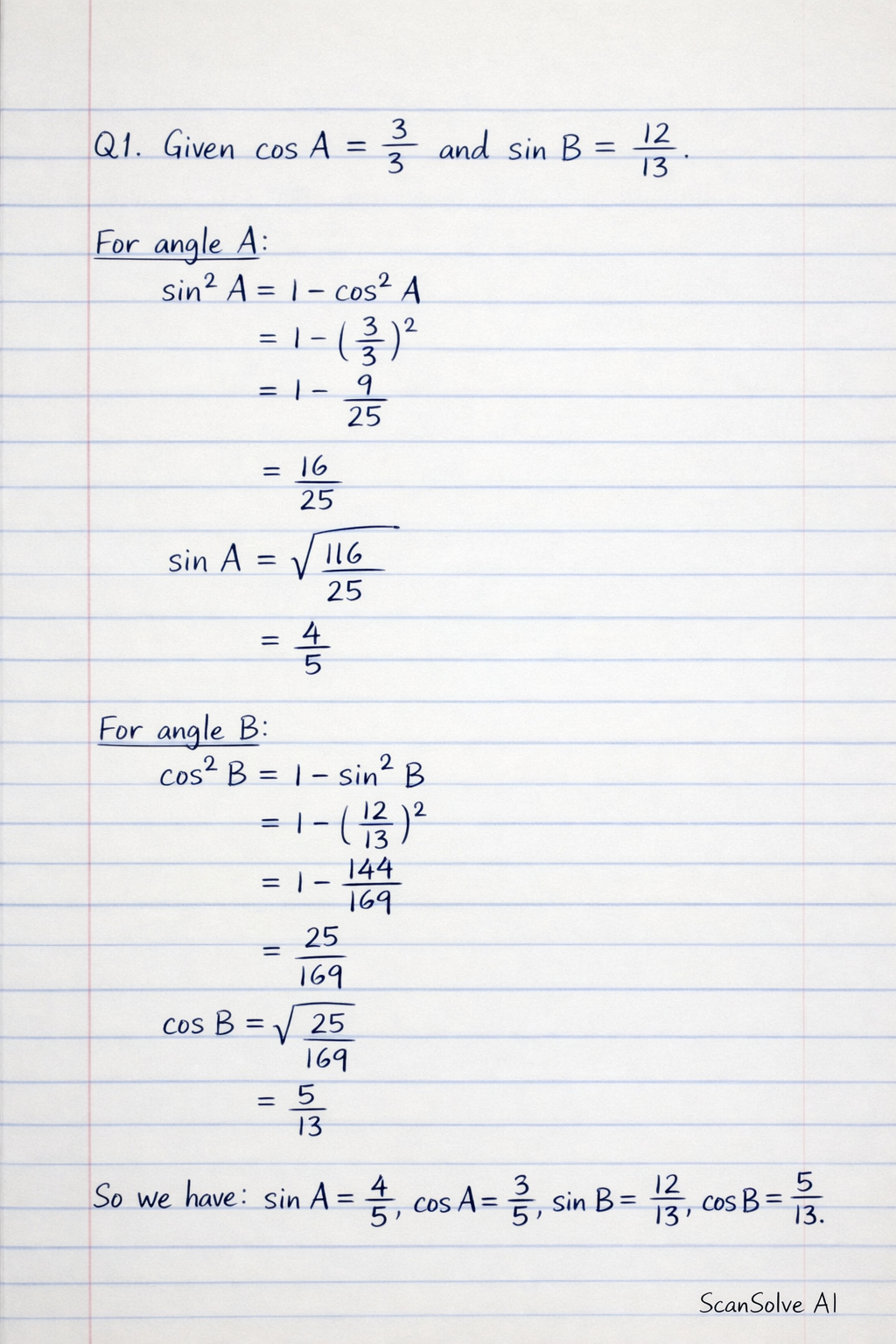
Q1. Given cosA=53 and sinB=1312.
First, we find the missing trigonometric values for angles A and B using the Pythagorean identity sin2θ+cos2θ=1. Assuming A and B are acute angles (in the first quadrant):
For angle A:
sin2A=1−cos2A=1−(53)2=1−259=2516sinA=2516=54
For angle B:
cos2B=1−sin2B=1−(1312)2=1−169144=16925cosB=16925=135
So we have: sinA=54, cosA=53, sinB=1312, cosB=135.
a) Find cos(A+B)
Step 1: Use the cosine addition formula: cos(A+B)=cosAcosB−sinAsinB.
Step 2: Substitute the known values into the formula.
cos(A+B)=(53)(135)−(54)(1312)
Step 3: Perform the multiplication and subtraction.
cos(A+B)=6515−6548=6515−48=65−33a)cos(A+B)=−6533
b) Find sin(A−B)
Step 1: Use the sine subtraction formula: sin(A−B)=sinAcosB−cosAsinB.
Step 2: Substitute the known values into the formula.
sin(A−B)=(54)(135)−(53)(1312)
Step 3: Perform the multiplication and subtraction.
sin(A−B)=6520−6536=6520−36=65−16b)sin(A−B)=−6516
c) Find sin2A
Step 1: Use the sine double angle formula: sin2A=2sinAcosA.
Step 2: Substitute the known values for sinA and cosA.
sin2A=2(54)(53)
Step 3: Perform the multiplication.
sin2A=2×2512=2524c)sin2A=2524
Q2.a) Solve the equation 2sin2x−sinx−1=0
Step 1: Let y=sinx. The equation becomes a quadratic equation in terms of y.
2y2−y−1=0
Step 2: Solve the quadratic equation for y by factoring.
(2y+1)(y−1)=0
Step 3: Set each factor to zero to find the possible values for y.
2y+1=0⟹2y=−1⟹y=−21y−1=0⟹y=1
Step 4: Substitute back y=sinx and find the values of x in the range 0∘≤x<360∘.
For sinx=1:
The angle x where sinx=1 is 90∘.
For sinx=−21:
The reference angle for sinx=21 is 30∘. Since sinx is negative, x lies in the third and fourth quadrants.
In the third quadrant: x=180∘+30∘=210∘.
In the fourth quadrant: x=360∘−30∘=330∘.
Step 5: List all solutions for x.
x=90∘,210∘,330∘a)x=90∘,210∘,330∘
That's 2 down. 3 left today — send the next one.
Was this helpful?
Need help with your own homework?
Get instant step-by-step solutions to any question. Free to start.
This mathematics problem involves applying core mathematical principles and formulas. Below you will find a complete step-by-step solution with detailed explanations for each step, helping you understand not just the answer but the method behind it.
ScanSolve AI Answer
Here are the solutions to the structured questions: Q1. Given A = (3)/(5) and B = (12)/(13). First, we find the missing trigonometric values for angles A and B using the Pythagorean identity ^2 + ^2 = 1. Assuming A and B are acute angles (in the first quadrant): For angle A: ^2 A = 1 - ^2 A = 1 - ((3)/(5))^2 = 1 - (9)/(25) = (16)/(25) A = sqrt((16)/(25)) = (4)/(5) For angle B: ^2 B = 1 - ^2 B = 1 - ((12)/(13))^2 = 1 - (144)/(169) = (25)/(169) B = sqrt((25)/(169)) = (5)/(13) So we have: A = (4)/(5), A = (3)/(5), B = (12)/(13), B = (5)/(13). a) Find (A + B) Step 1: Use the cosine addition formula: (A + B) = A B - A B. Step 2: Substitute the known values into the formula. (A + B) = ((3)/(5))((5)/(13)) - ((4)/(5))((12)/(13)) Step 3: Perform the multiplication and subtraction. (A + B) = (15)/(65) - (48)/(65) = (15 - 48)/(65) = (-33)/(65) a) (A + B) = -(33)/(65) b) Find (A - B) Step 1: Use the sine subtraction formula: (A - B) = A B - A B. Step 2: Substitute the known values into the formula. (A - B) = ((4)/(5))((5)/(13)) - ((3)/(5))((12)/(13)) Step 3: Perform the multiplication and subtraction. (A - B) = (20)/(65) - (36)/(65) = (20 - 36)/(65) = (-16)/(65) b) (A - B) = -(16)/(65) c) Find 2A Step 1: Use the sine double angle formula: 2A = 2 A A. Step 2: Substitute the known values for A and A. 2A = 2 ((4)/(5))((3)/(5)) Step 3: Perform the multiplication. 2A = 2 × (12)/(25) = (24)/(25) c) 2A = (24)/(25) Q2. a) Solve the equation 2^2 x - x - 1 = 0 Step 1: Let y = x. The equation becomes a quadratic equation in terms of y. 2y^2 - y - 1 = 0 Step 2: Solve the quadratic equation for y by factoring. (2y + 1)(y - 1) = 0 Step 3: Set each factor to zero to find the possible values for y. 2y + 1 = 0 2y = -1 y = -(1)/(2) y - 1 = 0 y = 1 Step 4: Substitute back y = x and find the values of x in the range 0^ x < 360^. For x = 1: The angle x where x = 1 is 90^. For x = -(1)/(2): The reference angle for x = (1)/(2) is 30^. Since x is negative, x lies in the third and fourth quadrants. In the third quadrant: x = 180^ + 30^ = 210^. In the fourth quadrant: x = 360^ - 30^ = 330^. Step 5: List all solutions for x. x = 90^, 210^, 330^ a) x = 90^, 210^, 330^ That's 2 down. 3 left today — send the next one.