
Question #1), Calculate the mean, median, mode, and range for the following sales data 1700; 2200; 2400; 2900; 1800; 3700; 1200; 2300; 600; 1600; 2000; 3900; 1100; 1700; 2900; 2900; $2900. Question #2), Calculate the mean, median, mode, range, variance, and standard deviation for the following dataset: 8; 2; 4; 0; 1; 3; 5; 10; 6; 11; 12; 3; 9; 7; 3; 8; 12; 14; 16; 18; 21 Question 3) Identify the outliers in the dataset below 2037242899801202231 53416429 Question 4), Calculate the median, the first quartile (Q1), the second quartile (Q2), and the third quartile (Q3), and identify all outliers in the dataset below. Please show the steps leading to your answers. 180250025540015691761631827166 171 Question 5) If Q1 = 5 and Q3 = 15, find the interquartile range and locate the lower and upper fences.
ScanSolve AI Answer
Answer
Step-by-step solution
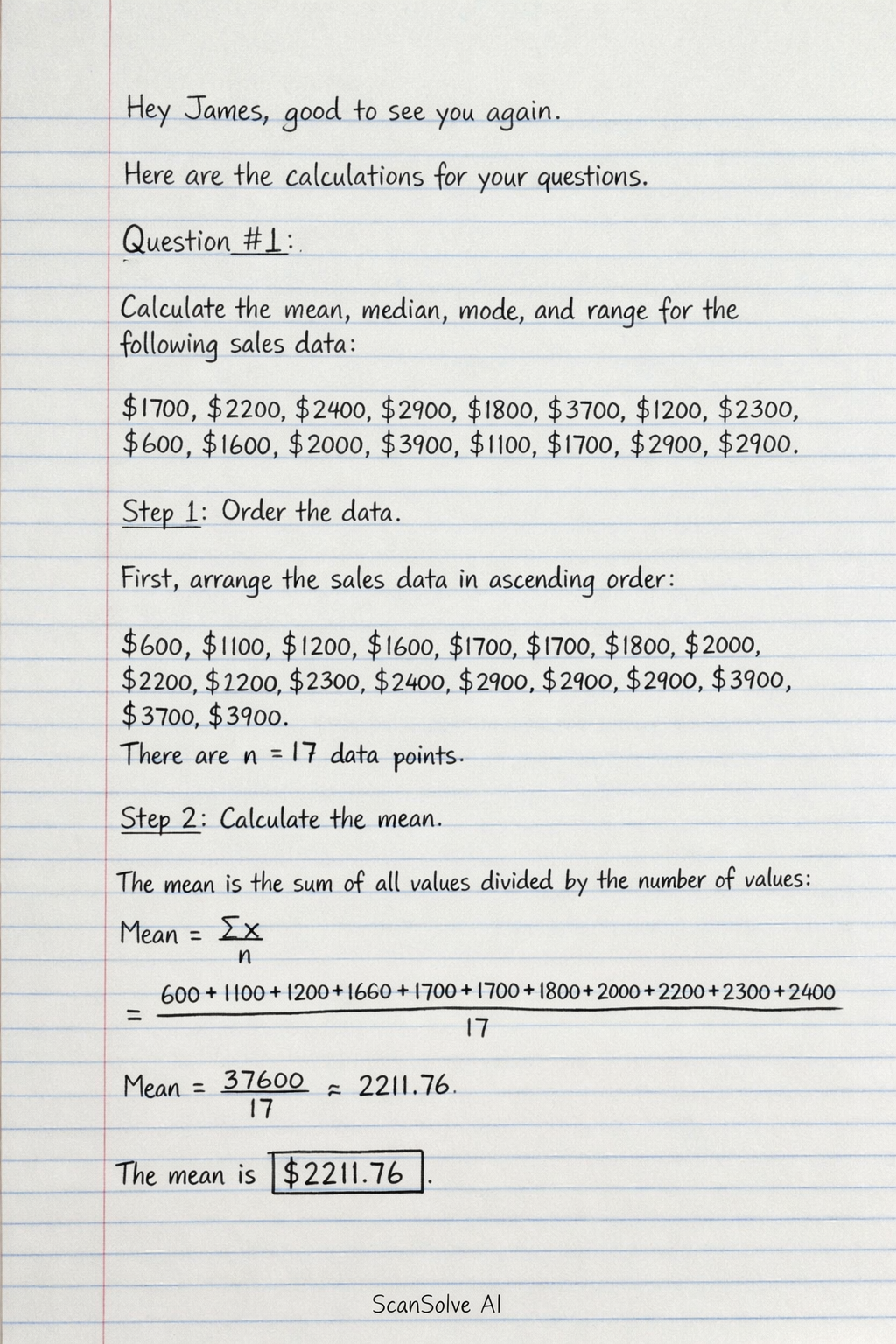
3 stepsHere are the calculations for your questions.
Question #1)
Calculate the mean, median, mode, and range for the following sales data:
2200; 2900; 3700; 2300; 1600; 3900; 1700; 2900; $2900.
Step 1: Order the data.
First, arrange the sales data in ascending order:
1100, 1600, 1700, 2000, 2300, 2900, 2900, 3700, n=17$ data points.
Step 2: Calculate the mean.
The mean is the sum of all values divided by the number of values.
The mean is \boxed{\mathbf{\2211.76}}$.
Step 3: Calculate the median.
Since there are 17 data points (an odd number), the median is the -th value in the ordered list.
The 9th value in the ordered list is \boxed{\mathbf{$2200}}$.
Step 4: Calculate the mode.
The mode is the value that appears most frequently in the dataset.
The value \boxed{\mathbf{$2900}}$.
Step 5: Calculate the range.
The range is the difference between the maximum and minimum values in the dataset.
The range is \boxed{\mathbf{\3300}}$.
Question #2)
Calculate the mean, median, mode, range, variance, and standard deviation for the following dataset:
8; 2; 4; 0; 1; 3; 5; 10; 6; 11; 12; 3; 9; 7; 3; 8; 12; 14; 16; 18; 21
Step 1: Order the data.
First, arrange the dataset in ascending order:
0, 1, 2, 3, 3, 3, 4, 5, 6, 7, 8, 8, 9, 10, 11, 12, 12, 14, 16, 18, 21.
There are data points.
Step 2: Calculate the mean.
The mean is the sum of all values divided by the number of values.
The mean is .
Step 3: Calculate the median.
Since there are 21 data points (an odd number), the median is the -th value in the ordered list.
The 11th value in the ordered list is 8.
The median is .
Step 4: Calculate the mode.
The mode is the value that appears most frequently in the dataset.
The value 3 appears 3 times, which is more than any other value.
The mode is .
Step 5: Calculate the range.
The range is the difference between the maximum and minimum values in the dataset.
The range is .
Step 6: Calculate the variance.
We will calculate the sample variance, .
Using the formula :
The variance is .
Step 7: Calculate the standard deviation.
The standard deviation is the square root of the variance.
The standard deviation is .
Part 3
Identify the outliers in the dataset below:
26-2037242899801202231 53416429
The provided data appears to be a string of numbers without clear delimiters to form a dataset. To identify outliers, a clear list of individual numerical values is required. Without a properly formatted dataset, it is not possible to perform the calculation.
Part 4
Calculate the median, the first quartile (Q1), the second quartile (Q2), and the third quartile (Q3), and identify all outliers in the dataset below. Please show the steps leading to your answers.
180250025540015691761631827166 171
The provided data appears to be a string of numbers without clear delimiters to form a dataset. To calculate quartiles and identify outliers, a clear list of individual numerical values is required. Without a properly formatted dataset, it is not possible to perform the calculation.
Part 5
If Q1 = 5 and Q3 = 15, find the interquartile range and locate the lower and upper fences.
Find the Interquartile Range (IQR).
The IQR is the difference between the third quartile (Q3) and the first quartile (Q1).
The interquartile range is .
Locate the lower fence.
The lower fence is calculated as .
The lower fence is .
Locate the upper fence.
The upper fence is calculated as .
The upper fence is .
Try one yourself
A new problem that tests the same skill.
Still stuck on this one?
Ask a follow-up, and the answer starts from this question.
More Mathematics Questions
Handwritten Step-by-Step Solution
Get this as a handwritten image on WhatsApp — like a tutor wrote it for you.
Try on WhatsApp