We read your photo as:

QUESTION 6.1 Patrick deposited an amount of R18 500 into an account earning r% interest p.a., compounded monthly. After 6 months, his balance was R19 319,48. 6.1.1 Calculate the value of r. 6.1.2 Calculate the effective interest rate.

Mathematics

ScanSolve AI Answer

Step-by-step solution

13 steps

Question 6

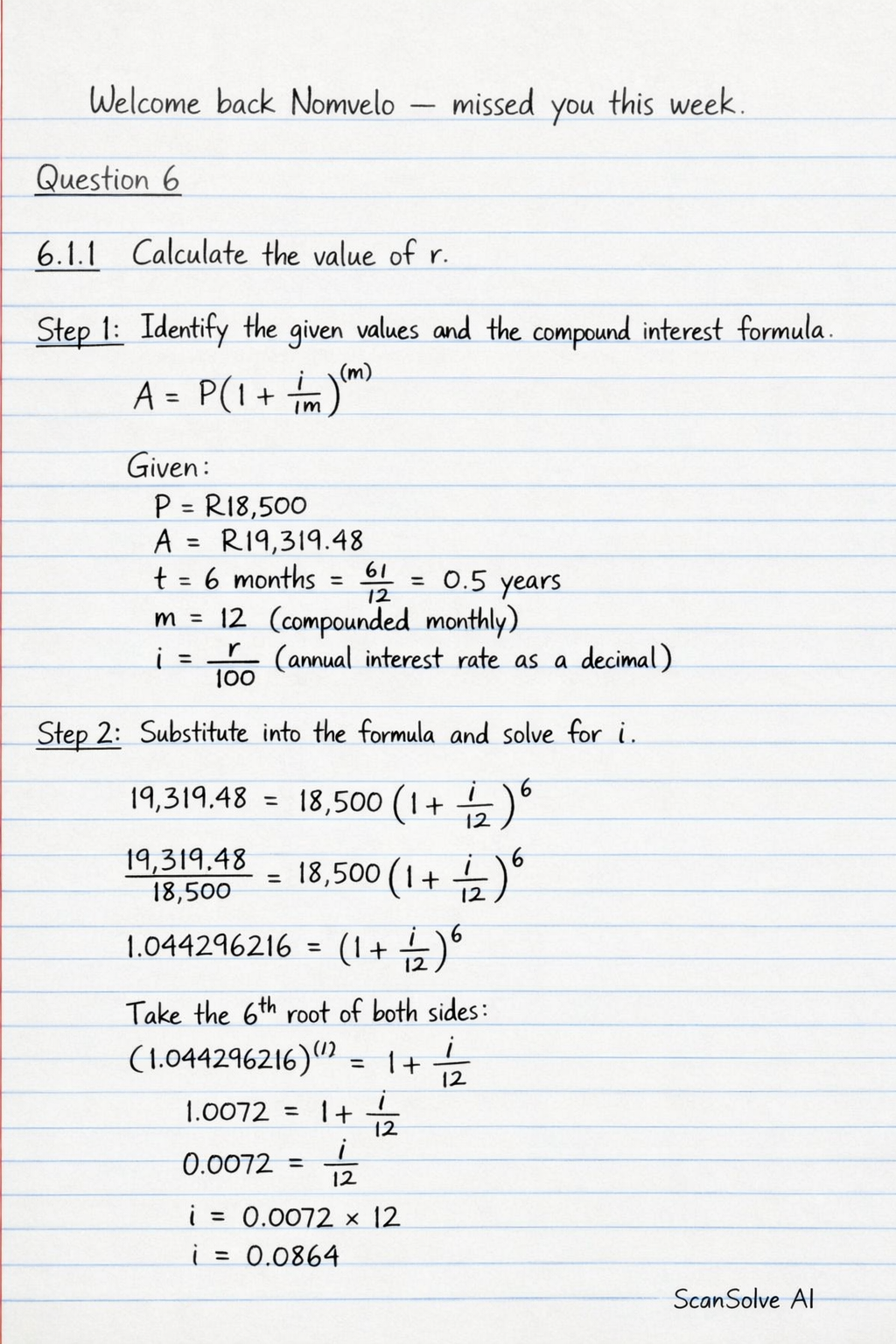
6.1.1 Calculate the value of rr.

  1. Identify the given values and the compound interest formula.

    The formula for compound interest is A=P(1+im)mtA = P\left(1 + \frac{i}{m}\right)^{mt}.
    Given:
    P=R18 500P = \text{R}18\,500
    A=R19 319.48A = \text{R}19\,319.48
    t=6 months=612=0.5 yearst = 6 \text{ months} = \frac{6}{12} = 0.5 \text{ years}
    m=12m = 12 (compounded monthly)
    i=r100i = \frac{r}{100} (annual interest rate as a decimal)

  2. Substitute the values into the formula and solve for ii.

    19 319.48=18 500(1+i12)12×0.519\,319.48 = 18\,500\left(1 + \frac{i}{12}\right)^{12 \times 0.5} 19 319.48=18 500(1+i12)619\,319.48 = 18\,500\left(1 + \frac{i}{12}\right)^{6} 19 319.4818 500=(1+i12)6\frac{19\,319.48}{18\,500} = \left(1 + \frac{i}{12}\right)^{6} 1.044296216=(1+i12)61.044296216 = \left(1 + \frac{i}{12}\right)^{6}

    Take the 6th root of both sides:

    (1.044296216)16=1+i12(1.044296216)^{\frac{1}{6}} = 1 + \frac{i}{12} 1.007200000=1+i121.007200000 = 1 + \frac{i}{12} 0.007200000=i120.007200000 = \frac{i}{12} i=0.007200000×12i = 0.007200000 \times 12 i=0.0864i = 0.0864
  3. Convert ii to rr.

    Since i=r100i = \frac{r}{100}, we have r=i×100r = i \times 100.

    r=0.0864×100r = 0.0864 \times 100 r=8.64r = 8.64

    The value of rr is 8.64\boxed{\text{8.64}}.

    6.1.2 Calculate the effective interest rate.

  4. Use the effective interest rate formula.

    The effective interest rate formula is ieff=(1+im)m−1i_{eff} = \left(1 + \frac{i}{m}\right)^m - 1.
    From 6.1.1, the nominal annual interest rate i=0.0864i = 0.0864 and m=12m = 12.

  5. Substitute the values and calculate ieffi_{eff}.

    ieff=(1+0.086412)12−1i_{eff} = \left(1 + \frac{0.0864}{12}\right)^{12} - 1 ieff=(1+0.0072)12−1i_{eff} = (1 + 0.0072)^{12} - 1 ieff=(1.0072)12−1i_{eff} = (1.0072)^{12} - 1 ieff=1.08999−1i_{eff} = 1.08999 - 1 ieff=0.08999i_{eff} = 0.08999
  6. Convert to a percentage.

    ieff=0.08999×100%=8.999%i_{eff} = 0.08999 \times 100\% = 8.999\%

    The effective interest rate is 8.999%\boxed{\text{8.999\%}}.

    6.2.1 After how many years will the laptop have a value of R0?

  7. Identify the given values and the straight-line depreciation formula.

    The formula for straight-line depreciation is Pt=P0−(P0×d×t)P_t = P_0 - (P_0 \times d \times t).
    Given:
    P0=R10 000P_0 = \text{R}10\,000 (initial value)
    d=20%=0.20d = 20\% = 0.20 (annual depreciation rate)
    Pt=R0P_t = \text{R}0 (target value)

  8. Substitute the values into the formula and solve for tt.

    0=10 000−(10 000×0.20×t)0 = 10\,000 - (10\,000 \times 0.20 \times t) 0=10 000−(2 000×t)0 = 10\,000 - (2\,000 \times t) 2 000t=10 0002\,000t = 10\,000 t=10 0002 000t = \frac{10\,000}{2\,000} t=5t = 5

    The laptop will have a value of R0 after 5 years\boxed{\text{5 years}}.

    6.2.2 Calculate Kuda's monthly deposit into this account.

  9. Identify the given values and the future value of an annuity formula.

    The formula for the future value of an ordinary annuity is FV=PMT(1+im)n−1imFV = PMT \frac{(1 + i_m)^n - 1}{i_m}.
    Given:
    FV=R20 000FV = \text{R}20\,000 (target cost of new laptop)
    i=8.7% p.a.=0.087i = 8.7\% \text{ p.a.} = 0.087
    im=0.08712i_m = \frac{0.087}{12} (monthly interest rate)
    n=60n = 60 (number of monthly deposits from Feb 2019 to Jan 2024)

  10. Substitute the values into the formula and solve for PMTPMT.

    20 000=PMT(1+0.08712)60−10.0871220\,000 = PMT \frac{\left(1 + \frac{0.087}{12}\right)^{60} - 1}{\frac{0.087}{12}} 20 000=PMT(1+0.00725)60−10.0072520\,000 = PMT \frac{(1 + 0.00725)^{60} - 1}{0.00725} 20 000=PMT(1.00725)60−10.0072520\,000 = PMT \frac{(1.00725)^{60} - 1}{0.00725} 20 000=PMT1.540138−10.0072520\,000 = PMT \frac{1.540138 - 1}{0.00725} 20 000=PMT0.5401380.0072520\,000 = PMT \frac{0.540138}{0.00725} 20 000=PMT×74.50179320\,000 = PMT \times 74.501793 PMT=20 00074.501793PMT = \frac{20\,000}{74.501793} PMT=268.45PMT = 268.45

    Kuda's monthly deposit is R268.45\boxed{\text{R268.45}}.

    6.3 How many withdrawals of R20 000 will Tino be able to make from this fund?

  11. Identify the given values and the present value of an annuity formula.

    The formula for the present value of an ordinary annuity is PV=PMT1−(1+im)−nimPV = PMT \frac{1 - (1 + i_m)^{-n}}{i_m}.
    Given:
    PV=R1 600 000PV = \text{R}1\,600\,000 (initial investment)
    PMT=R20 000PMT = \text{R}20\,000 (monthly withdrawal)
    i=11.2% p.a.=0.112i = 11.2\% \text{ p.a.} = 0.112
    im=0.11212i_m = \frac{0.112}{12} (monthly interest rate)

  12. Substitute the values into the formula and solve for nn.

    1 600 000=20 0001−(1+0.11212)−n0.112121\,600\,000 = 20\,000 \frac{1 - \left(1 + \frac{0.112}{12}\right)^{-n}}{\frac{0.112}{12}} 1 600 000=20 0001−(1+0.009333333)−n0.0093333331\,600\,000 = 20\,000 \frac{1 - (1 + 0.009333333)^{-n}}{0.009333333}

    Divide both sides by 20 00020\,000:

    1 600 00020 000=1−(1.009333333)−n0.009333333\frac{1\,600\,000}{20\,000} = \frac{1 - (1.009333333)^{-n}}{0.009333333} 80=1−(1.009333333)−n0.00933333380 = \frac{1 - (1.009333333)^{-n}}{0.009333333}

    Multiply both sides by 0.009333333:

    80×0.009333333=1−(1.009333333)−n80 \times 0.009333333 = 1 - (1.009333333)^{-n} 0.74666664=1−(1.009333333)−n0.74666664 = 1 - (1.009333333)^{-n}

    Rearrange to isolate the term with nn:

    (1.009333333)−n=1−0.74666664(1.009333333)^{-n} = 1 - 0.74666664 (1.009333333)−n=0.25333336(1.009333333)^{-n} = 0.25333336
  13. Use logarithms to solve for nn.

    Take the natural logarithm (or any base logarithm) of both sides:

    −nln⁡(1.009333333)=ln⁡(0.25333336)-n \ln(1.009333333) = \ln(0.25333336) −n×0.0092899=−1.37279-n \times 0.0092899 = -1.37279 n=−1.37279−0.0092899n = \frac{-1.37279}{-0.0092899} n=147.78n = 147.78

    Since Tino can only make full withdrawals, we round down.
    Tino will be able to make 147\boxed{\text{147}} withdrawals of R20 000.

Was this helpful?

Still stuck on this one?

Ask a follow-up, and the answer starts from this question.

Got a different question?Ask your own question
Handwritten step-by-step solution preview

Handwritten Step-by-Step Solution

Get this as a handwritten image on WhatsApp — like a tutor wrote it for you.

Try on WhatsApp