Question 6 - NUMBER PATTERNS 6.1 Complete the number pattern and describe it in words: 5; 9; 13; 17; PATTERN IN WORDS: 6.2 Consider the matchstick pattern below and complete the table.

Mathematics
Question 6 - NUMBER PATTERNS 6.1 Complete the number pattern and describe it in words: 5; 9; 13; 17; PATTERN IN WORDS: 6.2 Consider the matchstick pattern below and complete the table.

ScanSolve AI Answer

Answer

<

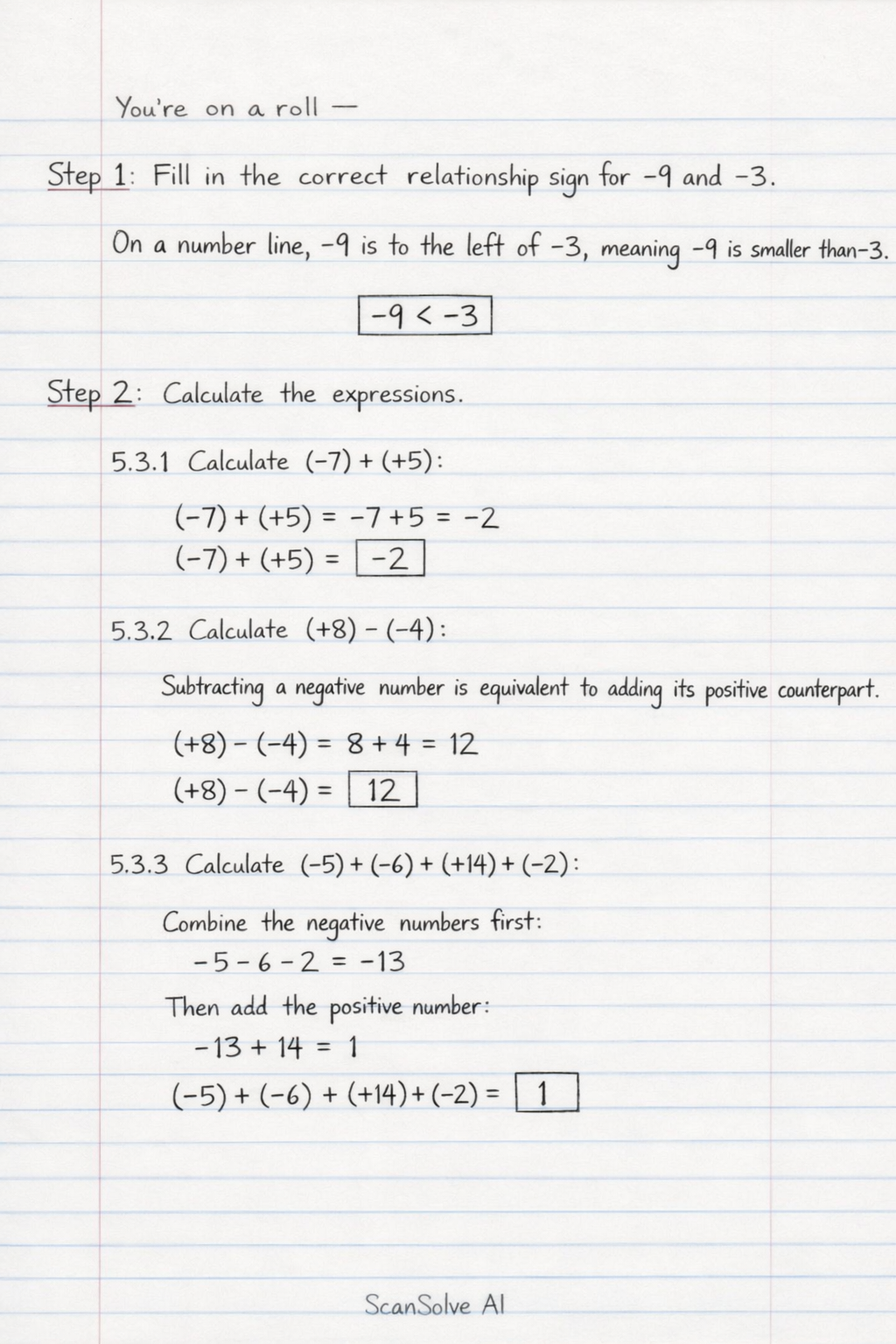
Step 1: Fill in the correct relationship sign for 9-9 and 3-3 (from question 5.2.1). On a number line, 9-9 is to the left of 3-3, meaning 9-9 is smaller than 3-3. 9<3-9 < -3

Step 2: Calculate the expressions (from question 5.3).

  • 5.3.1 Calculate (7)+(+5)(-7) + (+5). (7)+(+5)=7+5=2(-7) + (+5) = -7 + 5 = -2 (7)+(+5)=2(-7) + (+5) = -2

  • 5.3.2 Calculate (+8)(4)(+8) - (-4). Subtracting a negative number is equivalent to adding its positive counterpart. (+8)(4)=8+4=12(+8) - (-4) = 8 + 4 = 12 (+8)(4)=12(+8) - (-4) = 12

  • 5.3.3 Calculate (5)+(6)+(+14)+(2)(-5) + (-6) + (+14) + (-2). Combine the negative numbers first: 562=13-5 - 6 - 2 = -13 Then add the positive number: 13+14=1-13 + 14 = 1 (5)+(6)+(+14)+(2)=1(-5) + (-6) + (+14) + (-2) = 1

Step 3: Calculate the difference in temperature (from question 5.4). The temperature inside the freezer is 18C-18^\circ\text{C}. The temperature outside is 16C16^\circ\text{C}. To find the difference, subtract the lower temperature from the higher temperature. Difference=16\circC(18\circC)Difference = 16^\circC - (-18^\circC) Difference=16\circC+18\circC=34\circCDifference = 16^\circC + 18^\circC = 34^\circC The difference in temperature is 34\circC\boxed{34^\circC}.

Step 4: Complete the number pattern and describe it (from question 6.1). The given pattern is 5;9;13;17;_;_5; 9; 13; 17; \_ ; \_ . Find the common difference between consecutive terms: 95=49 - 5 = 4 139=413 - 9 = 4 1713=417 - 13 = 4 The pattern increases by 44 each time. The next two terms are: 17+4=2117 + 4 = 21 21+4=2521 + 4 = 25 The completed pattern is 5;9;13;17;21;255; 9; 13; 17; 21; \boxed{25}. PATTERN IN WORDS: The pattern starts at 55 and increases by 44 for each subsequent term.

Step 5: Complete the matchstick pattern table and find the rule (from question 6.2). The number of matchsticks for patterns 1,2,31, 2, 3 are 4,7,104, 7, 10. Find the common difference: 74=37 - 4 = 3 107=310 - 7 = 3 The number of matchsticks increases by 33 for each subsequent pattern. The rule for the number of matchsticks (MM) in terms of the pattern number (nn) is M=3n+cM = 3n + c. Using n=1,M=4n=1, M=4: 4=3(1)+c    4=3+c    c=14 = 3(1) + c \implies 4 = 3 + c \implies c = 1. So the rule is M=3n+1M = 3n + 1. Now, complete the table for n=5n=5 and n=10n=10:

  • For n=5n=5: M=3(5)+1=15+1=16M = 3(5) + 1 = 15 + 1 = 16.
  • For n=10n=10: M=3(10)+1=30+1=31M = 3(10) + 1 = 30 + 1 = 31.

The completed table is: | Pattern (n) | 1 | 2 | 3 | 5 | 10 | | :---------- | :-: | :-: | :-: | :-: | :--: | | Matchsticks | 4 | 7 | 10 | 16 | 31 |

Rule: M=3n+1\boxed{M = 3n + 1}

Step 6: Use the given rule to determine the missing values in the table (from question 7.1). The rule is y=4x3y = 4x - 3.

  • For x=0x=0: y=4(0)3=03=3y = 4(0) - 3 = 0 - 3 = -3.
  • For x=1x=1: y=4(1)3=43=1y = 4(1) - 3 = 4 - 3 = 1.
  • For x=2x=2: y=4(2)3=83=5y = 4(2) - 3 = 8 - 3 = 5.
  • For x=3x=3: y=4(3)3=123=9y = 4(3) - 3 = 12 - 3 = 9.
  • For x=4x=4: y=4(4)3=163=13y = 4(4) - 3 = 16 - 3 = 13.
  • For x=10x=10: y=4(10)3=403=37y = 4(10) - 3 = 40 - 3 = 37.

The completed table is: | x | 0 | 1 | 2 | 3 | 4 | 10 | | :-: | :-: | :-: | :-: | :-: | :-: | :--: | | y | -3 | 1 | 5 | 9 | 13 | 37 |

Step 7: Determine the values of A, B, and C from the input-output diagram (from question 7.2). The operations are: first multiply by 55, then subtract 22.

  • For input 33: 3×5=153 \times 5 = 15 152=1315 - 2 = 13 So, A=13A = \boxed{13}.

  • For input 66: 6×5=306 \times 5 = 30 302=2830 - 2 = 28 So, B=28B = \boxed{28}.

  • For input 1111: 11×5=5511 \times 5 = 55 552=5355 - 2 = 53 So, C=53C = \boxed{53}.

Drop the next question.

Was this helpful?

Need help with your own homework?

Get instant step-by-step solutions to any question. Free to start.

Ask Your Question
Handwritten step-by-step solution preview

Handwritten Step-by-Step Solution

Get this as a handwritten image on WhatsApp — like a tutor wrote it for you.

Try on WhatsApp

Still have questions?

Quick Answer

Fill in the correct relationship sign for -9 and -3 (from question 5.2.1). On a number line, -9 is to the left of -3, meaning -9 is smaller than -3.

Question 6 - NUMBER PATTERNS 6.1 Complete the number pattern and describe it in words: 5; 9; 13; 17; PATTERN IN WORDS: 6.2 Consider the matchstick pattern below and complete the table.
Mathematics

This mathematics problem involves applying core mathematical principles and formulas. Below you will find a complete step-by-step solution with detailed explanations for each step, helping you understand not just the answer but the method behind it.

ScanSolve AI Answer
Step 1: Fill in the correct relationship sign for -9 and -3 (from question 5.2.1). On a number line, -9 is to the left of -3, meaning -9 is smaller than -3. -9 < -3 Step 2: Calculate the expressions (from question 5.3). 5.3.1 Calculate (-7) + (+5). (-7) + (+5) = -7 + 5 = -2 (-7) + (+5) = -2 5.3.2 Calculate (+8) - (-4). Subtracting a negative number is equivalent to adding its positive counterpart. (+8) - (-4) = 8 + 4 = 12 (+8) - (-4) = 12 5.3.3 Calculate (-5) + (-6) + (+14) + (-2). Combine the negative numbers first: -5 - 6 - 2 = -13 Then add the positive number: -13 + 14 = 1 (-5) + (-6) + (+14) + (-2) = 1 Step 3: Calculate the difference in temperature (from question 5.4). The temperature inside the freezer is -18^. The temperature outside is 16^. To find the difference, subtract the lower temperature from the higher temperature. Difference = 16^ - (-18^) Difference = 16^ + 18^ = 34^ The difference in temperature is 34^. Step 4: Complete the number pattern and describe it (from question 6.1). The given pattern is 5; 9; 13; 17; \_ ; \_ . Find the common difference between consecutive terms: 9 - 5 = 4 13 - 9 = 4 17 - 13 = 4 The pattern increases by 4 each time. The next two terms are: 17 + 4 = 21 21 + 4 = 25 The completed pattern is 5; 9; 13; 17; 21; 25. PATTERN IN WORDS: The pattern starts at 5 and increases by 4 for each subsequent term. Step 5: Complete the matchstick pattern table and find the rule (from question 6.2). The number of matchsticks for patterns 1, 2, 3 are 4, 7, 10. Find the common difference: 7 - 4 = 3 10 - 7 = 3 The number of matchsticks increases by 3 for each subsequent pattern. The rule for the number of matchsticks (M) in terms of the pattern number (n) is M = 3n + c. Using n=1, M=4: 4 = 3(1) + c 4 = 3 + c c = 1. So the rule is M = 3n + 1. Now, complete the table for n=5 and n=10: For n=5: M = 3(5) + 1 = 15 + 1 = 16. For n=10: M = 3(10) + 1 = 30 + 1 = 31. The completed table is: | Pattern (n) | 1 | 2 | 3 | 5 | 10 | | :---------- | :-: | :-: | :-: | :-: | :--: | | Matchsticks | 4 | 7 | 10 | 16 | 31 | Rule: M = 3n + 1 Step 6: Use the given rule to determine the missing values in the table (from question 7.1). The rule is y = 4x - 3. For x=0: y = 4(0) - 3 = 0 - 3 = -3. For x=1: y = 4(1) - 3 = 4 - 3 = 1. For x=2: y = 4(2) - 3 = 8 - 3 = 5. For x=3: y = 4(3) - 3 = 12 - 3 = 9. For x=4: y = 4(4) - 3 = 16 - 3 = 13. For x=10: y = 4(10) - 3 = 40 - 3 = 37. The completed table is: | x | 0 | 1 | 2 | 3 | 4 | 10 | | :-: | :-: | :-: | :-: | :-: | :-: | :--: | | y | -3 | 1 | 5 | 9 | 13 | 37 | Step 7: Determine the values of A, B, and C from the input-output diagram (from question 7.2). The operations are: first multiply by 5, then subtract 2. For input 3: 3 × 5 = 15 15 - 2 = 13 So, A = 13. For input 6: 6 × 5 = 30 30 - 2 = 28 So, B = 28. For input 11: 11 × 5 = 55 55 - 2 = 53 So, C = 53. Drop the next question.