
This mathematics problem involves applying core mathematical principles and formulas. Below you will find a complete step-by-step solution with detailed explanations for each step, helping you understand not just the answer but the method behind it.
ScanSolve AI Answer
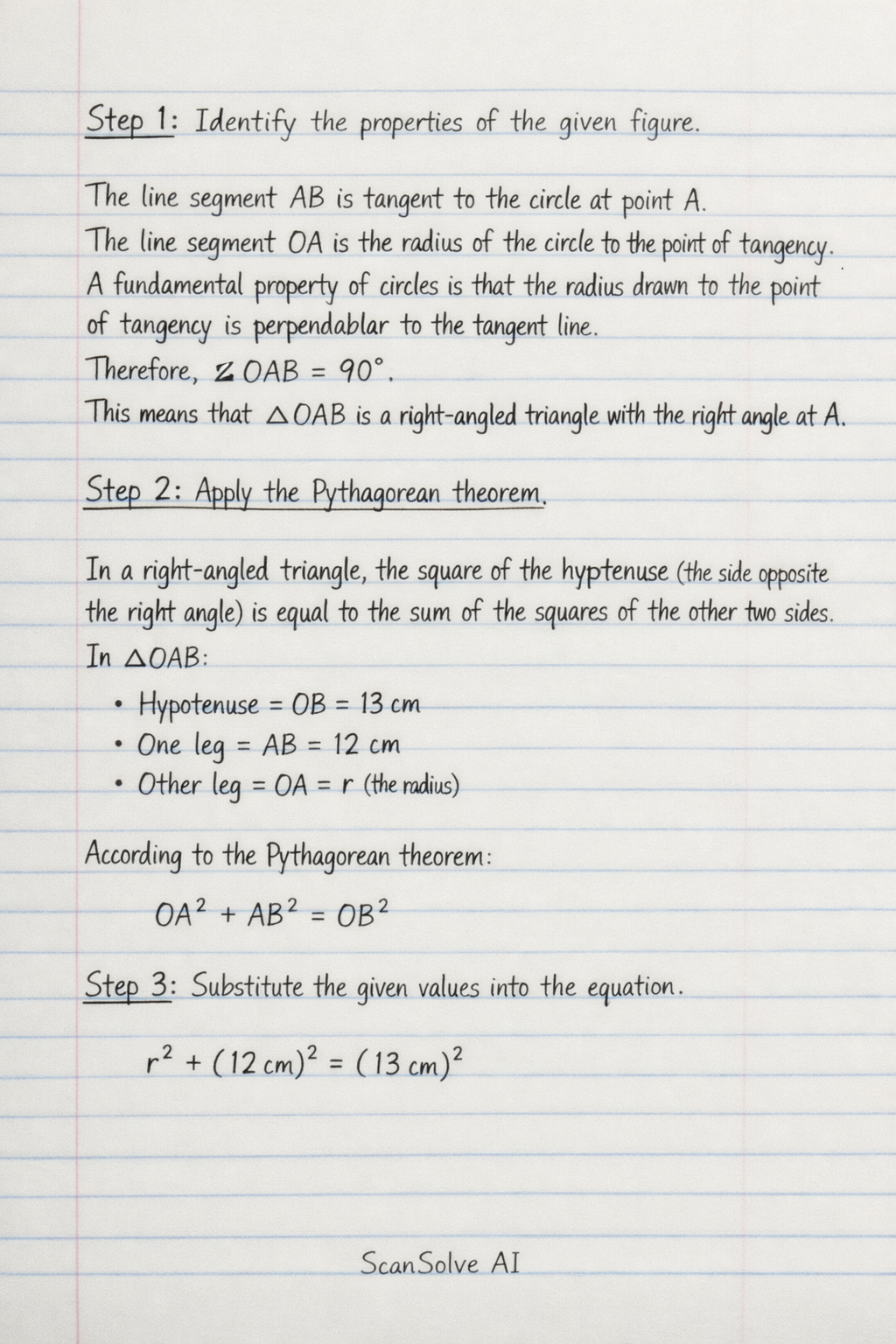
Step 1: Identify the properties of the given figure. The line segment AB is tangent to the circle at point A. The line segment OA is the radius of the circle to the point of tangency. A fundamental property of circles is that the radius drawn to the point of tangency is perpendicular to the tangent line. Therefore, OAB = 90^. This means that OAB is a right-angled triangle with the right angle at A. Step 2: Apply the Pythagorean theorem. In a right-angled triangle, the square of the hypotenuse (the side opposite the right angle) is equal to the sum of the squares of the other two sides. In OAB: • Hypotenuse = OB = 13 cm • One leg = AB = 12 cm • Other leg = OA = r (the radius) According to the Pythagorean theorem: OA^2 + AB^2 = OB^2 Step 3: Substitute the given values into the equation. r^2 + (12\, cm)^2 = (13\, cm)^2 Step 4: Solve for r. r^2 + 144\, cm^2 = 169\, cm^2 Subtract 144\, cm^2 from both sides: r^2 = 169\, cm^2 - 144\, cm^2 r^2 = 25\, cm^2 Take the square root of both sides: r = sqrt(25\, cm)^2 r = 5\, cm The radius is 5\, cm.