
We read your photo as:
Calculate the radius ratio (rc)/(ra):
ScanSolve AI Answer
Answer
Step-by-step solution
5 stepsIdentify the given radii and determine the crystal structure.
The radius of the cation A () is .
The radius of the anion X () is .Calculate the radius ratio :
For ionic compounds with a radius ratio in the range , the coordination number is 6. This typically corresponds to an NaCl-type crystal structure, where the anions form a Face-Centered Cubic (FCC) lattice and the cations occupy the octahedral voids.
Determine the relationship between the unit cell edge length and the ionic radii for an NaCl-type structure.
In an NaCl-type structure, the cation and anion touch along the edge of the unit cell. The edge length () is twice the sum of the cation and anion radii.
Calculate the edge length () of the unit cell.
Calculate the volume of the unit cell ().
The volume of a cubic unit cell is given by .
Compare the calculated volume with the given options.
The calculated volume is , which matches option (d).
The final answer is .
Try one yourself
A new problem that tests the same skill.
Still stuck on this one?
Ask a follow-up, and the answer starts from this question.
More Mathematics Questions
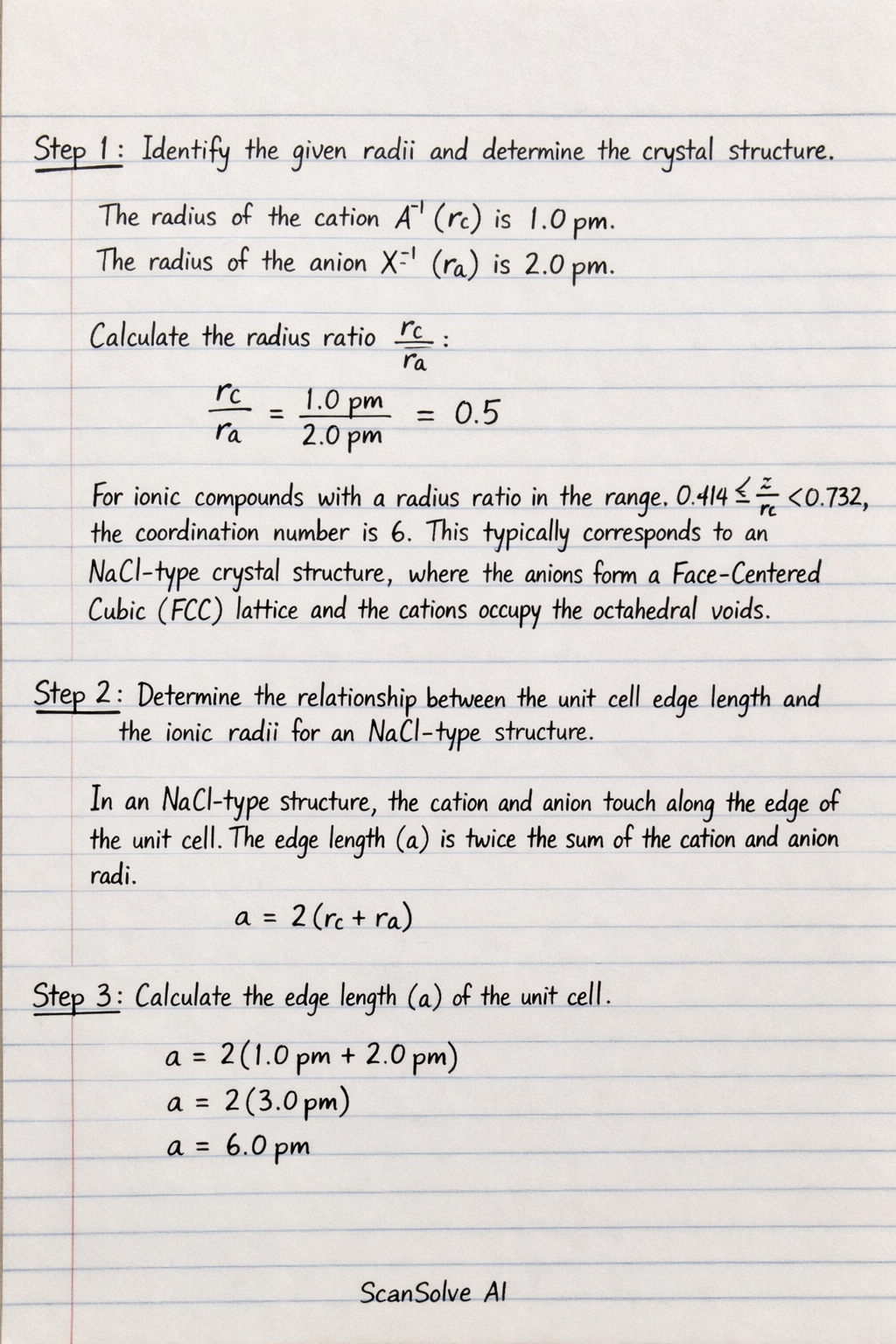
Handwritten Step-by-Step Solution
Get this as a handwritten image on WhatsApp — like a tutor wrote it for you.
Try on WhatsApp