
We read your photo as:
Calculate the ratio (AD)/(DF).
ScanSolve AI Answer
Answer
DE || FC
Step-by-step solution
8 stepsHere's the solution to your geometry problem:
1. Prove that $DE || FC$.
Calculate the ratio .
We are given that .
This implies that represents 3 parts of , and represents 5 parts.
Therefore, .
So, the ratio .Calculate the ratio .
We are given units and units.
Compare the ratios and conclude.
Since , by the converse of the Basic Proportionality Theorem (also known as Thales's Theorem), the line segment is parallel to the line segment .
Therefore, .2. If units, calculate the length of .
Interpret the parallel line statement.
The statement "E on AC // FE" is interpreted to mean that the line segment is parallel to the side of . So, .
Apply Thales's Theorem (Basic Proportionality Theorem) to .
Since , we can write the proportion:
Calculate the length of .
is the sum of and .
Substitute the known values into the proportion to find .
We have units, units, and units.
To solve for , multiply both sides by 14:
Simplify the fraction to :
Calculate the length of .
The length of is the total length of minus the length of .
The length of is .
Try one yourself
A new problem that tests the same skill.
Still stuck on this one?
Ask a follow-up, and the answer starts from this question.
More Mathematics Questions
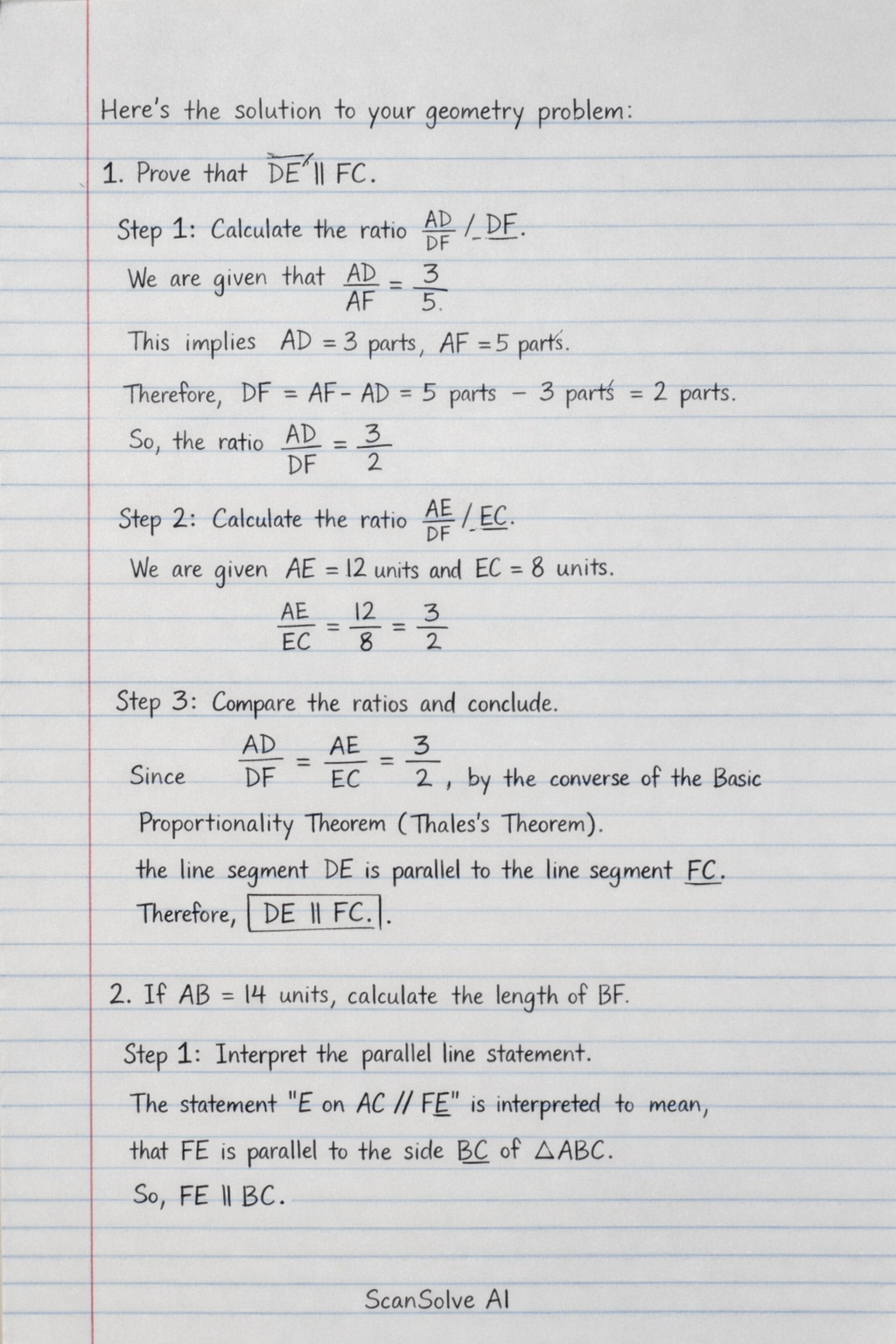
Handwritten Step-by-Step Solution
Get this as a handwritten image on WhatsApp — like a tutor wrote it for you.
Try on WhatsApp