

This mathematics problem involves applying core mathematical principles and formulas. Below you will find a complete step-by-step solution with detailed explanations for each step, helping you understand not just the answer but the method behind it.
ScanSolve AI Answer
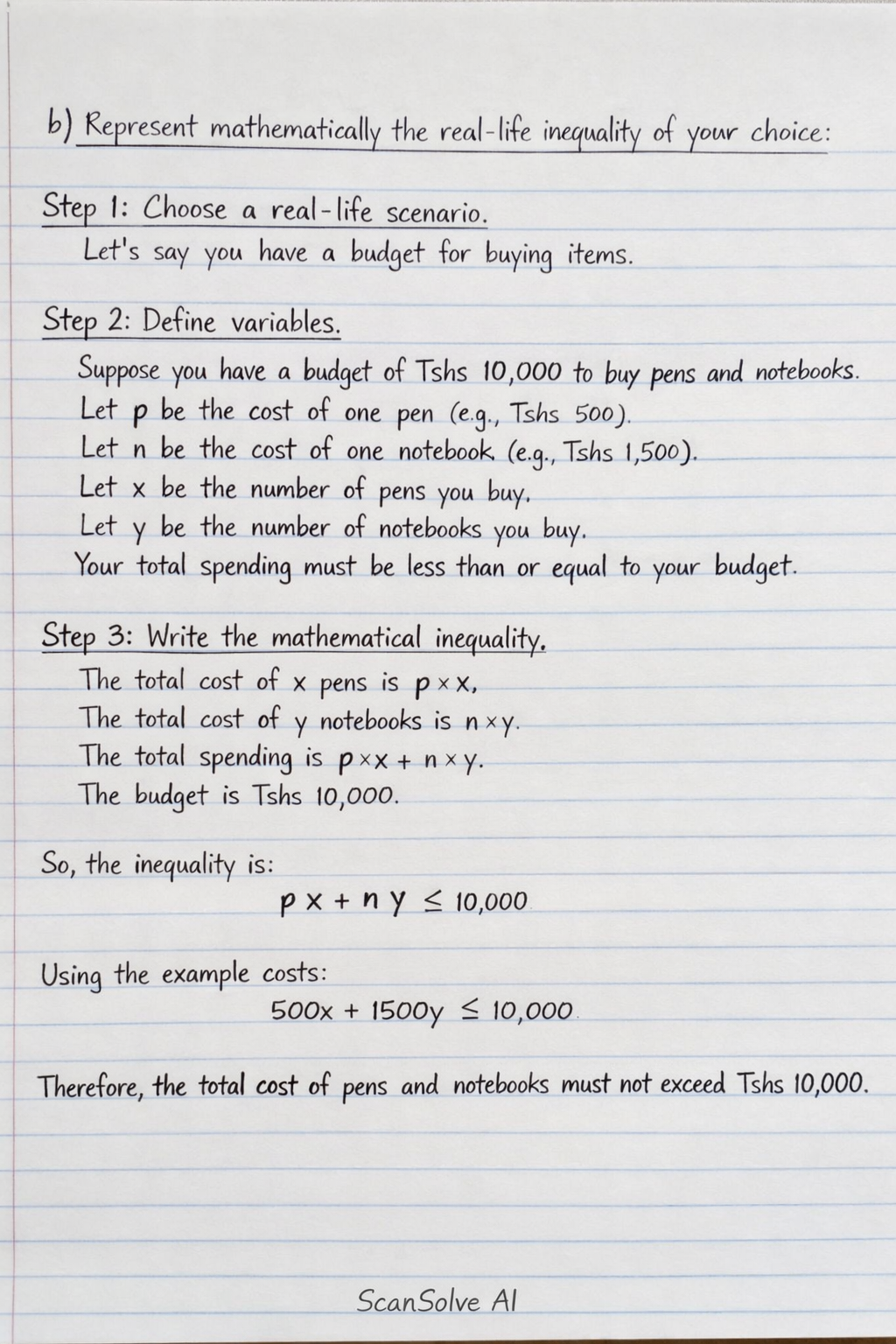
Here is the solution to the remaining question: b) Represent mathematically the real-life inequality of your choice. Step 1: Choose a real-life scenario. Let's consider a scenario involving a budget for buying items. Step 2: Define variables. Suppose you have a budget of Tshs 10,000 to buy pens and notebooks. Let p be the cost of one pen (e.g., Tshs 500). Let n be the cost of one notebook (e.g., Tshs 1,500). Let x be the number of pens you buy. Let y be the number of notebooks you buy. Your total spending must be less than or equal to your budget. Step 3: Write the mathematical inequality. The total cost of x pens is p × x. The total cost of y notebooks is n × y. The total spending is p × x + n × y. The budget is Tshs 10,000. So, the inequality is: p × x + n × y 10,000 Using the example costs: 500x + 1500y 10,000 This inequality represents that the total cost of pens and notebooks must not exceed Tshs 10,000.