
We read your photo as:
Revise vertices, edges and faces. 1. Identify and count the: i. vertices ii. edges iii. faces
ScanSolve AI Answer
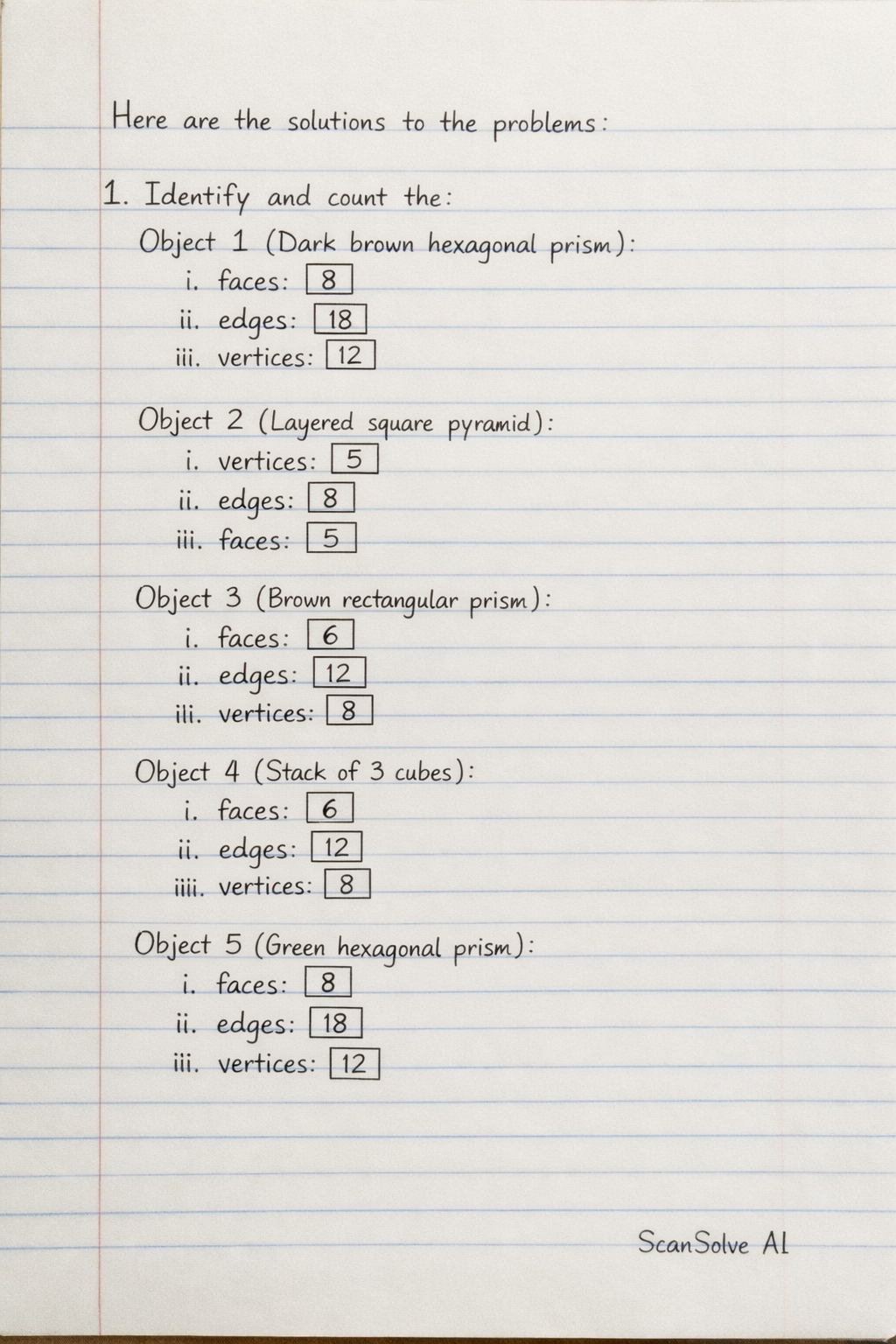
Here are the solutions to the problems:
1. Identify and count the:
-
Object 1 (Dark brown hexagonal prism):
- i. faces:
- ii. edges:
- iii. vertices:
-
Object 2 (Layered square pyramid):
- i. vertices:
- ii. edges:
- iii. faces:
-
Object 3 (Brown rectangular prism/cuboid):
- i. faces:
- ii. edges:
- iii. vertices:
-
Object 4 (Stack of 3 cubes, forming a rectangular prism):
- i. faces:
- ii. edges:
- iii. vertices:
-
Object 5 (Green hexagonal prism):
- i. faces:
- ii. edges:
- iii. vertices:
-
Object 6 (House-like structure: rectangular prism base + triangular prism roof):
- i. vertices:
- ii. edges:
- iii. faces:
2. Find or draw pictures of objects with:
-
a. 8 vertices, 12 edges and 6 faces: This describes a rectangular prism (also known as a cuboid or a cube).
- Drawing description: Draw a rectangle. Draw another identical rectangle slightly above and to the right of the first. Connect the corresponding vertices of the two rectangles with straight lines.
-
b. 4 vertices, 6 edges and 4 faces: This describes a triangular pyramid (also known as a tetrahedron).
- Drawing description: Draw a triangle for the base. From a point above the center of the triangle, draw lines connecting to each of the three vertices of the base.
3. Can a 3-D object have equal numbers of vertices, edges and faces?
No, a 3-D object (specifically a polyhedron) cannot have an equal number of vertices, edges, and faces. This is governed by Euler's formula for polyhedra, which states that , where is the number of vertices, is the number of edges, and is the number of faces. If , then substituting this into the formula would give , which simplifies to . A polyhedron cannot have only 2 vertices, 2 edges, and 2 faces in a non-degenerate form.
The answer is .
Still stuck on this one?
Ask a follow-up, and the answer starts from this question.
More Mathematics Questions
Handwritten Step-by-Step Solution
Get this as a handwritten image on WhatsApp — like a tutor wrote it for you.
Try on WhatsApp