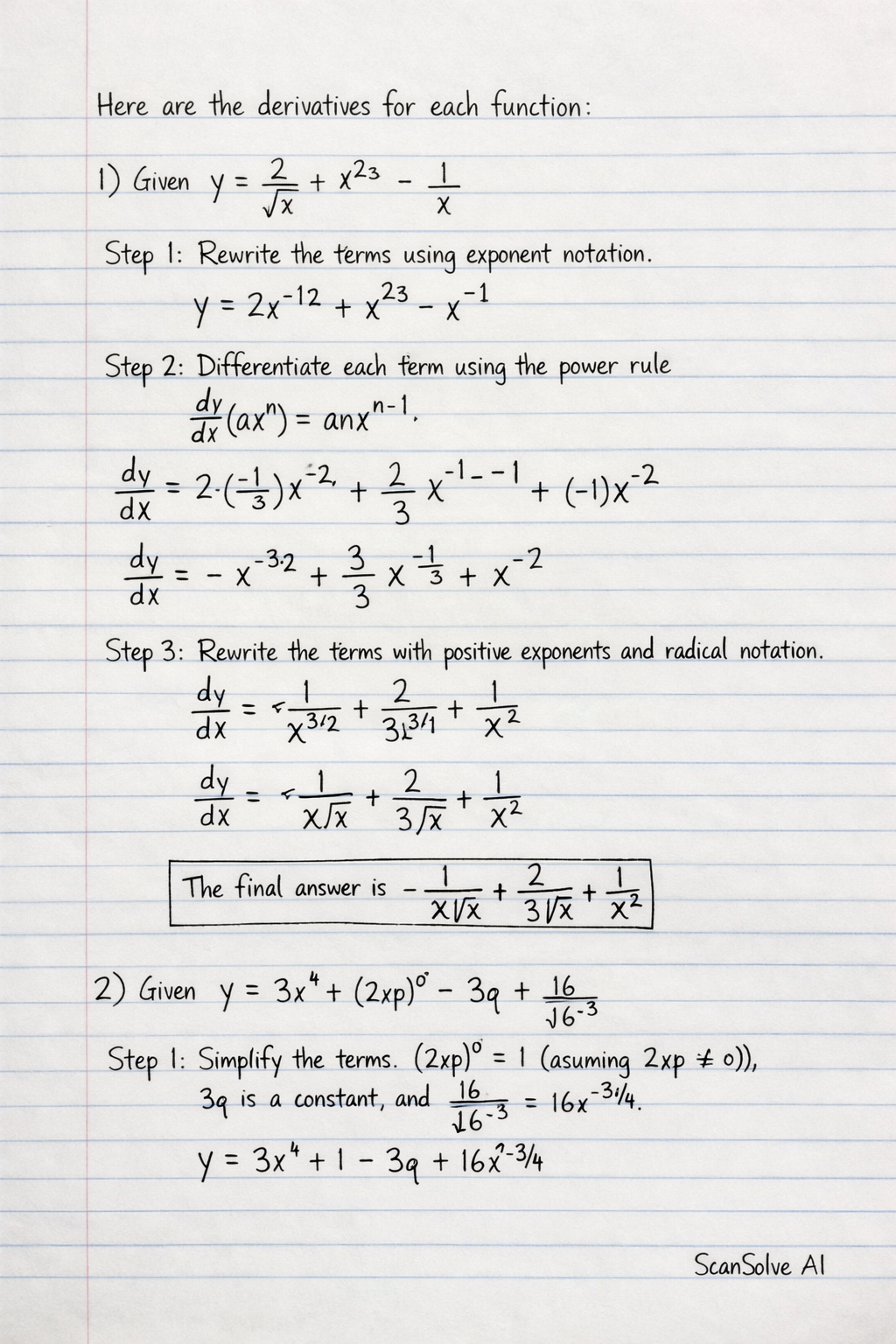
Step 1: Rewrite the terms using exponent notation.
y=2x−1/2+x2/3−x−1
Step 2: Differentiate each term using the power rule dxd(axn)=anxn−1.
dxdy=2(−21)x−1/2−1+32x2/3−1−(−1)x−1−1dxdy=−x−3/2+32x−1/3+x−2
Step 3: Rewrite the terms with positive exponents and radical notation.
dxdy=−x3/21+3x1/32+x21dxdy=−xx1+33x2+x21
The final answer is −xx1+33x2+x21.
2) Given y=3x4+(2xp)0−3q+4x316
Step 1: Simplify the terms. (2xp)0=1 (assuming 2xp=0), 3q is a constant, and 4x316=16x−3/4.
y=3x4+1−3q+16x−3/4
Step 2: Differentiate each term. The derivative of a constant is 0.
dxdy=3(4)x4−1+0−0+16(−43)x−3/4−1dxdy=12x3−12x−7/4
Step 3: Rewrite the term with a positive exponent.
dxdy=12x3−x7/412dxdy=12x3−x4x312
The final answer is 12x3−x4x312.
3) Given y=x34x2+3x+2
Step 1: Divide each term in the numerator by x3.
y=x34x2+x33x+x32y=4x−1+3x−2+2x−3
Step 2: Differentiate each term using the power rule.
dxdy=4(−1)x−1−1+3(−2)x−2−1+2(−3)x−3−1dxdy=−4x−2−6x−3−6x−4
Step 3: Rewrite the terms with positive exponents.
dxdy=−x24−x36−x46
The final answer is −x24−x36−x46.
4) Given y=(−2x2)3
Step 1: Simplify the expression.
y=(−2)3(x2)3y=−8x2×3y=−8x6
Step 2: Differentiate using the power rule.
dxdy=−8(6)x6−1dxdy=−48x5
The final answer is −48x5.
5) Given y=(2x2−3)(3x−2)
Step 1: Expand the expression by multiplying the terms.
y=(2x2)(3x)+(2x2)(−2)+(−3)(3x)+(−3)(−2)y=6x3−4x2−9x+6
Step 2: Differentiate each term using the power rule.
dxdy=6(3)x3−1−4(2)x2−1−9(1)x1−1+0dxdy=18x2−8x−9x0dxdy=18x2−8x−9
The final answer is 18x2−8x−9.
Send me the next one 📸
Was this helpful?
Need help with your own homework?
Get instant step-by-step solutions to any question. Free to start.
This mathematics problem involves applying core mathematical principles and formulas. Below you will find a complete step-by-step solution with detailed explanations for each step, helping you understand not just the answer but the method behind it.
ScanSolve AI Answer
Here are the derivatives for each function: 1) Given y = (2)/(sqrt(x)) + [3]x^2 - (1)/(x) Step 1: Rewrite the terms using exponent notation. y = 2x^-1/2 + x^2/3 - x^-1 Step 2: Differentiate each term using the power rule (d)/(dx)(ax^n) = anx^n-1. (dy)/(dx) = 2(-(1)/(2))x^-1/2 - 1 + (2)/(3)x^2/3 - 1 - (-1)x^-1 - 1 (dy)/(dx) = -x^-3/2 + (2)/(3)x^-1/3 + x^-2 Step 3: Rewrite the terms with positive exponents and radical notation. (dy)/(dx) = -(1)/(x^3/2) + (2)/(3x^1/3) + (1)/(x^2) (dy)/(dx) = -(1)/(xsqrt(x)) + (2)/(3[3]x) + (1)/(x^2) The final answer is -(1)/(xsqrt(x)) + (2)/(3[3]x) + (1)/(x^2). 2) Given y = 3x^4 + (2xp)^0 - 3q + (16)/([4]x^3) Step 1: Simplify the terms. (2xp)^0 = 1 (assuming 2xp ≠ 0), 3q is a constant, and (16)/([4]x^3) = 16x^-3/4. y = 3x^4 + 1 - 3q + 16x^-3/4 Step 2: Differentiate each term. The derivative of a constant is 0. (dy)/(dx) = 3(4)x^4-1 + 0 - 0 + 16(-(3)/(4))x^-3/4 - 1 (dy)/(dx) = 12x^3 - 12x^-7/4 Step 3: Rewrite the term with a positive exponent. (dy)/(dx) = 12x^3 - (12)/(x^7/4) (dy)/(dx) = 12x^3 - (12)/(x[4]x^3) The final answer is 12x^3 - (12)/(x[4]x^3). 3) Given y = (4x^2 + 3x + 2)/(x^3) Step 1: Divide each term in the numerator by x^3. y = (4x^2)/(x^3) + (3x)/(x^3) + (2)/(x^3) y = 4x^-1 + 3x^-2 + 2x^-3 Step 2: Differentiate each term using the power rule. (dy)/(dx) = 4(-1)x^-1-1 + 3(-2)x^-2-1 + 2(-3)x^-3-1 (dy)/(dx) = -4x^-2 - 6x^-3 - 6x^-4 Step 3: Rewrite the terms with positive exponents. (dy)/(dx) = -(4)/(x^2) - (6)/(x^3) - (6)/(x^4) The final answer is -(4)/(x^2) - (6)/(x^3) - (6)/(x^4). 4) Given y = (-2x^2)^3 Step 1: Simplify the expression. y = (-2)^3 (x^2)^3 y = -8x^2 × 3 y = -8x^6 Step 2: Differentiate using the power rule. (dy)/(dx) = -8(6)x^6-1 (dy)/(dx) = -48x^5 The final answer is -48x^5. 5) Given y = (2x^2 - 3)(3x - 2) Step 1: Expand the expression by multiplying the terms. y = (2x^2)(3x) + (2x^2)(-2) + (-3)(3x) + (-3)(-2) y = 6x^3 - 4x^2 - 9x + 6 Step 2: Differentiate each term using the power rule. (dy)/(dx) = 6(3)x^3-1 - 4(2)x^2-1 - 9(1)x^1-1 + 0 (dy)/(dx) = 18x^2 - 8x - 9x^0 (dy)/(dx) = 18x^2 - 8x - 9 The final answer is 18x^2 - 8x - 9. Send me the next one 📸