
We read your photo as:
Sebenzisa irula ukumela ipherimitha yamabumbeko alandelako. Tiola ipendulakho ngamamlimitha.
ScanSolve AI Answer
Step-by-step solution
12 stepsTo accurately solve this problem, you need a physical ruler to measure the sides of each shape on the printed page. The instructions ask you to measure in centimeters and then write your final answer in millimeters.
Since I cannot physically measure the shapes, I will demonstrate the process using example measurements. You should replace these example values with your own measurements from the printed page.
Here's how to measure and calculate the perimeter for each shape:
General Steps:
- Use a ruler to measure the length of each side (Ihlangoithi) of the shape in centimeters (cm).
- Add all the side lengths together to find the total perimeter in centimeters.
- Convert the total perimeter from centimeters to millimeters (mm) by multiplying by 10 (since ).
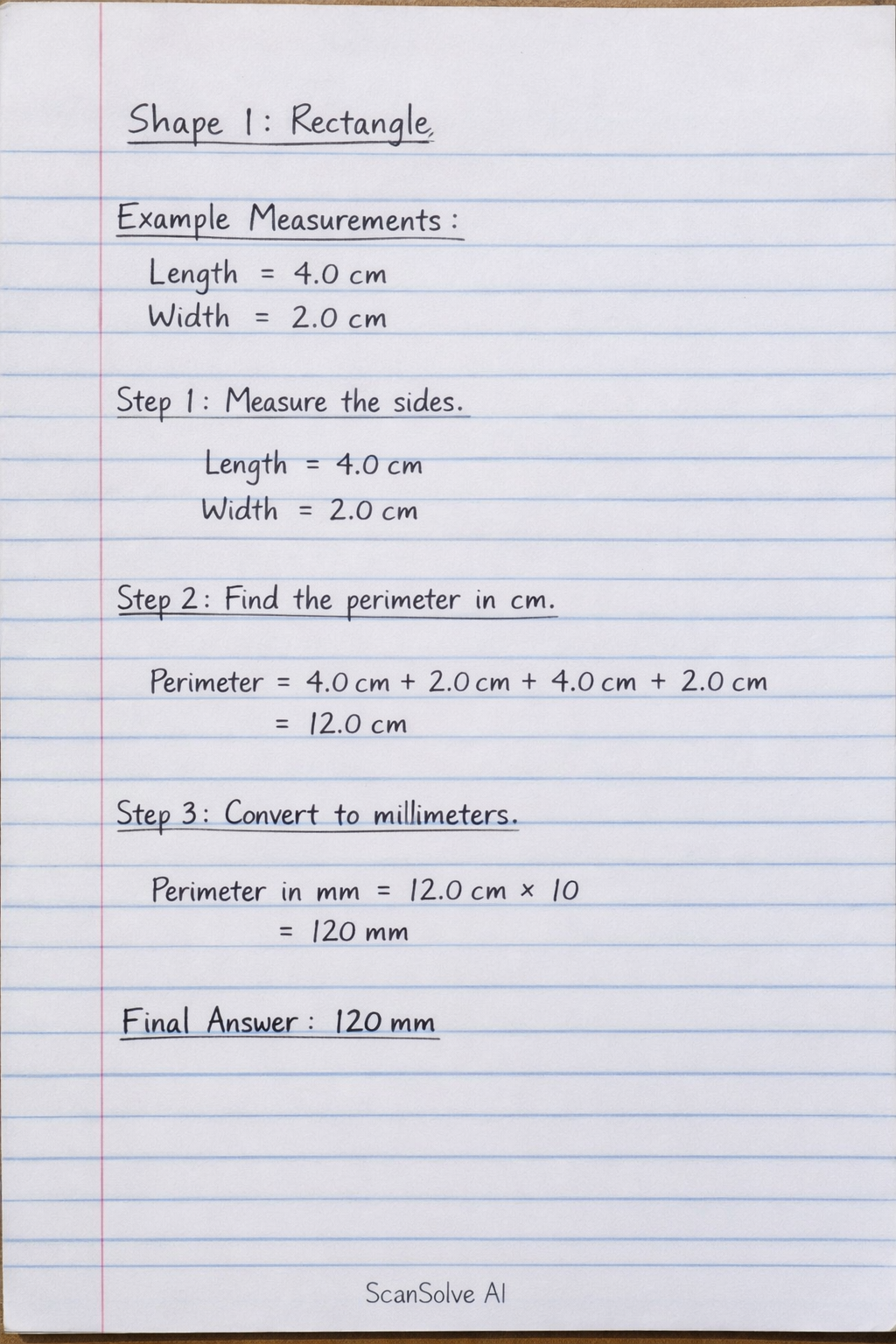
Shape 1: Rectangle
Example Measurements:
Let's assume the rectangle has sides of and .
Measure the sides.
- Ihlangoithi 1 (Length):
- Ihlangoithi 2 (Width):
- Ihlangoithi 3 (Length):
- Ihlangoithi 4 (Width):
Calculate the perimeter in centimeters.
Convert the perimeter to millimeters.
The perimeter of Shape 1 is .
Shape 2: Triangle
Example Measurements:
Let's assume the triangle is equilateral with each side measuring .Measure the sides.
- Ihlangoithi 1:
- Ihlangoithi 2:
- Ihlangoithi 3:
Calculate the perimeter in centimeters.
Convert the perimeter to millimeters.
The perimeter of Shape 2 is .
Shape 3: L-shaped Polygon
Example Measurements:
This shape has 6 sides. Let's assume the following measurements:Measure the sides.
- Side 1 (Top horizontal):
- Side 2 (Right vertical):
- Side 3 (Bottom horizontal):
- Side 4 (Left vertical):
- Side 5 (Inner horizontal):
- Side 6 (Inner vertical):
Calculate the perimeter in centimeters.
Convert the perimeter to millimeters.
The perimeter of Shape 3 is .
Shape 4: Rhombus/Square
Example Measurements:
Let's assume this is a rhombus with all four sides equal, each measuring .Measure the sides.
- Ihlangoithi 1:
- Ihlangoithi 2:
- Ihlangoithi 3:
- Ihlangoithi 4:
Calculate the perimeter in centimeters.
Convert the perimeter to millimeters.
The perimeter of Shape 4 is .
Here is the table with the example measurements and calculated perimeters:
Shape Ihlangoithi 1 (mm) Ihlangoithi 2 (mm) Ihlangoithi 3 (mm) Ihlangoithi 4 (mm) Ipherimitha (mm) 1 40 20 40 20 120 2 35 35 35 - 105 3 20 40 40 20 160 4 28 28 28 28 112 Note: For Shape 3, you would measure all 6 sides and sum them up for the perimeter. The table only has space for 4 sides, so the perimeter column reflects the sum of all sides.
Still stuck on this one?
Ask a follow-up, and the answer starts from this question.
More Mathematics Questions
Handwritten Step-by-Step Solution
Get this as a handwritten image on WhatsApp — like a tutor wrote it for you.
Try on WhatsApp