
This mathematics problem involves applying core mathematical principles and formulas. Below you will find a complete step-by-step solution with detailed explanations for each step, helping you understand not just the answer but the method behind it.
ScanSolve AI Answer
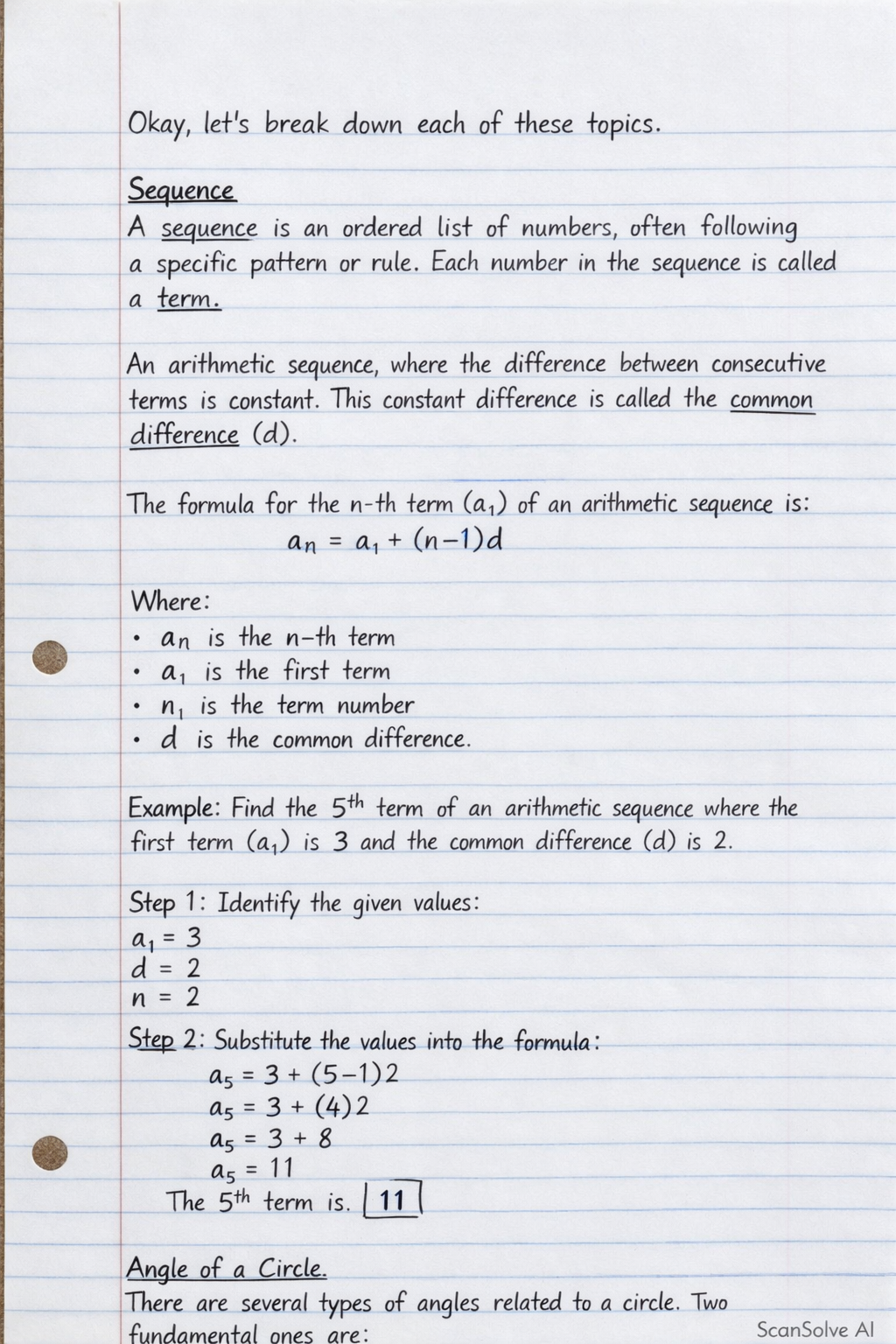
Okay, let's break down each of these topics. Sequence A sequence is an ordered list of numbers, often following a specific pattern or rule. Each number in the sequence is called a term. One common type is an arithmetic sequence, where the difference between consecutive terms is constant. This constant difference is called the common difference (d). The formula for the n-th term (a_n) of an arithmetic sequence is: a_n = a_1 + (n-1)d Where: a_n is the n-th term a_1 is the first term n is the term number d is the common difference Example: Find the 5th term of an arithmetic sequence where the first term (a_1) is 3 and the common difference (d) is 2. Step 1: Identify the given values. a_1 = 3 d = 2 n = 5 Step 2: Substitute the values into the formula. a_5 = 3 + (5-1)2 Step 3: Calculate the term. a_5 = 3 + (4)2 a_5 = 3 + 8 a_5 = 11 The 5th term is 11. Angle of a Circle There are several types of angles related to a circle. Two fundamental ones are: Central Angle: An angle whose vertex is the center of the circle and whose sides are radii. Its measure is equal to the measure of the intercepted arc. Inscribed Angle: An angle whose vertex is on the circle and whose sides are chords of the circle. Relationship between Central and Inscribed Angles: An inscribed angle is half the measure of the central angle that subtends the same arc. If a central angle _c and an inscribed angle _i both intercept the same arc, then: _i = (1)/(2) _c Example: If a central angle subtends an arc of 80^, what is the measure of an inscribed angle that subtends the same arc? Step 1: Identify the given central angle. _c = 80^ Step 2: Use the relationship formula. _i = (1)/(2) _c _i = (1)/(2) (80^) Step 3: Calculate the inscribed angle. _i = 40^ The inscribed angle is 40^. Area of a Cone A cone is a three-dimensional geometric shape that tapers smoothly from a flat base (usually circular) to a point called the apex or vertex. To find the area of a cone, we usually refer to its surface area, which includes the area of its base and its lateral (curved) surface. Let: r be the radius of the circular base h be the perpendicular height from the base to the apex l be the slant height (the distance from the apex to any point on the circumference of the base) The formulas are: Area of the Base (A_b): A_b = r^2 Lateral Surface Area (A_L): A_L = r l Total Surface Area (A_T): A_T = A_b + A_L = r^2 + r l = r (r + l) Note: The slant height l can be found using the Pythagorean theorem if r and h are known: l = sqrt(r^2 + h^2). Example: Find the total surface area of a cone with a base radius (r) of 3 cm and a slant height (l) of 5 cm. Step 1: Identify the given values. r = 3 cm l = 5 cm Step 2: Use the formula for total surface area. A_T = r (r + l) A_T = (3 cm) (3 cm + 5 cm) Step 3: Calculate the total surface area. A_T = 3 (8 cm^2) A_T = 24 cm^2 The total surface area is 24 cm^2. Median The median is the middle value in a dataset when the data is arranged in numerical order. It represents the central tendency of the data. How to find the median: Step 1: Arrange the data values in ascending (or descending) order. Step 2: Determine the number of data points (N). Step 3: If N is odd: The median is the middle value. Its position is (N+1)/(2). If N is even: The median is the average of the two middle values. Their positions are (N)/(2) and (N)/(2) + 1. Example 1 (Odd number of data points): Find the median of the dataset: 7, 2, 9, 4, 5. Step 1: Arrange the data in ascending order. 2, 4, 5, 7, 9 Step 2: Count the number of data points (N). N = 5 Step 3: Since N is odd, the median is the value at position (5+1)/(2) = 3. The 3rd value in the ordered list is 5. The median is 5. Example 2 (Even number of data points): Find the median of the dataset: 10, 3, 8, 6. Step 1: Arrange the data in ascending order. 3, 6, 8, 10 Step 2: Count the number of data points (N). N = 4 Step 3: Since N is even, the median is the average of the values at positions (4)/(2) = 2 and (4)/(2) + 1 = 3. The 2nd value is 6. The 3rd value is 8. Median = (6 + 8)/(2) = (14)/(2) = 7 The median is 7. What's next? 📸