

This mathematics problem involves applying core mathematical principles and formulas. Below you will find a complete step-by-step solution with detailed explanations for each step, helping you understand not just the answer but the method behind it.
ScanSolve AI Answer
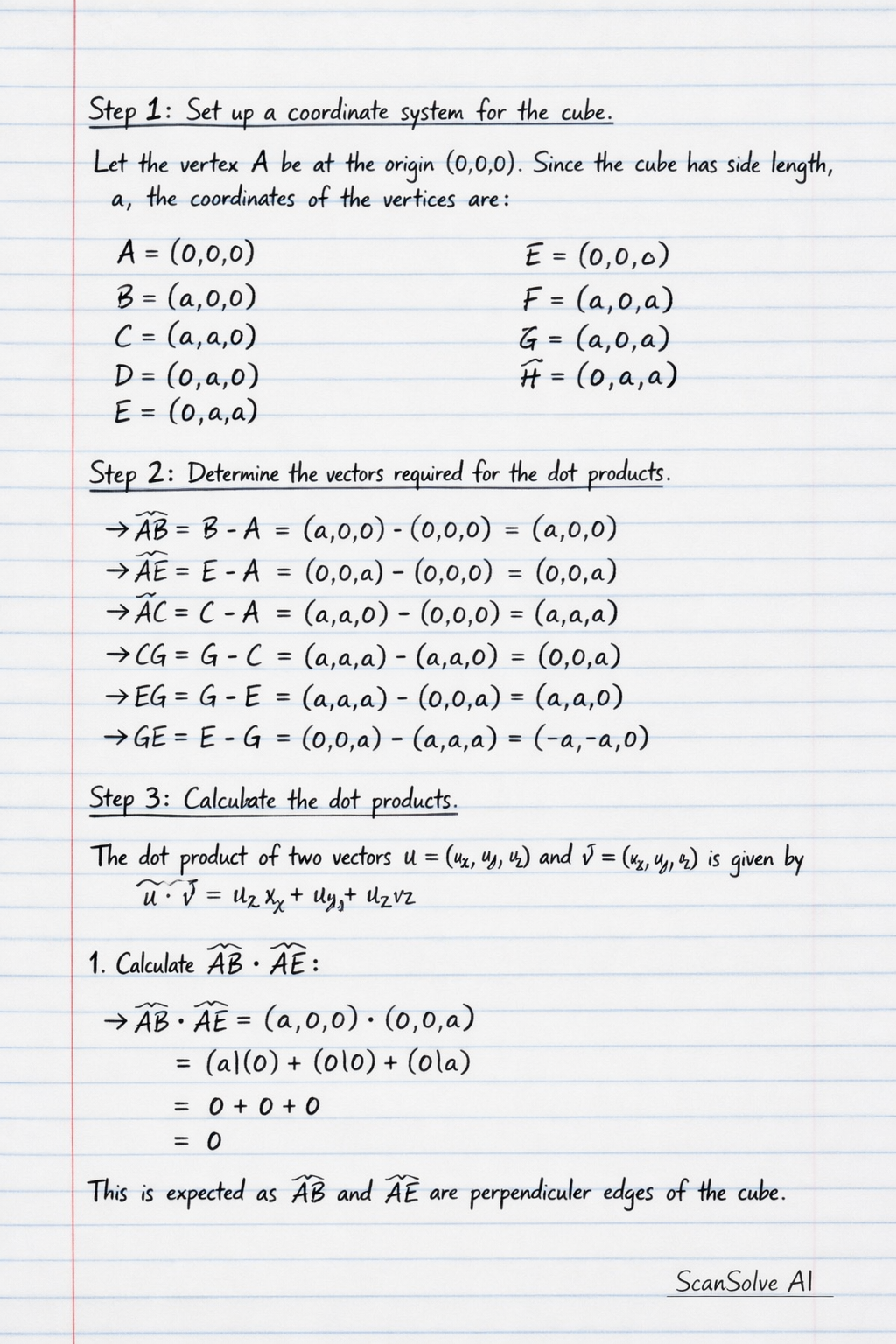
Step 1: Set up a coordinate system for the cube. Let the vertex A be at the origin (0,0,0). Since the cube has side length a, the coordinates of the vertices are: A = (0,0,0) B = (a,0,0) C = (a,a,0) D = (0,a,0) E = (0,0,a) F = (a,0,a) G = (a,a,a) H = (0,a,a) Step 2: Determine the vectors required for the dot products. AB = B - A = (a,0,0) - (0,0,0) = (a,0,0) AE = E - A = (0,0,a) - (0,0,0) = (0,0,a) AC = C - A = (a,a,0) - (0,0,0) = (a,a,0) CG = G - C = (a,a,a) - (a,a,0) = (0,0,a) EG = G - E = (a,a,a) - (0,0,a) = (a,a,0) GE = E - G = (0,0,a) - (a,a,a) = (-a,-a,0) Step 3: Calculate the dot products. The dot product of two vectors u = (u_x, u_y, u_z) and v = (v_x, v_y, v_z) is given by u · v = u_x v_x + u_y v_y + u_z v_z. 1. Calculate AB · AE: AB · AE = (a)(0) + (0)(0) + (0)(a) = 0 + 0 + 0 = 0 This is expected as AB and AE are perpendicular edges of the cube. 2. Calculate AB · AC: AB · AC = (a)(a) + (0)(a) + (0)(0) = a^2 + 0 + 0 = a^2 3. Calculate AB · CG: AB · CG = (a)(0) + (0)(0) + (0)(a) = 0 + 0 + 0 = 0 This is expected as AB is parallel to the x-axis and CG is parallel to the z-axis, making them perpendicular. 4. Calculate AB · EG: AB · EG = (a)(a) + (0)(a) + (0)(0) = a^2 + 0 + 0 = a^2 5. Calculate AC · GE: AC · GE = (a)(-a) + (a)(-a) + (0)(0) = -a^2 - a^2 + 0 = -2a^2 The calculated dot products are: AB · AE = 0 AB · AC = a^2 AB · CG = 0 AB · EG = a^2 AC · GE = -2a^2