
We read your photo as:
Shape 1 (Rectangle):
Mathematics
ScanSolve AI Answer
Step-by-step solution
3 stepsLet's review your work for Question 3.
-
Shape 1 (Rectangle): Your setup for the perimeter of the rectangle, , is ✅ Correct. The final perimeter is .
-
Shape 2 (Combined shape): Your calculations for the second shape (e.g., and ) are ❌ Incorrect for the perimeter of the entire composite shape. The perimeter of a composite shape is the sum of all its outer edges. Your calculations either found the perimeter of only the rectangular part or incorrectly summed internal lines and parts of the shape.
Identify all the outer side lengths of the combined shape.
The outer sides are 4 cm (top), 3 cm (left), 4 cm (bottom), 5 cm (right slanted), and 5 cm (top slanted).Add all the outer side lengths to find the perimeter.
$$ P = 4 \text{ cm} + 3 \text{ cm} + 4 \text{ cm} + 5 \text{ cm} + 5 \text{ cm} $$Calculate the sum.
$$
P = 21 \text{ cm}
$$
The correct perimeter of the second shape is $\boxed{\text{21 cm}}$.
Was this helpful?
Still stuck on this one?
Ask a follow-up, and the answer starts from this question.
Got a different question?Ask your own question
More Mathematics Questions
QA shape is composed of a rectangle and a quarter circle. Calculate its perimeter.QMatch the shapes to their names: rectangle, triangle, circle, square.QName the following shapes.QA shape is made up of a rectangle and a quarter circle. The dimensions are given. Calculate the…QComplete the following: This shape is called . All the sides are , It has square area. It has…
Browse by topic:Geometry
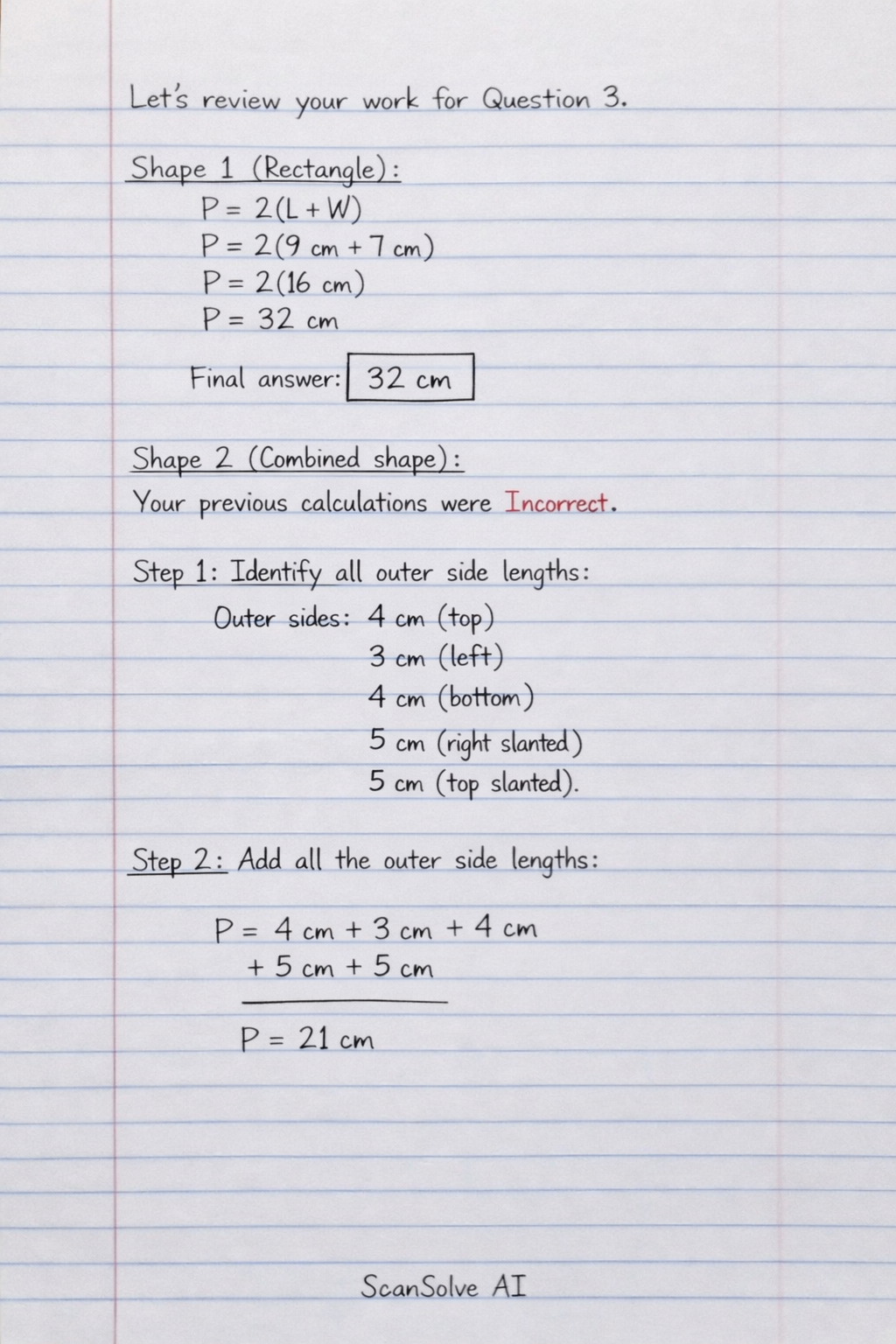
Handwritten Step-by-Step Solution
Get this as a handwritten image on WhatsApp — like a tutor wrote it for you.
Try on WhatsApp