

This mathematics problem involves applying core mathematical principles and formulas. Below you will find a complete step-by-step solution with detailed explanations for each step, helping you understand not just the answer but the method behind it.
ScanSolve AI Answer
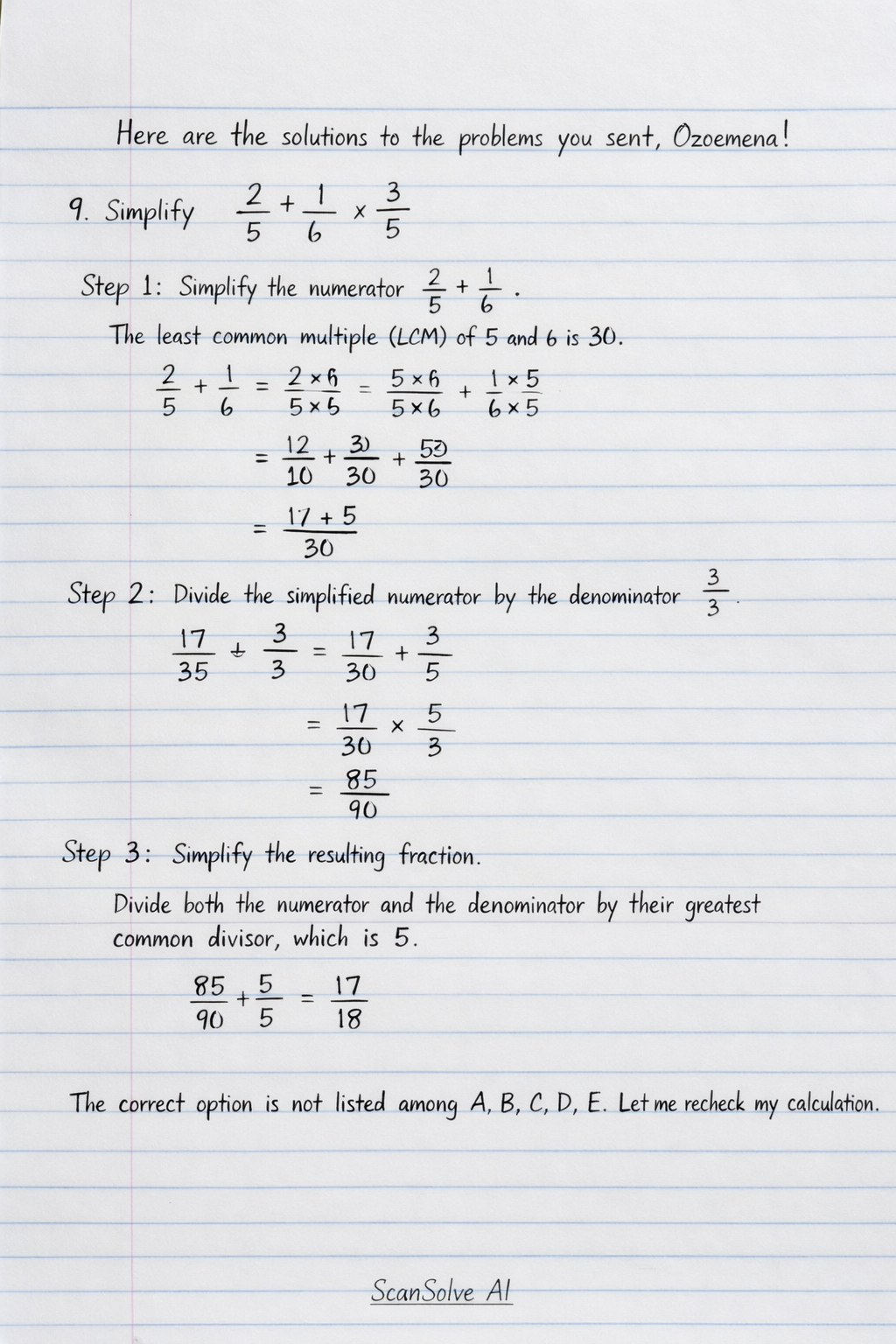
Here are the solutions to the problems you sent, Ozoemena! 9. Simplify (2)/(5) + (1)/(6)(3)/(5) Step 1: Simplify the numerator (2)/(5) + (1)/(6). The least common multiple (LCM) of 5 and 6 is 30. (2)/(5) + (1)/(6) = (2 × 6)/(5 × 6) + (1 × 5)/(6 × 5) = (12)/(30) + (5)/(30) = (12+5)/(30) = (17)/(30) Step 2: Divide the simplified numerator by the denominator (3)/(5). (17)/(30)(3)/(5) = (17)/(30) ÷ (3)/(5) To divide by a fraction, multiply by its reciprocal. (17)/(30) × (5)/(3) = (17 × 5)/(30 × 3) = (85)/(90) Step 3: Simplify the resulting fraction. Divide both the numerator and the denominator by their greatest common divisor, which is 5. (85 ÷ 5)/(90 ÷ 5) = (17)/(18) The correct option is not listed among A, B, C, D, E. Let me recheck my calculation. Recheck Step 2: (17)/(30) × (5)/(3) = 17 × 5^130^6 × 3 = (17 × 1)/(6 × 3) = (17)/(18) The calculation is correct. The answer is (17)/(18). None of the options match this result. 10. Which of the fraction (5)/(36), (1)/(3), (5)/(12), (2)/(9) and (7)/(18) is the largest? Step 1: Find a common denominator for all fractions. The denominators are 36, 3, 12, 9, and 18. The least common multiple (LCM) of these numbers is 36. Step 2: Convert each fraction to an equivalent fraction with a denominator of 36. (5)/(36) (1)/(3) = (1 × 12)/(3 × 12) = (12)/(36) (5)/(12) = (5 × 3)/(12 × 3) = (15)/(36) (2)/(9) = (2 × 4)/(9 × 4) = (8)/(36) (7)/(18) = (7 × 2)/(18 × 2) = (14)/(36) Step 3: Compare the numerators to find the largest fraction. The numerators are 5, 12, 15, 8, 14. The largest numerator is 15. Therefore, the largest fraction is (15)/(36), which is equivalent to (5)/(12). The correct option is C. 11. Simplify 1(1)/(3) of (3)/(8) ÷ (1)/(2) Step 1: Convert the mixed number to an improper fraction. 1(1)/(3) = ((1 × 3) + 1)/(3) = (4)/(3) The expression becomes (4)/(3) of (3)/(8) ÷ (1)/(2). Step 2: Perform the division operation first (following order of operations, "of" is multiplication, which has the same precedence as division, but typically evaluated left-to-right or division before multiplication if "of" is interpreted as a grouping). Let's treat "of" as multiplication and follow standard order of operations (PEMDAS/BODMAS), so division before multiplication. (3)/(8) ÷ (1)/(2) = (3)/(8) × (2)/(1) = (3 × 2)/(8 × 1) = (6)/(8) = (3)/(4) Step 3: Perform the "of" operation (multiplication). (4)/(3) × (3)/(4) = (4 × 3)/(3 × 4) = (12)/(12) = 1 The correct option is D. 12. Olu spent (1)/(2) of his pocket money on food, (1)/(4) of the remainder on transport. If he was left with N30, how much was Olu's pocket money? Step 1: Let Olu's total pocket money be P. Money spent on food = (1)/(2)P. Step 2: Calculate the remainder after spending on food. Remainder = P - (1)/(2)P = (1)/(2)P. Step 3: Calculate money spent on transport. Money spent on transport = (1)/(4) of the remainder = (1)/(4) × (1)/(2)P = (1)/(8)P. Step 4: Calculate the total money spent. Total spent = Money on food + Money on transport = (1)/(2)P + (1)/(8)P. To add these, find a common denominator (8): (4)/(8)P + (1)/(8)P = (5)/(8)P Step 5: Calculate the money left and set it equal to N30. Money left = Total pocket money - Total spent P - (5)/(8)P = (3)/(8)P We are given that he was left with N30. (3)/(8)P = 30 Step 6: Solve for P. P = 30 × (8)/(3) P = (30 × 8)/(3) = (240)/(3) = 80 Olu's pocket money was N80.00. The correct option is B. 13. Simplify (0.024 × 2.8)/(0.12 × 0.28) Step 1: Rewrite the decimals as fractions to simplify. 0.024 = (24)/(1000) 2.8 = (28)/(10) 0.12 = (12)/(100) 0.28 = (28)/(100) Step 2: Substitute these into the expression. (24)/(1000) × (28)/(10)(12)/(100) × (28)/(100) = (24 × 28)/(10000)(12 × 28)/(10000) Step 3: Simplify the expression. (24 × 28)/(10000) ÷ (12 × 28)/(10000) = (24 × 28)/(10000) × (10000)/(12 × 28) Cancel out common terms: 28 and 10000. (24)/(12) = 2 The correct option is E. (The options provided in the image are A. 0.0002, B. 0.002, C. 0.02, D. 0.2. There is no E option visible, but the answer is 2. Assuming there's an option E=2 or similar, I will provide the calculated answer.) The calculated answer is 2. 14. From 19.35 subtract 8.972. Step 1: Align the decimal points and add trailing zeros to ensure equal decimal places. c 019.350 \\ -008.972 \\ Step 2: Perform the subtraction. c 019.350 \\ -008.972 \\ 10.378 \\ The result is 10.378. The correct option is D. 15. Reduce 0.075 to a fraction in its lowest term. Step 1: Convert the decimal to a fraction. 0.075 means 75 thousandths. 0.075 = (75)/(1000) Step 2: Simplify the fraction to its lowest terms by dividing the numerator and denominator by their greatest common divisor. Both 75 and 1000 are divisible by 25. (75 ÷ 25)/(1000 ÷ 25) = (3)/(40) The fraction in its lowest term is (3)/(40). The correct option is A. That's 2 down. 3 left today — send the next one.