
We read your photo as:
Simplify: a) (y2+4y+3)/(2y2+7y+5) b) (2k-2t)/15 ÷ (k-t)/3 c) (x+4)/2 - (2x+1)/3
ScanSolve AI Answer
Answers
6 partsStep-by-step solution
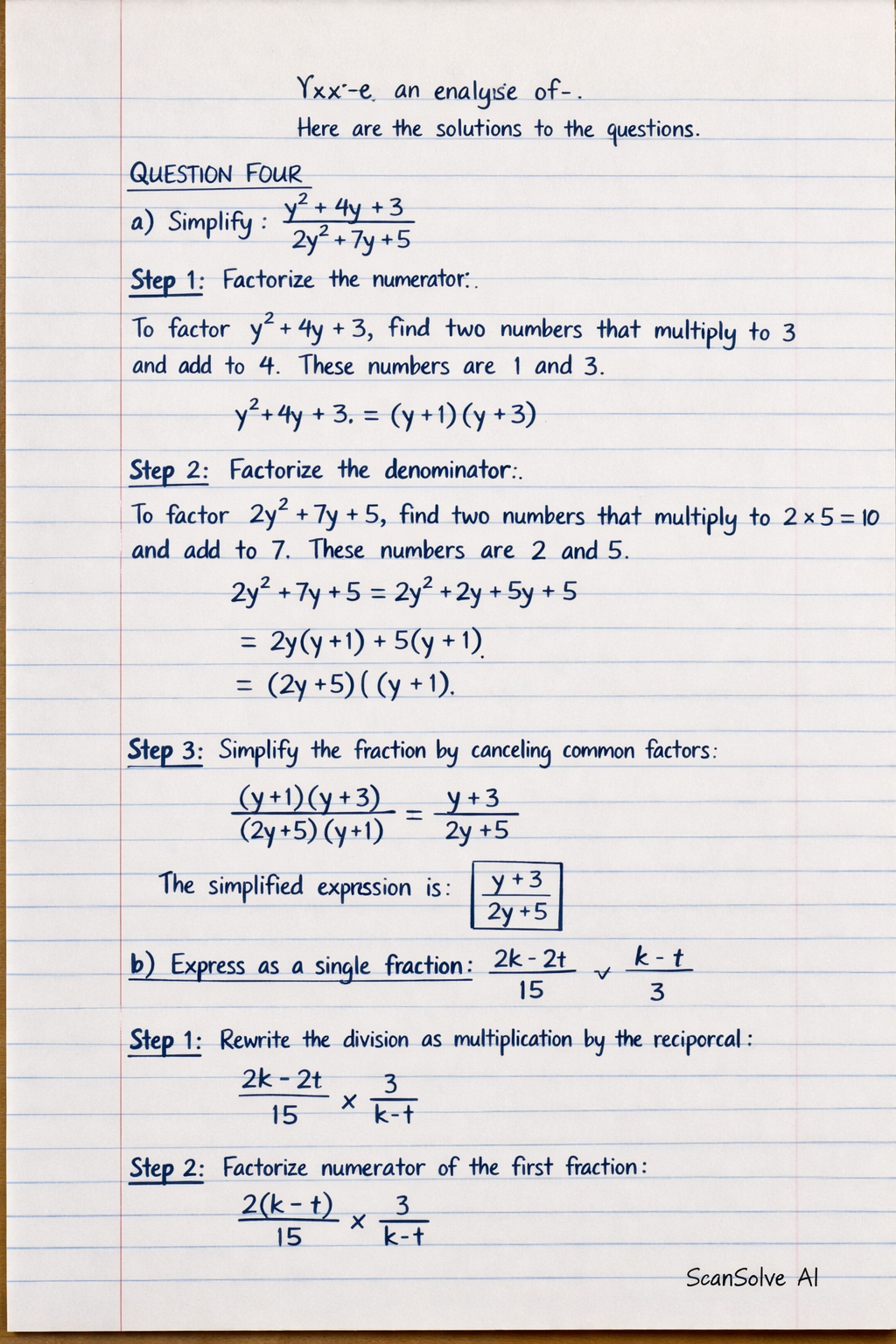
21 stepsHere are the solutions to the questions.
QUESTION FOUR
Part a· 3 steps
Simplify:
Factorize the numerator.
To factor , find two numbers that multiply to 3 and add to 4. These numbers are 1 and 3.
Factorize the denominator.
To factor , find two numbers that multiply to and add to 7. These numbers are 2 and 5.
Simplify the fraction by canceling common factors.
The simplified expression is .
Part b
Express as a single fraction:
Rewrite the division as multiplication by the reciprocal of the second fraction.
Factorize the numerator of the first fraction.
Multiply the fractions and simplify by canceling common factors.
Assuming , we can cancel .
Reduce the fraction to its simplest form.
The expression as a single fraction is .
Part c
Solve:
Find a common denominator for the fractions, which is 6.
Multiply each term by the common denominator to eliminate the fractions.
Expand and simplify the equation.
Solve for .
The solution is .
Part d
Solve the simultaneous equations: and
Label the equations.
(1)
(2)From equation (2), express in terms of .
Substitute this expression for into equation (1).
Substitute the value of back into the expression for from Step 2.
The solution is .
Part e(i)(x+1)(x+7)
Factorise the following expressions;
Assumption: The expression is intended to be , as simplifies to which is a linear expression and cannot be factorised into binomials.
For , find two numbers that multiply to 7 and add to 8.
These numbers are 1 and 7.
Write the factored form.
The factorised expression is .
Part e(ii)-(4b-3)(b+2)
Rearrange the expression in standard quadratic form ().
Factor out to make the leading coefficient positive.
Factor the quadratic expression .
Find two numbers that multiply to and add to 5. These numbers are 8 and .
Combine with the factored out .
This can also be written as .
The factorised expression is or .
Try one yourself
A new problem that tests the same skill.
Still stuck on this one?
Ask a follow-up, and the answer starts from this question.
More Mathematics Questions
Handwritten Step-by-Step Solution
Get this as a handwritten image on WhatsApp — like a tutor wrote it for you.
Try on WhatsApp