
We read your photo as:
Simplify sqrt(12) + sqrt(3), determine if the result is rational or irrational, and find two consecutive integers it lies between.
ScanSolve AI Answer
Answers
2 partsStep-by-step solution
8 stepsHere's the solution for Question 1:
Part 1.1· 2 steps
Determine the value of A rounded off to TWO decimal places.
Simplify the expression for .
Calculate the numerical value and round to two decimal places.
Using the approximate value :
Rounding to two decimal places:
Part 1.2· 2 steps
State whether the value of A is rational or irrational. Justify your answer.
Recall the simplified form of .
Determine if is rational or irrational.
A number is rational if it can be expressed as a fraction where and are integers and . A number is irrational if it cannot be expressed in this form.
Since is an irrational number, and the product of a non-zero rational number (3) and an irrational number () is always irrational, is an irrational number.The value of A is irrational.
Justification: is an irrational number, and the product of a non-zero rational number (3) and an irrational number () is always irrational.
Part 1.3
Without using a calculator, determine between which two consecutive integers the value of A lies.
Use the simplified form of .
Square the value of to compare it with perfect squares.
Find two consecutive perfect squares that 27 lies between.
We know that and .
So, .Take the square root of all parts of the inequality.
Since , the value of A lies between 5 and 6.
The value of A lies between the consecutive integers .
Try one yourself
A new problem that tests the same skill.
Still stuck on this one?
Ask a follow-up, and the answer starts from this question.
More Mathematics Questions
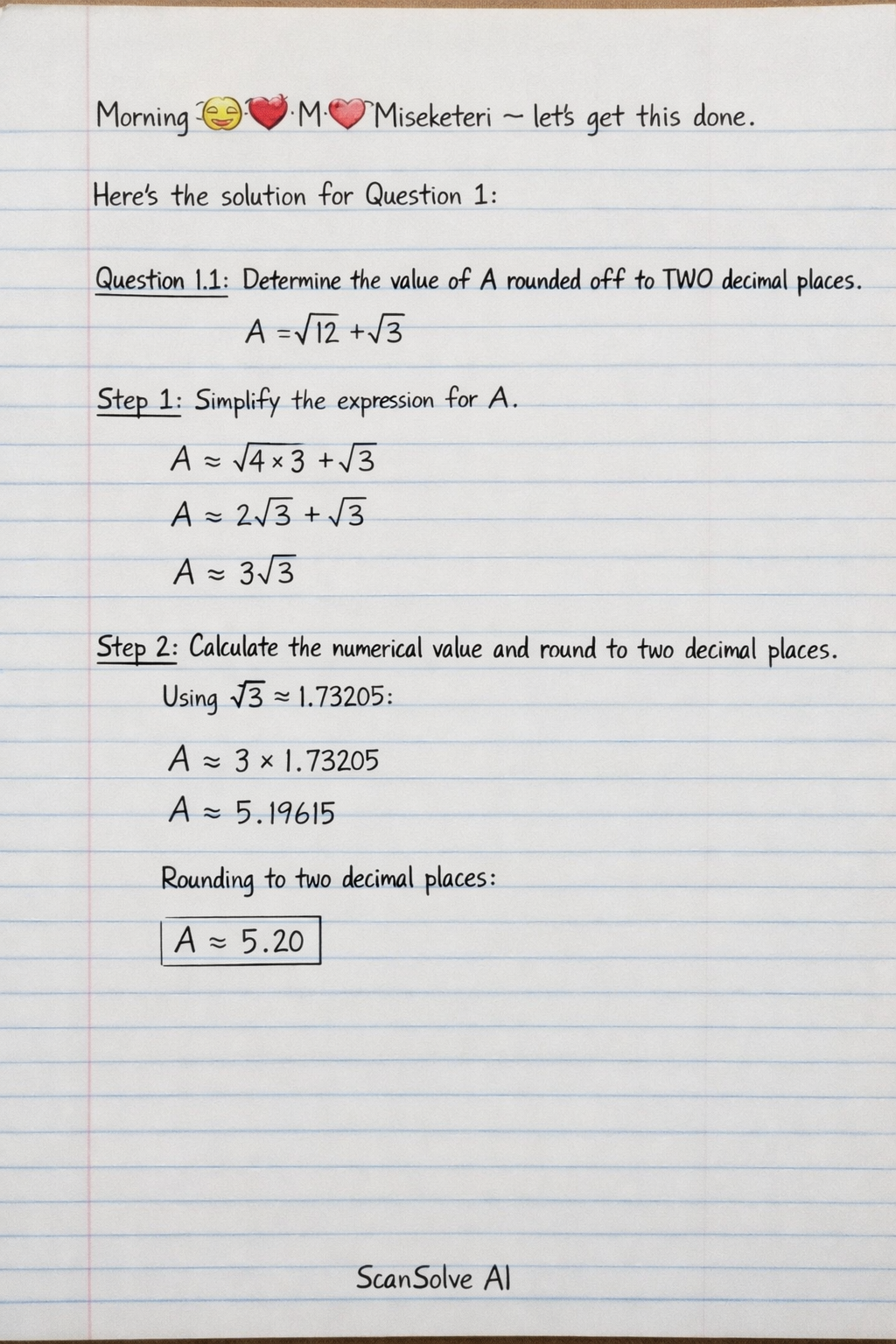
Handwritten Step-by-Step Solution
Get this as a handwritten image on WhatsApp — like a tutor wrote it for you.
Try on WhatsApp