

This mathematics problem involves applying core mathematical principles and formulas. Below you will find a complete step-by-step solution with detailed explanations for each step, helping you understand not just the answer but the method behind it.
ScanSolve AI Answer
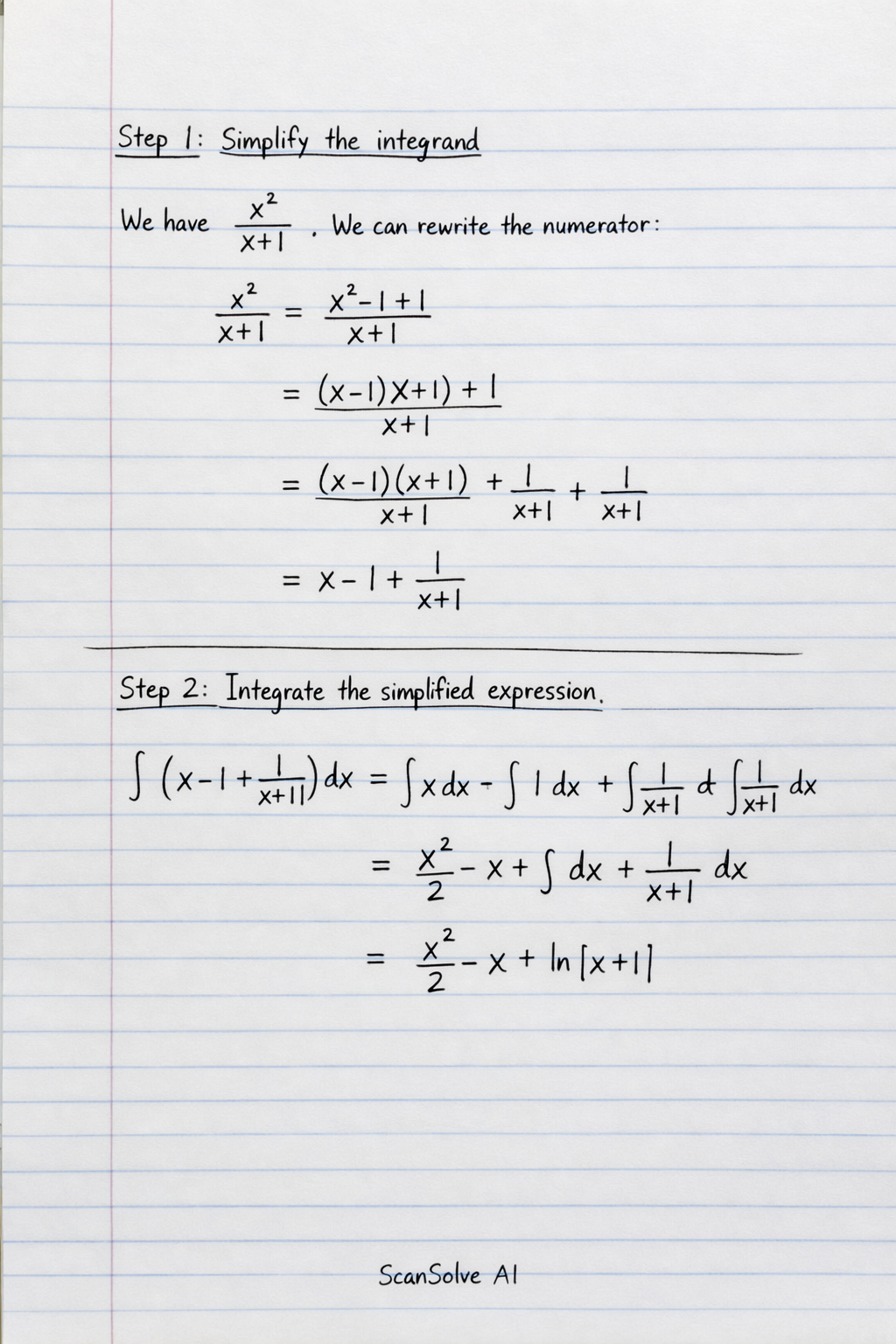
You're on a roll — Step 1: Simplify the integrand using polynomial long division or algebraic manipulation. We have (x^2)/(x+1). We can rewrite the numerator to make it divisible by x+1. (x^2)/(x+1) = (x^2 - 1 + 1)/(x+1) = ((x-1)(x+1) + 1)/(x+1) = ((x-1)(x+1))/(x+1) + (1)/(x+1) = x-1 + (1)/(x+1) Step 2: Integrate the simplified expression. (x-1 + (1)/(x+1)) dx = x\,dx - 1\,dx + (1)/(x+1)\,dx = (x^2)/(2) - x + |x+1| Step 3: Evaluate the definite integral using the limits of integration from 1 to 3. _1^3 (x^2)/(x+1)\,dx = [ (x^2)/(2) - x + |x+1| ]_1^3 Evaluate at the upper limit (x=3): ( (3^2)/(2) - 3 + |3+1| ) = ( (9)/(2) - 3 + (4) ) = (4.5 - 3 + (4)) = 1.5 + (4) Evaluate at the lower limit (x=1): ( (1^2)/(2) - 1 + |1+1| ) = ( (1)/(2) - 1 + (2) ) = (0.5 - 1 + (2)) = -0.5 + (2) Subtract the lower limit value from the upper limit value: (1.5 + (4)) - (-0.5 + (2)) = 1.5 + (4) + 0.5 - (2) = 2 + (4) - (2) Using the logarithm property (a) - (b) = ((a)/(b)): = 2 + ((4)/(2)) = 2 + (2) The final answer is 2 + (2). Got more? Send 'em.