
This mathematics problem involves applying core mathematical principles and formulas. Below you will find a complete step-by-step solution with detailed explanations for each step, helping you understand not just the answer but the method behind it.
ScanSolve AI Answer
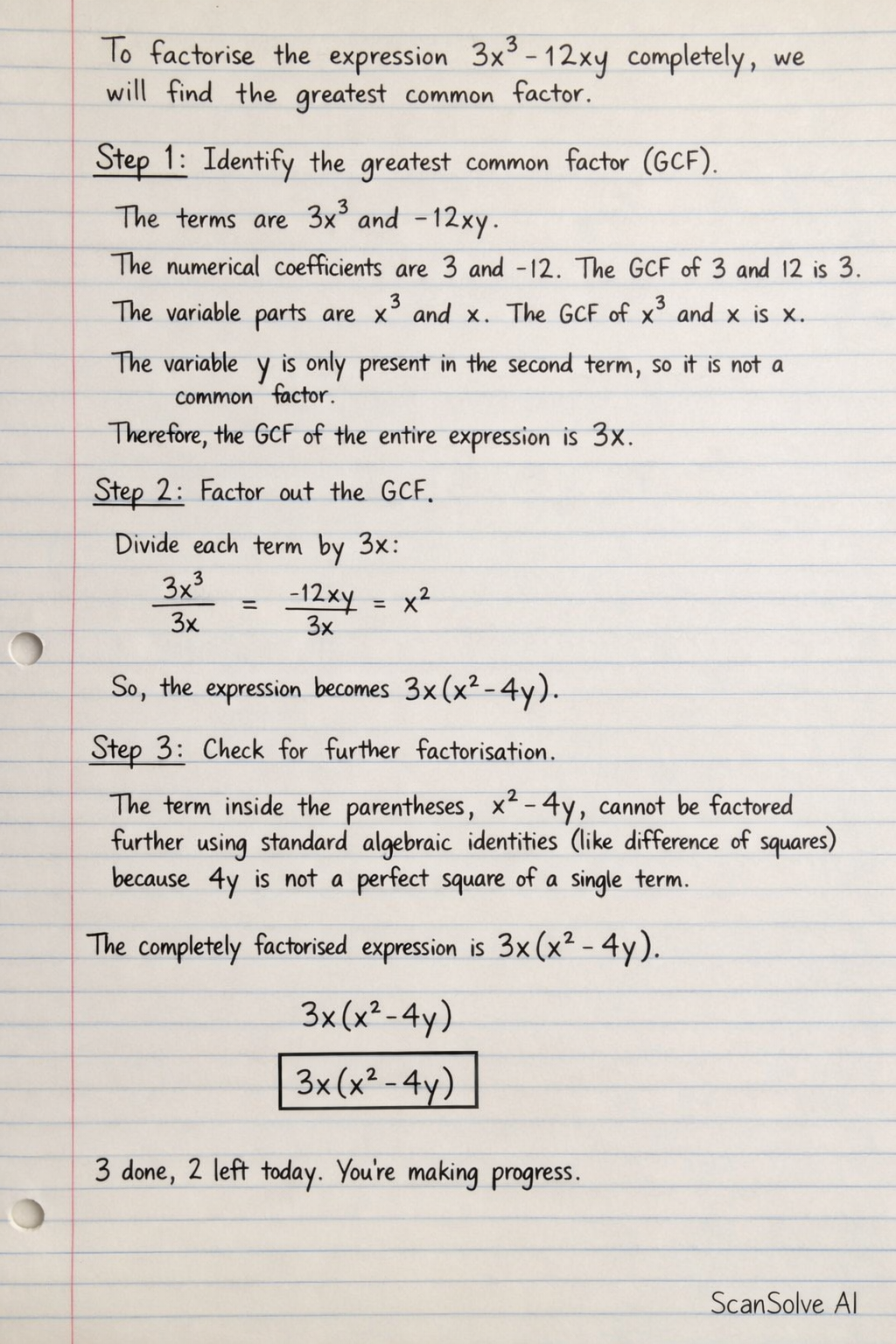
To factorise the expression 3x^3 - 12xy completely, we will find the greatest common factor. Step 1: Identify the greatest common factor (GCF). The terms are 3x^3 and -12xy. The numerical coefficients are 3 and -12. The GCF of 3 and 12 is 3. The variable parts are x^3 and x. The GCF of x^3 and x is x. The variable y is only present in the second term, so it is not a common factor. Therefore, the GCF of the entire expression is 3x. Step 2: Factor out the GCF. Divide each term by 3x: (3x^3)/(3x) = x^2 (-12xy)/(3x) = -4y So, the expression becomes 3x(x^2 - 4y). Step 3: Check for further factorisation. The term inside the parentheses, x^2 - 4y, cannot be factored further using standard algebraic identities (like difference of squares) because 4y is not a perfect square of a single term. The completely factorised expression is 3x(x^2 - 4y). 3x(x^2 - 4y) 3x(x^2 - 4y) 3 done, 2 left today. You're making progress.