
We read your photo as:
Simplify the product (1+(1)/(2))(1+(1)/(3))(1+(1)/(4))(1+(1)/(n)) and determine the values of n for which the result is an integer.
ScanSolve AI Answer
This answer stops before the end.
It was cut off when it was first written. Ask ScanSolve this question again for the full working.
Here are the solutions to the problems:
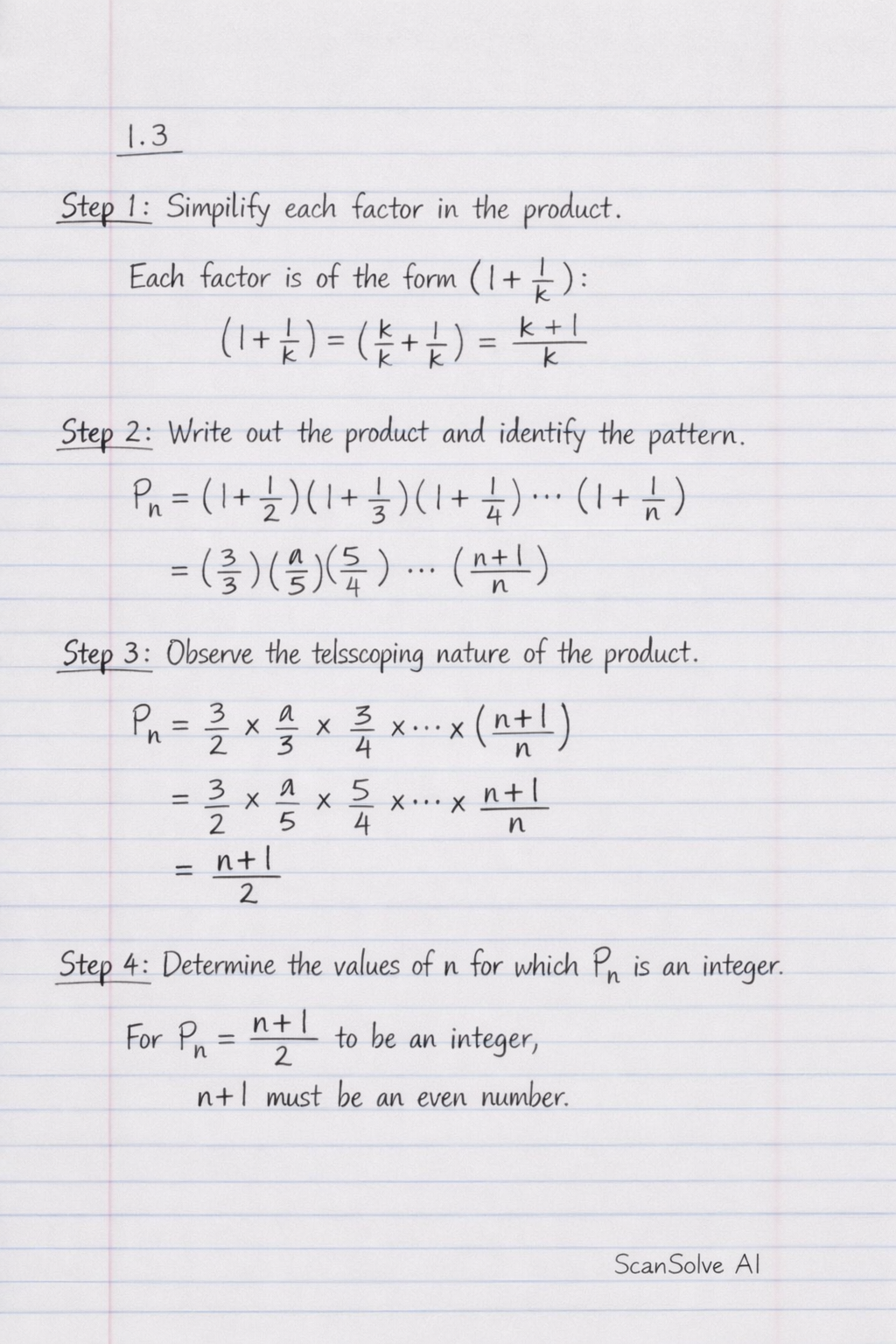
1.3
Step 1: Simplify each factor in the product.
Each factor is of the form .
Step 2: Write out the product and identify the pattern.
The product is .
Substituting the simplified factors:
Step 3: Observe the telescoping nature of the product.
The numerator of each term cancels with the denominator of the subsequent term.
Step 4: Determine the values of for which is an integer.
For to be an integer, must be an even number.
If is even, then must be an odd number.
Given that , the possible values for are odd integers starting from 3.
2.1.1
Step 1: Identify the given values for the arithmetic series.
First term, .
Common difference, .
Number of terms, .
Step 2: Use the formula for the sum of an arithmetic series.
The sum of an arithmetic series is .
Substitute the given values:
The sum of this series is .
2.1.2
Step 1: Calculate the sum of the terms added to the original series.
The original series has 20 terms, and its sum is .
The extended series has 75 terms, and its sum is .
The sum of the terms added is .
Step 2: Determine the general term of the arithmetic series.
The general term is .
Step 3: Write the equation for the sum of the added terms using sigma notation.
The terms added are from the 21st term to the 75th term.
2.2.1
Step 1: Determine the general term for the first differences.
The sequence of first differences is . This is an arithmetic progression.
First term of differences, .
Common difference of differences, .
The -th term of the first differences is .
Still stuck on this one?
Ask a follow-up, and the answer starts from this question.
More Mathematics Questions
Handwritten Step-by-Step Solution
Get this as a handwritten image on WhatsApp — like a tutor wrote it for you.
Try on WhatsApp